

Most posts about SEO examples show you a screenshot of a big brand's traffic chart and call it a strategy.
That's not a strategy. That's a result.
A real SEO strategy is a specific, repeatable bet: the type of pages you build, the people those pages serve, and the reason those pages will win over everything else in the results. Once you can name the bet, you can copy it.
So that's what this post is. Seven SEO strategy examples that real companies are running right now:
- Programmatic SEO: thousands of pages from one template
- Topic clusters: own one subject completely
- Link-led authority: skyscraper content and digital PR
- Local service-area domination
- Product-led SEO: free tools that rank
- Comparison and alternatives pages
- Generative engine optimization: the AI search strategy
For each one you get the strategy in a sentence, who it fits, a real company you can go look at today, and a numbered playbook to run it yourself. Every number in this post comes from a linked source or from our own published case studies. No made-up screenshots, no "studies show".
First, what actually counts as an SEO strategy?
Tactics are things you do to a page: fix the title, add internal links, compress the images. Necessary, but nobody ever grew from 0 to 200,000 visitors on tactics alone.
A strategy answers three questions. What pages are we going to build? Who searches for them? And why will ours win: more scale, more depth, more authority, or a better format than everything currently ranking.
Every example below answers those three questions differently. If you want to see how we string a full strategy together end to end, audit through content through links, we've documented our entire SEO process separately. This post is about picking the right bet in the first place.
7 SEO Strategy Examples for 2026
Example #1: Programmatic SEO (thousands of pages from one template)
The strategy in one sentence: build one great page template, then fill it with structured data to generate hundreds or thousands of pages, each targeting its own long-tail keyword.
Who it fits: companies sitting on structured data that people actually search for. Currency pairs, integrations, locations, templates, salaries, product specs. If your keyword has a "___ to ___" or "___ for ___" shape, this is your play. It's a natural fit for SaaS and marketplaces, and it's the same logic behind category page architecture in ecommerce SEO.
The real example: Wise, the money transfer company. Their currency converter is one template repeated for every currency pair: USD to EUR, USD to GBP, and on and on. When Ahrefs profiled the strategy, they estimated Wise's currency pages at roughly 15,000 pages pulling around 4.7 million organic visits per month. Same study, second example: Zapier's app directory, over 800,000 estimated pages, one for every pair of tools you might want to connect, like Slack + Gmail.
Notice what both have in common: each generated page answers the query better than a handwritten article could, because the data is the answer. That's the line between programmatic SEO and thin-content spam, and Google only rewards one of them.
Run it yourself:
- Find the repeatable query pattern. Dump your keyword tool's long-tail report and look for the same sentence with one variable swapped. "[currency] to [currency]", "[tool] vs [tool]", "[service] in [city]".
- Confirm you have (or can build) the data. You need a real data source per page: rates, specs, prices, reviews. If every page would say the same thing, stop here. This strategy is not for you.
- Design one template page by hand first. Make a single page so good it could rank on its own. Direct answer up top, the data in a clean table or widget, a short FAQ.
- Generate a small batch, not the full set. Launch 50 to 100 pages, index them, and watch Search Console for 6 to 8 weeks.
- Scale only what gets impressions. If the batch earns clicks, expand. If Google ignores it, fix the template before you mint 10,000 copies of a loser.
- Interlink the set. Every generated page should link to related pages in the set and up to a hub page, so crawlers can walk the whole graph.
Example #2: Topic clusters (own one subject completely)
The strategy in one sentence: pick one subject your buyers care about, publish a pillar page plus a cluster of articles covering every subtopic, and interlink them until search engines treat you as the authority on that subject.
Who it fits: almost everyone, honestly. It's the default strategy for SaaS and B2B companies where buyers research before they buy. If you only copy one SEO strategy example from this page, copy this one.
The real example: HubSpot didn't just use topic clusters, they named the model. Their topic clusters guide defines it as a pillar page linked to a set of focused cluster pages, with every cluster page linking back to its pillar. The interesting part is why they switched: a 2015 internal study found that the more internal links they added between related pages, the higher those pages climbed and the more impressions they earned. Browse their blog and you can see the hubs in the wild, from broad topics down to hyper-specific questions inside each one.
This is also the closest thing to Apollo's house strategy. It's the core of how we took a SaaS site from 0 to 197,514 monthly organic visitors in under two years, and the engine behind Deskera's climb from 5K to 120K monthly visitors. The full method is in our SaaS SEO mega-guide if you want every step.
Run it yourself:
- Pick one cluster, not five. Choose the subject closest to what you sell. A project management tool starts with "project management", not "productivity".
- Map the whole cluster before writing. List every question, comparison, and how-to inside the subject. A serious cluster is usually 15 to 40 articles plus one pillar.
- Write the pillar page. A genuinely complete guide to the broad term, structured with clean H2s so every section can be linked to (and quoted by AI engines).
- Publish cluster articles on a fixed cadence. One to two strong pieces a week beats ten thin ones. Brief every article properly; our free content brief generator does the skeleton for you.
- Interlink ruthlessly. Every cluster article links to the pillar and to two or three sibling articles. This is the mechanism the whole strategy runs on, per HubSpot's own data.
- Finish the cluster before starting the next. Half-built clusters are the most common way this strategy fails. Depth wins; breadth stalls.
Example #3: Link-led authority (skyscraper content and digital PR)
The strategy in one sentence: create an asset that other sites want to cite, then put it in front of the people who run those sites, so backlinks lift your whole domain.
Who it fits: sites stuck on page two in competitive niches, where the content is fine but the domain is outgunned. Also anyone sitting on proprietary data, because data is the easiest thing on the internet to earn links with.
The real example: Brian Dean's Skyscraper Technique is over a decade old and still the cleanest documented version of this play. He found content that already had links, built something clearly better, then emailed the people linking to the original. From 160 emails he landed 17 links, an 11% hit rate, and his organic traffic doubled in 14 days. Here's the actual outreach email he sent:
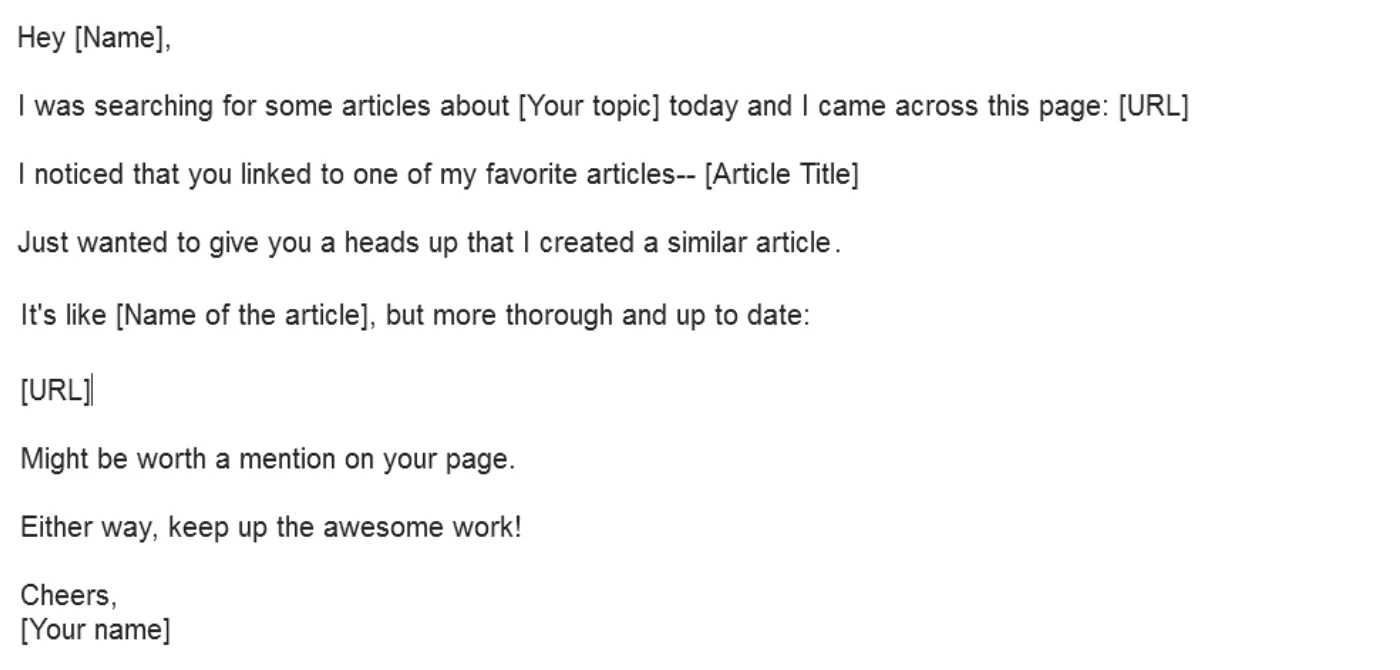
The 2026 version of this strategy leans harder on digital PR: original surveys, data studies, and stats pages that journalists and bloggers cite because they need a source. Cold "great post, link to me" emails are mostly dead. Giving a writer a number they can quote is very much alive, and it's the honest way we approach link building for clients.
Run it yourself:
- Find what already earns links in your niche. Put competitors into Ahrefs or Semrush and sort their pages by referring domains. Patterns jump out fast: stats pages, original studies, definitive guides, free templates.
- Build a genuinely better asset. More recent data, a bigger sample, a clearer chart. "Longer" alone isn't better, and everyone can see through it.
- Mine your own data first. If you have product usage data, anonymize and publish it. A single original number ("we analyzed 4,500 articles...") outperforms any roundup.
- Build the prospect list before you publish. Everyone who linked to the weaker version, plus writers who cover the topic. Aim for 100+ real names, not a scraped blast list.
- Pitch the finding, not the page. Your email should contain the takeaway a writer could quote tomorrow. Make citing you the path of least resistance.
- Point the authority somewhere. Internally link from the asset to the money pages that need the boost. Links to a study that links to nothing are wasted equity.
Example #4: Local service-area domination
The strategy in one sentence: win the map pack and the local organic results for "[service] + [city]" queries across every area you serve, one location at a time.
Who it fits: any business where the customer and the service share a zip code. Law firms, clinics, contractors, agencies with a local niche. These queries are lower volume but absurdly high intent: the searcher needs the thing, near them, now.
The real example: the primary source here is Google itself. Their local ranking documentation says local results are ranked on exactly three factors: relevance (how well your profile matches the search), distance (how far you are from the searcher), and prominence (how well known you are, including how many sites link to you and how many reviews you have). You can't move your building, so the entire strategy is maximizing the other two. For what this looks like when it works, our interior design SEO case study shows a local firm holding the #1 spot and pulling around 30 leads a month from it.
Run it yourself:
- Complete your Google Business Profile to 100%. Every field: categories, services, hours, photos, service areas. Google explicitly says complete profiles rank better. This is free ranking signal being left on the table by most of your competitors.
- Build one real page per service, per area. Not ten cloned pages with the city name swapped. Local proof on each: projects in that area, local photos, area-specific FAQs.
- Make reviews a weekly habit. Ask every happy customer, respond to every review. Reviews feed prominence, which is a third of the algorithm.
- Fix your citations. Same name, address, and phone everywhere your business appears. Inconsistency quietly erodes trust signals.
- Earn a handful of local links. Local news, chambers of commerce, sponsorships, suppliers. Ten relevant local links can outweigh a hundred generic ones for map-pack visibility.
- Work through a real checklist. Local SEO is 80% execution discipline. We maintain a free 38-step local SEO checklist that covers the entire sequence.
Example #5: Product-led SEO (free tools that rank)
The strategy in one sentence: build a free tool that solves one searchable problem, let it rank for "free [thing] checker/generator/calculator" queries, and convert a slice of the users it attracts.
Who it fits: SaaS and service companies whose product can be sliced into one free, instantly useful function. It's a bigger upfront investment than an article, which is exactly why it's defensible: your competitors can copy a blog post in an afternoon, but not a tool.
The real example: the SEO industry eats its own cooking here. Ahrefs ranks for backlink-related tool queries with its free backlink checker, a stripped-down taste of the paid product. HubSpot has run Website Grader since their early days: paste a URL, get a graded report, and an on-ramp into their funnel. Both are pages that rank precisely because they do something, instead of describing something.
We run the same strategy ourselves. Our free tools hub exists because tool pages attract exactly the people who eventually need the paid service, like the AI visibility checker and the content brief generator. The tools are the marketing.
Run it yourself:
- Find tool-intent keywords in your niche. Search your keyword tool for "calculator", "checker", "generator", "template", "grader" plus your topic. These queries have crystal-clear intent and surprisingly reasonable competition.
- Pick the smallest tool that delivers a real answer. One input, one useful output, ten seconds to value. Resist the platform fantasy.
- Put the tool above the fold and the SEO below it. The interactive part answers the searcher; the explainer content below it (how it works, FAQs, methodology) gives Google something to rank.
- Ship a soft conversion path. "Want the full report?" beats a signup wall. Gate depth, never the first answer.
- Add schema and a clean H1 so the page is legible to search engines and AI answers alike.
- Launch it like a product. Tool pages are unusually good at earning links, because "free X checker" is the kind of thing bloggers and newsletters love to list. One launch push can seed years of passive links.
Example #6: Comparison and alternatives pages
The strategy in one sentence: capture buyers at the moment of decision with "[X] vs [Y]" and "[X] alternatives" pages, where the search volume is small but the visitor is holding a credit card.
Who it fits: anyone in a category where buyers shortlist. SaaS above all, but it works for agencies, apps, even physical products. These are usually the highest-converting organic pages on any site we touch.
The real example: two flavors worth studying. Zapier's blog captures third-party comparison searches for tools it integrates with, like Trello vs Asana: they win the click by being the neutral referee. Asana itself runs the vendor version, a whole comparison hub making its case against each rival by name. We run the pattern too; our Moz vs Semrush vs Ahrefs piece is exactly this play in our own niche.
Run it yourself:
- List every competitor a buyer might shortlist against you and pull volumes for "you vs them", "them vs them", and "[competitor] alternatives".
- Build "vs" pages for the matchups you appear in. Be honest about who each option genuinely suits. Readers can smell a rigged comparison in the first paragraph, and honesty converts better anyway.
- Build "[competitor] alternatives" pages for the incumbents. Searchers typing that are actively defecting. List real alternatives, including ones that aren't you, and make the case for when you're the right pick.
- Cover the "them vs them" matchups you're not in. That's the Zapier move: referee your category's comparisons and you get in front of every buyer, whichever tools they typed.
- Use a consistent comparison structure (pricing, features, best-for verdict) with a real summary table. These pages get quoted by AI answers constantly, and structure is why.
- Refresh quarterly. Stale pricing on a comparison page kills trust instantly and rankings shortly after.
Example #7: Generative engine optimization (the AI search strategy)
The strategy in one sentence: optimize to be the source that ChatGPT, Perplexity, Claude, and Google's AI Overviews retrieve, quote, and name when your buyers ask them questions.
Who it fits: everyone reading this in 2026, frankly. A growing share of your buyers now ask an AI engine instead of (or before) searching Google. Almost none of your competitors are deliberately optimizing for it yet, which is the whole opportunity.
The real example: this one has an actual peer-reviewed source. The paper that coined the term, "GEO: Generative Engine Optimization" (published at KDD 2024), tested nine optimization methods and found they could boost a source's visibility in generative engine responses by up to 40%. The methods that worked are refreshingly unmagical: adding citations to sources, quotations, and statistics to your content. In other words, the pages that get quoted are the pages built to be quotable. We break down what holds up and what's snake oil in our GEO guide.
Run it yourself:
- Baseline your AI visibility. Ask ChatGPT, Perplexity, and Google's AI Mode the 10 to 20 questions your buyers actually ask, and record who gets named and cited. Our free AI visibility checker gives you a fast read.
- Unblock the AI crawlers. GPTBot, PerplexityBot, and ClaudeBot can't cite what they can't read. Check your robots.txt before anything else.
- Restructure key pages to be quotable. A direct answer in the first two sentences under every heading, then the detail. AI engines lift self-contained passages, not vibes.
- Add the elements the research validated. Statistics with linked sources, expert quotes, named citations. This is the "up to 40%" lever from the KDD paper.
- Make your entity consistent. Same company description, category, and facts across your site, LinkedIn, directories, and profiles. AI engines cross-check before they recommend. Our guide on getting cited by ChatGPT goes deeper.
- Re-run your prompt panel monthly. AI answers drift between model versions. Treat it like rank tracking: a fixed panel of prompts, checked on a schedule, trended over time.
Which of these SEO strategy examples should you copy?
Don't run all seven. Pick one compounding strategy and one fast one, based on what you're selling and what assets you already have.
If you're a SaaS or B2B company, start with topic clusters, then add comparison pages the moment the cluster is moving. That pairing is behind most of our results, including a workflow SaaS going from 8K to 380K monthly organic visitors. If you sit on structured data, programmatic SEO is your unfair advantage; it's part of how Novorésumé scaled from 1M to 5.2M monthly visitors across templates and examples pages. Ecommerce brands should treat clusters plus category architecture as one system, the way we did taking Happy Healthy Hippie from 0 to 10K monthly visitors. Local businesses have the easiest call on this page: example #4, executed weekly, beats everything else combined.
And whichever one you pick, layer the GEO example on top. It's the only strategy here your competitors probably haven't started.
If you'd rather have the team that wrote these playbooks run them for you, that's literally what we do.
SEO strategy examples: FAQ
What is an SEO strategy example?
It's a documented, repeatable pattern a real site used to grow organic traffic: the page type they built, who those pages serve, and the mechanism that made them rank. Programmatic templates, topic clusters, and free-tool pages are strategies. Fixing a title tag is a tactic. The difference is that a strategy tells you what to build next, every week, for a year.
Which SEO strategy works fastest?
Comparison pages and local SEO, usually. Both target queries with low competition or high intent, so movement shows up in weeks rather than quarters. Programmatic SEO and topic clusters take longer to compound but scale far beyond them. The practical answer for most sites is one of each: a fast strategy for pipeline now, a compounding one for the moat.
How long does an SEO strategy take to show results?
Expect first movement in 3 to 6 months and meaningful business impact in 12 to 24. Our documented case study reached 197,514 monthly organic visitors in under two years, and the single biggest factor was boring: the same strategy, executed weekly, without switching bets every quarter.
Do these SEO strategies still work now that AI answers exist?
Yes, and mostly for the same reason they worked before: AI engines retrieve and cite the best-structured, most authoritative sources on a topic, which is exactly what these strategies produce. What's new is the measurement layer. You now track whether AI answers name you, not just where you rank. Start with our GEO guide and a free scan in the AI visibility checker.