

Hiring an organic SEO consultant is one of those decisions where the downside is bigger than the fee. Pick well and you get a channel that compounds for years. Pick badly and you lose six to twelve months you can't get back, because that's how long it takes to even find out it isn't working.
This guide is the version we wish clients had read before they came to us. It covers what an organic SEO consultant actually does in 2026 (AI search is now part of the job), what the market really charges, a step-by-step vetting process, the exact questions to ask on a call, and the red flags that should end one.
One scope note before we start. This article is specifically about organic SEO consultants: the senior specialists you bring in to own your unpaid search growth. If you're earlier in the process and just want a map of every place to find SEO help, from job boards to communities, that's a different article and we wrote it too: how to hire an SEO expert. Read this one when you're ready to actually evaluate people.
What Does an Organic SEO Consultant Do?
An organic SEO consultant grows your unpaid traffic from search engines and, increasingly, from AI assistants. Unlike an ads manager, who rents visibility for as long as you keep paying, a consultant builds visibility you own: rankings, content, and authority that keep producing after the invoice stops.
"Organic" simply means the non-paid results. We've written a full breakdown of how organic SEO works, but the consultant's job splits into five areas:
Strategy. Deciding which keywords and topics are worth your money, in what order, and what "working" looks like in numbers. This is the part that actually separates seniors from juniors. Anyone can export a keyword list; few people can tell you which 20 pages will pay for the whole engagement.
Technical SEO. Making sure search engines can crawl, render, and index your site without tripping over it. Site architecture, page speed, duplicate content, structured data, indexation issues.
Content direction. Deciding what gets written, briefing it properly, and making sure what ships is genuinely better than what already ranks. Some consultants write; most direct writers.
Authority building. Earning links and mentions from real sites. Done honestly this is digital PR and genuinely useful content. Done dishonestly it's the fastest way to buy yourself a Google penalty, which is why it's worth understanding what legitimate link building looks like before you evaluate anyone selling it.
AI search visibility. New since the last time most people hired an SEO. A growing share of buying research now happens inside ChatGPT, Perplexity, Claude, and Google's AI Mode, and those assistants name and cite specific companies. A consultant worth hiring in 2026 measures whether you show up in those answers and works to change it. This goes by GEO (generative engine optimization) or AI SEO; the label matters less than whether they can show you the data. You can see your own baseline in about a minute with our free AI visibility checker.
One thing consultants generally do not do: everything. Most consultants advise and direct while your team, or their subcontractors, execute. If you have no writers and no developer time, you don't need a consultant, you need an agency. Which brings us to the real first question.
Consultant vs. Agency vs. Freelancer vs. In-House
The short answer: hire a consultant for senior strategy when you can execute in-house, an agency when you need strategy plus execution done for you, a freelancer for well-defined tasks, and an in-house SEO when search is a permanent core channel with enough work for a full-time person.
Here's the honest breakdown of each, since every option is selling against the others.
An independent consultant gives you the sharpest senior attention per dollar. You're paying for judgment: what to do, in what order, and what to ignore. The catch is that nothing happens unless someone does the work, so a consultant only pays off if you have writers and developer time to point at their roadmap. If their advice piles up in a backlog, you've bought an expensive PDF.
An agency costs more per month but replaces several roles at once: strategist, writers, technical SEO, link builders. For most companies without a content team, it's the option that actually ships. The failure mode is the assembly-line agency where a senior closes the sale and juniors run the account. (This is the model we run at Apollo, so judge our incentives accordingly, and judge our pricing and case studies the same way you'd judge anyone else's.)
A freelancer is the budget version of a consultant: great for defined, scoped tasks like an audit, a content batch, or a migration checklist. Quality variance is enormous, so the vetting process below matters even more. We keep a separate guide on hiring a freelance SEO with tips specific to that route.
An in-house hire makes sense once SEO is a proven channel that needs daily attention, roughly when you'd otherwise spend more on external help than a salary. The trap is hiring in-house too early: one mid-level generalist, alone, with no budget, is how SEO programs go to die.
A common pattern that works well: bring in a consultant to set the strategy and vet the execution, have an agency or freelancers do the production, then hire in-house once the channel is proven. You don't have to pick one forever.
How Much Does an Organic SEO Consultant Cost?
Most independent organic SEO consultants charge roughly $75 to $200 per hour, or $1,000 to $5,000 per month on retainer, with well-known specialists above that. Ahrefs' pricing survey of 439 SEO providers puts the average consultant at about $171 per hour and $3,250 per month, notably higher than freelancers (about $72 per hour) and roughly level with agencies on retainers.
Here are the market-typical ranges as of 2026:
| Engagement model | Typical cost | Best for |
|---|---|---|
| Hourly consulting | $75 – $200+/hour | Second opinions, ad-hoc strategy calls |
| One-off audit or project | $1,000 – $10,000 | Site audits, migrations, penalty recovery |
| Consultant retainer | $1,000 – $5,000/month | Ongoing strategy with your team executing |
| Agency retainer | $2,500 – $10,000+/month | Strategy plus content, technical, and links done for you |
| In-house SEO hire | $70,000 – $130,000+/year | Proven channel needing full-time ownership |
Backlinko's survey of 300+ SEO professionals lines up with this: $1,001 to $2,500 per month is the most common retainer band, most one-off projects land between $1,000 and $5,000, agencies charge about 30% more than freelancers, and US-based providers run 3 to 5 times the price of providers in emerging markets.
Three things actually move the price: scope (strategy-only is cheaper than strategy plus execution, and link building is usually the most expensive component), competition (ranking a local service business is a different sport from ranking a SaaS in a crowded category), and seniority (a named specialist with a track record charges more per hour and typically saves you multiples of the difference in avoided dead ends).
The number to actually watch isn't the fee, it's the fee relative to a customer. If a customer is worth $5,000 to you and organic search can realistically bring you ten a month within a year, a $3,000 retainer is cheap. If a customer is worth $30, most consultants are too expensive for you and you should be reading guides, not hiring.
Be suspicious of the bottom of the market. A $299 per month "SEO package" cannot pay for senior time, so it pays for automated reports and spam links instead. That's not a discount, it's a different product.
How to Vet an Organic SEO Expert, Step by Step
The reliable way to vet an organic SEO expert is to check their public footprint, make them explain their process on your actual site, and start with a small paid project before committing to a retainer. Here's the full process we'd use ourselves.
Step 1: Define what success means before you talk to anyone
Write down the business result you want (leads, signups, revenue from organic) and your realistic budget and timeline. "More traffic" is not a goal; traffic from people who will never buy is worthless. Candidates will shape their pitch to whatever you say here, so if you're vague, every pitch will sound great.
Step 2: Build a shortlist from work, not ads
The best candidates are found through their output: case studies they've published, teardowns they've written, talks they've given, references from other founders. Google the problems you have and see who wrote the best answers. Our guide to hiring SEO experts lists the specific places to look. Anyone who found you through a cold email promising page one is pre-disqualified.
Step 3: Verify their own footprint
A consultant's own site is a free work sample. Does it rank for anything? Is the content actually good? Run their domain through our free website authority checker: a link-building specialist with a DR of 12 is telling you something. Don't over-index on this for senior consultants who live off referrals, but combined with everything else it's signal.
Step 4: Make them walk you through their process on your site
Ask every finalist the same question: "What would your first 90 days on our site look like, specifically?" Good consultants will have looked at your site before the call and will give you specifics: these pages, these problems, this order, for these reasons. Bad ones give you the same generic deck every prospect gets. If you want to calibrate what a real answer sounds like, we've published our entire SEO process; a serious candidate's answer should be at that level of detail.
Step 5: Check proof, then check it again
Ask for two or three case studies with real numbers and enough context to verify: the site (or at least the niche), the starting point, what they did, and what happened. Then ask for a reference from a current or recent client and actually call them. Anyone doing good work has clients happy to say so. A wall of logos with no numbers, or numbers with no names, is decoration, not proof. (Here's the standard we hold ourselves to: our SEO case study documents the full playbook behind growing a SaaS to ~200K monthly organic visitors, step by step.)
Step 6: Test how they handle the AI question
Ask: "How do you measure our visibility in AI search, and what would you do to improve it?" In 2026 this question sorts the field fast. A current practitioner will talk about running your buying-intent prompts across ChatGPT, Perplexity, and Google's AI Mode, tracking who gets named and cited, and fixing the gaps. A stale one will wave at "quality content." If you want to understand what a real answer involves, our DIY AI visibility audit walks through the whole exercise.
Step 7: Start small, then commit
Don't sign a 12-month retainer off a good call. Pay for a scoped first project (an audit with a prioritized roadmap is the classic) and judge the output: is it specific to your site, honest about trade-offs, and actionable by your team? Google's own guidance on hiring an SEO gives the same advice: ask for specifics, check references, and be wary of anyone who won't explain exactly what they'll do and why. If the audit is great, extend. If it's boilerplate, you just bought your way out of a year-long mistake for a few thousand dollars.
15 Questions to Ask Before You Sign
Take these into every call. The point isn't the answers alone, it's whether the answers are specific to you or reheated for everyone.
- What would your first 90 days on our site look like, specifically?
- Which of our pages would you fix or kill first, and why?
- What's a realistic traffic and lead outcome for us in 6 and 12 months?
- Can you show me a case study in a niche with similar difficulty to ours?
- Can I speak to a current client?
- Who does the actual work: you, your team, or subcontractors?
- How do you approach link building, and where do the links come from?
- How do you measure AI search visibility, and what have you changed for a client because of it?
- What do you need from our team each month to make this work?
- What does your monthly reporting include, and can I see a real (redacted) report?
- What would make you tell us to stop spending on SEO?
- Have you ever had a client hit by a core update? What happened next?
- What tools do you use, and who pays for them?
- What are the contract terms: notice period, who owns the content and reporting access?
- Why should we hire you instead of an agency, or nobody?
Question 11 is the quiet killer. Honest consultants have real answers ("if your unit economics can't support the content investment," "if after six months nothing has moved and we know why"). People selling a subscription have none.
Red Flags When Hiring an Organic SEO Specialist
The single biggest red flag when hiring an organic SEO specialist is a guarantee: guaranteed rankings, guaranteed traffic, or a claimed special relationship with Google. Google's own documentation explicitly warns that no one can guarantee a #1 ranking and that anyone claiming otherwise should be shown the door.
The rest of the list, from years of cleaning up after these people:
- "Results in 30 days." Organic SEO compounds on a 3-to-12-month curve. Anyone promising faster is either lying or doing something you'll pay for later.
- Secret methods. "Proprietary techniques we can't disclose" means either nothing or link spam. Real practitioners explain their work happily; the moat is execution, not secrecy.
- Cold outreach with fake audits. The "I found 27 critical errors on your site" email is a template blasted to thousands of domains. Delete.
- Suspiciously cheap link packages. "50 DA50+ backlinks for $500" is a link scheme. Those links come from farms, and the best case is that they do nothing.
- Vanity reporting. If the sample report leads with rankings for keywords nobody searches, or "impressions" with no clicks, they're planning to manage your perception instead of your growth.
- No questions about your business. A consultant who quotes you a price before understanding your margins, your customers, and your capacity to execute is selling a package, not a strategy.
- Lock-in contracts. Twelve months, no exit clause, and they own the content and the analytics accounts. Fine print like this is a confession about their retention strategy.
- Still partying like it's 2019. If AI search, or how core updates have reshaped content quality standards, doesn't come up at all, you're hiring someone whose playbook has already expired.
None of these are automatically fatal alone (except the guarantees, that one's fatal). Two or three together mean walk.
Organic SEO Experts Worth Your Shortlist in 2026
What follows is a short list of organic SEO experts and teams with a public, verifiable track record who are active right now, in 2026. It's deliberately short: a curated six beats a padded twenty-five. And yes, we put ourselves first. It's our blog; here's the evidence so you can judge for yourself.
1. Apollo Digital (that's us)
We're an organic SEO and GEO team, not a solo consultant, which matters if you need execution and not just advice: strategy, content production, technical SEO, and link building under one roof, plus AI search visibility work as a first-class deliverable.
Rather than tell you we're great, here's the paper trail. Our SEO case study documents taking a bootstrapped SaaS to roughly 200,000 monthly organic visitors, including the exact process:
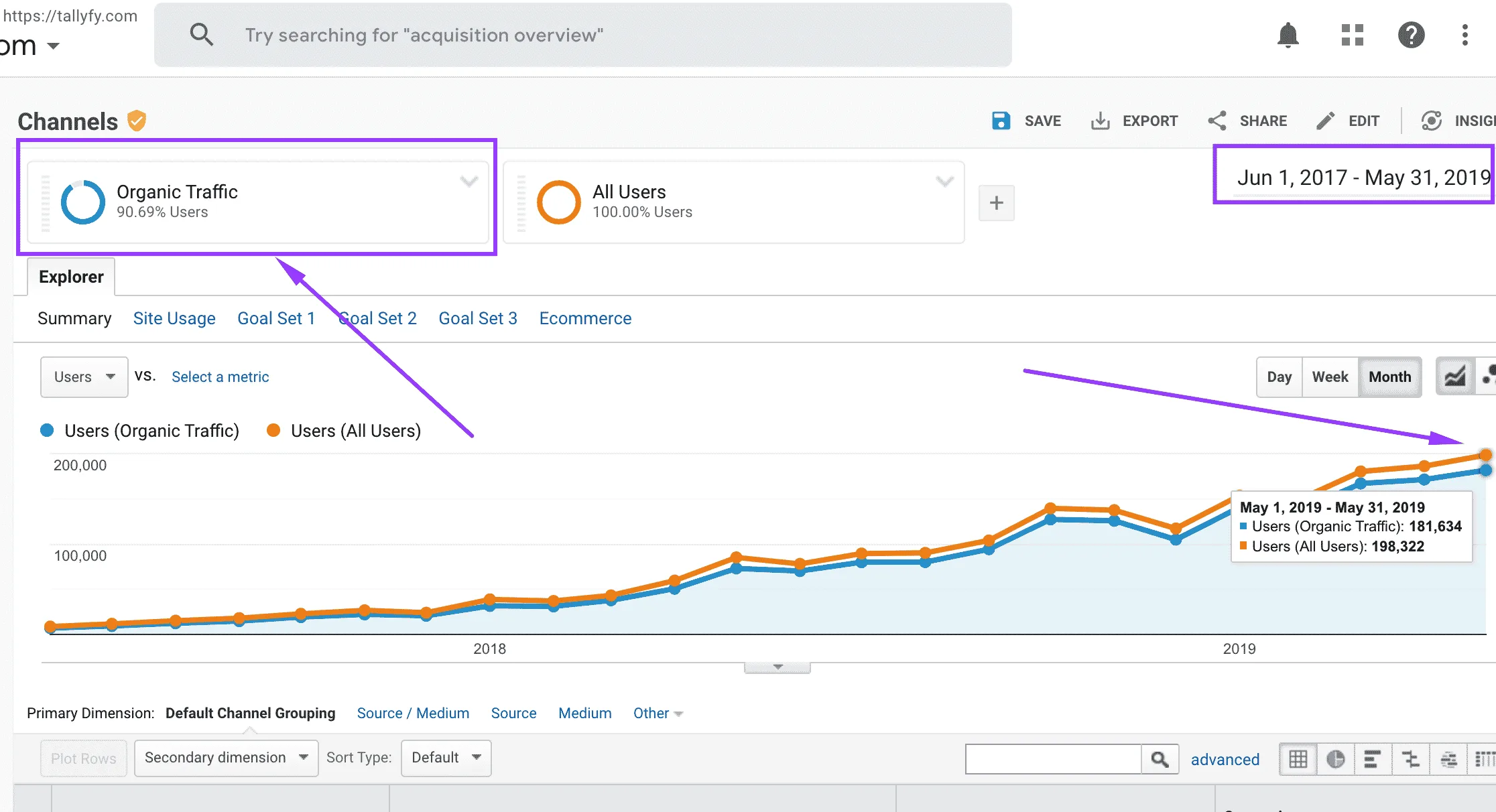
Our content marketing case study breaks down a single blog post that generated over $50,000 in client revenue, and our interior design SEO case study shows the same playbook working for a local service business. The rest of our documented results live on our case studies page, and our entire process is public, so you can vet us with the exact steps from this article. If that sounds like a fit, our pricing is public too.
2. Aleyda Solis
Aleyda Solis is an international SEO and AI search consultant and the founder of the boutique consultancy Orainti. She's one of the most respected strategists in the industry, works with enterprise and high-growth brands, and runs the widely read SEOFOMO newsletter. Best fit: international, multilingual, or enterprise-scale SEO strategy.
3. Glenn Gabe
Glenn Gabe of G-Squared Interactive has spent two decades doing deep technical and site-quality consulting, and he's the industry's go-to analyst on Google algorithm updates. Best fit: diagnosing a traffic drop, recovering from a core update, or auditing a large site's quality problems.
4. Marie Haynes
Marie Haynes has specialized in Google's quality algorithms since 2008, with a focus on site quality reviews, link audits, and, more recently, how Google's AI-driven ranking systems work. Best fit: understanding why Google doesn't trust your site, and what to change so it does.
5. Eli Schwartz
Eli Schwartz is a growth advisor and the author of Product-Led SEO, with a client list that includes the likes of Shutterstock, Gusto, and Zendesk. His angle: build SEO into the product itself instead of bolting on a blog. Best fit: SaaS and marketplaces where the product can generate the pages.
6. Mike King
Mike King founded iPullRank and has become the leading technical voice on how AI search systems actually rank and retrieve content, an approach he calls relevance engineering. Best fit: enterprise teams that want the deepest available technical thinking on ranking in both Google and AI engines.
Every consultant above is someone whose work we'd point a friend at, and none of them paid or asked to be here. Availability and rates change; all of them sit at the premium end of the ranges earlier in this article.
Frequently Asked Questions
What does an organic SEO consultant do, in one paragraph?
They grow your unpaid traffic from search engines and AI assistants: auditing your site, setting keyword and content strategy, fixing technical issues, directing link building, and measuring your visibility in both Google rankings and AI answers. Most advise and direct while your team or their partners execute the work.
How much does an organic SEO consultant cost?
Typically $75 to $200 per hour or $1,000 to $5,000 per month on retainer, with survey data putting the average consultant around $171 per hour. One-off audits and projects usually run $1,000 to $10,000. Agencies that handle execution as well typically start around $2,500 per month.
Should I hire a consultant or an agency?
Hire a consultant if you have writers and developer time to execute their strategy. Hire an agency if you need the strategy and the execution: content, technical fixes, and links delivered for you. If advice would just sit in your backlog, an agency (or a consultant plus freelancers) is the honest answer.
How long until I see results?
First measurable movement typically takes 3 to 6 months, with real compounding at 6 to 12 months. Google's own guidance says most changes need four months to a year to show benefit. Judge a consultant at month three on leading indicators (indexing, impressions, early rankings), not on revenue.
Is organic SEO still worth it now that AI answers questions directly?
Yes, and arguably more than before. AI assistants cite sources, and they overwhelmingly cite sites that already have strong organic visibility. The same work that ranks you in Google earns you citations in ChatGPT and Perplexity, so one investment now feeds two channels. Check where you stand today with our free AI visibility checker.