

An AI visibility audit answers one question with evidence instead of vibes: when your buyers ask ChatGPT, Claude, Perplexity or Google's AI Overviews for a recommendation in your category, do you show up, or does your competitor? Most founders have never checked. They watch their Google rankings while an AI engine recommends someone else by name, every day, to buyers who never see a results page.
This is the full audit we run at the start of every AI SEO engagement, written up so you can run it yourself. Eight steps, seven of them scored, adding up to a 100-point picture of where you stand and, more usefully, an ordered list of what to fix. Everything here runs on free tools and a spreadsheet. Budget an afternoon: three to four focused hours.
Here is the map:
- Step 1: The prompt panel baseline: what the engines actually say about you (25 points)
- Step 2: Crawler access: whether AI bots can fetch your site (15 points)
- Step 3: Technical readability: whether machines can parse what they fetch (10 points)
- Step 4: Bing indexation: whether ChatGPT's retrieval layer can find you (10 points)
- Step 5: Content quotability: whether your pages can be lifted into answers (15 points)
- Step 6: Entity consistency: whether engines can be confident about who you are (10 points)
- Step 7: Third-party surfaces: whether the sources engines trust include you (15 points)
- Step 8: The scorecard and the fix roadmap
Before You Start: How the Audit and Scoring Work
The audit is seven scored checks that add up to 100 points, ordered from "what do the engines say" down through the plumbing that explains why they say it. You score each step against the rubric given at the end of that step, write the number into the scorecard in step 8, and the weights do the rest. The weights reflect what we see move client results: the prompt panel is worth the most because it measures the outcome; third-party presence and quotability are worth more than technical checks because they are harder to earn and matter more.
What you need before you begin:
- A spreadsheet. Open one now. The audit produces data, and data in your head is not an audit.
- Free accounts on ChatGPT, Claude and Perplexity. Logged-out sessions behave differently and make sloppy baselines.
- A list of your top pages: homepage, main money page, pricing, your best comparison or guide. You will grade five of them in step 5.
- Honesty. You are grading yourself. A generous 74 teaches you nothing; a truthful 51 hands you a quarter's roadmap.
One framing note before the checklist starts. AI visibility is not a separate discipline bolted onto SEO; it is the same fundamentals measured on a new surface, which is why this audit will feel familiar if you have run technical SEO audits before. The strategy behind the checks lives in our GEO guide. This page is the checks.
Step 1: The Prompt Panel Baseline (25 Points)
Your baseline is ten buying questions run across four engines: forty answers, logged in a spreadsheet. This is the anchor of the whole audit. Every other step exists to explain and eventually move the number you produce here.
Why it matters is almost too obvious to write: this is the only step that measures what buyers actually see. You can pass every technical check in this audit and still be absent from every answer, and the panel is how you find that out on a Tuesday afternoon instead of in next quarter's pipeline review.
How to build the panel
Write ten questions the way a stressed buyer types, not the way a marketer writes keywords. A good panel mixes four types:
- Category questions: "best project management tool for construction teams", "top email warmup services". These decide shortlists.
- Comparison questions: "[you] vs [competitor], which should I pick". If nobody compares you to anyone yet, use the two competitors you lose deals to.
- Problem questions: "how do I stop losing track of client approvals". The buyer does not know your category exists; the engine's answer teaches them.
- Local or niche questions, if they apply: "best family law firm in Austin".
Aim for roughly four category, two comparison, three problem and one niche question. If staring at a blank cell is the blocker, our free prompt panel builder generates a starting panel for your category from five fields, plus the scoring spreadsheet. Edit what it gives you; your sales calls know phrasings no generator does.
How to run it
- Set up spreadsheet columns: date, prompt, engine, brands named, domains cited, you (named / cited / both / absent), sentiment note.
- ChatGPT: open a fresh chat for every prompt so earlier answers do not contaminate later ones. Make sure web search is active; if the answer comes back with no source links, reply "search the web before answering" and log that version.
- Perplexity: searches the web by default. Log the brands in the prose and the domains in the numbered citations. The citations matter more than the prose; they tell you where the answer came from.
- Claude: enable web search, fresh conversation per prompt, log names and cited links the same way.
- Google: run each prompt as a normal search and read the AI Overview if one appears: brands named in the summary, sites in the citation links. No AI Overview? Try the AI Mode tab and log that instead.
- When you do appear, record the sentiment. "X is popular though users report slow support" is a different problem from absence, and a worse one to discover late.
What good and bad look like
Good: you are named or cited in at least half the answers where you plausibly belong, and the description matches how you would describe yourself. Bad: forty answers, zero appearances, and the same competitor named in most of them. Ugly but common: you appear, described with two-year-old positioning and someone else's pricing. Either way, do not skip the "domains cited" column. The same handful of sources will keep recurring across all forty answers, and that list is the raw material for step 7.
Score yourself
Count the answers, out of 40, where you are named or cited. Divide by 40, multiply by 25, round. Named with materially wrong facts counts half. A brand new to this typically lands between 0 and 6; do not take it personally, take notes.
The fix if you fail
There is no single fix, which is the point of the rest of the audit: steps 2 through 7 are the diagnosis, in order. For the strategic version of why engines name some brands and not others, read how to get cited by ChatGPT after you finish scoring.

Step 2: The Crawler Access Audit (15 Points)
Open yoursite.com/robots.txt and confirm the bots that build AI answers are not blocked. This is the fastest check in the audit and the most common catastrophic failure: engines cannot cite what they cannot fetch, and plenty of sites blocked "AI bots" wholesale in 2023 without noticing they had also blocked the bots that put brands inside answers.
The nuance most audits miss: AI crawlers split into training bots and answer-path bots, and they are controlled separately. Blocking a training bot is a policy decision about your content and models. Blocking an answer-path bot is deleting yourself from AI search. Know which is which before you touch anything:
| Robots.txt token | Operator | What it feeds | Blocking it costs you |
|---|---|---|---|
| OAI-SearchBot | OpenAI | ChatGPT search results | Visibility: OpenAI's docs say blocked sites "will not be shown in ChatGPT search answers" |
| ChatGPT-User | OpenAI | Pages ChatGPT fetches when a user asks | Live answers about your pages |
| GPTBot | OpenAI | Foundation model training | Nothing in search; a training opt-out only |
| ClaudeBot | Anthropic | Web content for model improvement | Long-term model knowledge of your brand |
| Claude-SearchBot | Anthropic | Claude's search result quality | Visibility in Claude's web search |
| Claude-User | Anthropic | Pages Claude fetches when a user asks | Live answers about your pages |
| PerplexityBot | Perplexity | Perplexity search results (not model training, per their docs) | Visibility in Perplexity answers |
| Perplexity-User | Perplexity | User-initiated fetches; generally ignores robots.txt | Little via robots.txt; WAF blocks still bite |
| Google-Extended | Gemini training and grounding | Nothing in Search: Google states it does not affect Search inclusion or ranking | |
| Googlebot | Google Search, including AI Overviews | Everything. Do not block this one |
Sources, since robots directives are exactly the kind of thing you should not take from a blog on faith: OpenAI's bot documentation, Anthropic's crawler documentation, Perplexity's crawler documentation and Google's crawler documentation.
How to run the check
- Type yoursite.com/robots.txt into your browser. It is a plain text file; anyone can read it, including you.
- Scan every User-agent: line for the tokens in the table above. A token followed by Disallow: / means that bot is banned from the whole site.
- Check the wildcard block too: User-agent: * with Disallow: / bans everything at once, including all of the above.
- Robots.txt is not the whole story. Firewalls and CDNs (Cloudflare especially) ship one-toggle AI bot blocking that returns errors to these crawlers no matter what your robots.txt says, and someone on your team may have flipped it in 2023. Our free AI crawler checker tests both layers: paste your domain and it reports which AI crawlers can actually reach you.
What good and bad look like
Good: every answer-path bot in the table can fetch your pages, and any training-bot block that exists is a decision someone made on purpose and can defend. Bad: a blanket disallow nobody remembers adding, or a clean robots.txt sitting behind a firewall that 403s every AI crawler. The deeper background, including what your server logs can tell you, is in our AI crawler access guide.
Score yourself
Start at 15. Subtract 4 for each engine family (OpenAI, Anthropic, Perplexity, Google) whose answer-path bots are blocked at either layer. Floor at 0. Training-bot blocks (GPTBot, ClaudeBot, Google-Extended) cost you nothing here; that is a separate decision about a separate question.
The fix if you fail
Delete the disallow lines for the answer-path bots, turn off the WAF toggle or add exceptions for the documented crawlers, then re-run the checker to confirm. Crawlers re-read robots.txt frequently, so the fix lands within days. Whole minutes of work, double-digit visibility impact; there is nothing else in this audit with that ratio.
Step 3: The Technical Readability Audit (10 Points)
Once bots can reach your pages, this step checks whether they can parse them: one clear H1, honest title and meta description, valid structured data, Open Graph tags, a current sitemap, and content that exists without JavaScript. Ten checks, one point each, on your homepage and your main money page.
Why it matters: AI crawlers read fast and cheap. They do not linger, most do not execute JavaScript, and when your markup is ambiguous they resolve the ambiguity by moving on to a site where it is not. Structured data will not make a weak brand quotable, but sloppy fundamentals make a strong brand illegible, and illegible does not get cited.
How to run the check
Open your homepage, then repeat for your money page. For each, work through this list:
- One H1, and only one. Right-click, View Page Source (or press Cmd+Option+U in Chrome on a Mac, Ctrl+U on Windows), and search for "<h1". Exactly one hit, and it should say what the page is about, not "Welcome".
- Title tag that names what you do, unique to the page.
- Meta description present and current.
- Canonical tag present and pointing at the page itself.
- Organization or Article JSON-LD that validates: paste the URL into validator.schema.org and confirm zero errors.
- FAQPage markup wherever the page has a visible FAQ (and no markup for content that is not on the page).
- Open Graph tags: og:title, og:description, og:image.
- Sitemap: yoursite.com/sitemap.xml loads, includes your key pages, and is referenced in robots.txt.
- Content without JavaScript. In Chrome, open DevTools (F12), press Cmd+Shift+P (Ctrl+Shift+P on Windows), type "Disable JavaScript", hit Enter, reload the page. If your content vanishes, that blank screen is roughly what most AI crawlers see.
- Heading hierarchy: H2s that describe their sections, no jumping from H1 to H4 because the H4 "looked right".
Score yourself, and the fix
One point per check passed on both pages; if a check passes on one page and fails on the other, half a point. The fixes are ordinary web work: pre-render or server-render anything you want cited, add the missing schema, write real titles and descriptions. Nothing here needs a specialist; most of it needs an afternoon and the checklist above.
Step 4: The Bing Indexation Check (10 Points)
Search site:yoursite.com on Bing and see whether your key pages are indexed there. ChatGPT's web search leans on Microsoft's Bing index, so a page missing from Bing is a page ChatGPT's retrieval layer struggles to surface, no matter how well it ranks on Google.
Why this deserves its own step: almost everyone reading this has Google Search Console open in another tab and has never once signed into Bing Webmaster Tools. That neglect was rational for fifteen years. It stopped being rational the day the most-used AI assistant started pulling its search results from Bing's index, and most sites have not caught up.
How to run the check
- Go to bing.com and search site:yoursite.com. Note roughly how many results come back, and run the same query on Google for comparison. Bing showing a small fraction of what Google shows is your first red flag.
- Now check the pages that matter: search site:yoursite.com plus the topic of your money page, or paste the exact URL into Bing. Missing money pages hurt more than a low total.
- If anything important is missing, set up Bing Webmaster Tools: go to bing.com/webmasters, sign in with a Microsoft or Google account.
- Choose Import from Google Search Console if your site is verified there; your verification carries over in two clicks. Otherwise add the site manually and verify by XML file, meta tag or DNS record.
- Open Sitemaps in the left menu and submit your sitemap URL.
- Use URL Inspection on your top ten pages; request indexing for any page Bing does not know about, and read the reported crawl errors on the ones it refuses.
- Come back in a week and re-run the site: search. Bing's own getting started checklist covers the same flow if you want their version of the walkthrough.
What good and bad look like
Good: your ten most important pages all appear in Bing, and the totals are in the same ballpark as Google's. Bad: a site: search returning a handful of results, or your money pages absent while your privacy policy is indexed. The usual causes are unsubmitted sitemaps, crawl errors nobody has seen because nobody has looked, and aggressive bot-blocking that caught Bingbot in the crossfire (see step 2; the failure modes travel together).
Score yourself, and the fix
One point for each of your ten most important pages indexed in Bing. The fix is the walkthrough above: verify, submit, inspect, request, then fix whatever errors the inspection reports. Indexation follows in days to weeks. This is the least glamorous step in the audit and one of the most commonly failed.
Step 5: The Content Quotability Audit (15 Points)
Pick your five most important pages and grade each against six quotability checks. AI answers are assembled from passages, not pages: an engine lifts two or three self-contained sentences that answer the question, cites the source, and moves on. This step measures whether your pages contain anything liftable.
Why it matters: this is where "we have great content" goes to be tested. A 2,000-word page that circles its subject for six paragraphs before saying anything concrete gives an engine nothing to extract, and the citation goes to a worse page that answered in its first sentence. Quotability is a structural property, and structure is checkable.
How to run the check
Choose five pages: homepage, main money page, pricing, your best comparison or guide, and your highest-traffic blog post. For each page, mark pass or fail on six checks:
- The page answers its own headline within the first two sentences after the H1. Not "in today's fast-moving landscape". The answer.
- Headings read like the questions people ask. "How much does X cost?" is quotable infrastructure; "Pricing philosophy" is decoration.
- Every major section opens with a direct answer, then elaborates. Read only the first sentence under each H2 and ask: could this stand alone in an AI answer? That one-sentence test is the whole skill.
- At least one specific number with a named, linked source. Engines quote claims they can verify; "studies show" is not a source, it is a confession.
- A table or list that makes sense out of context. Comparison tables and step lists get lifted whole.
- A freshness signal: a visible updated date, current-year references, no "as of 2023" fossils.
What good and bad look like
Good pages feel almost blunt when you re-read them this way: question, answer, evidence, next question. Bad pages read like the writer was paid to delay the answer. If your best page fails checks 1 and 3, you have found the highest-leverage rewrite of your quarter.
Score yourself, and the fix
Thirty checks total (5 pages, 6 checks each). Divide your passes by two for a score out of 15. The fix is a rewrite pattern, not a rewrite from scratch: turn headings into questions, move each section's conclusion to its first sentence, attach a sourced number to your main claims, add one honest comparison table. Our GEO guide covers the full writing system, including the parts that are about substance rather than structure.
Step 6: The Entity Consistency Audit (10 Points)
Write the one-sentence description of your company you wish every AI engine used: name, category, who it is for. Then check the eight places machines learn who you are, and count how many actually say that. Engines assemble your identity from many surfaces; when the surfaces disagree, the model hedges, and a hedging model cites somebody it is sure about.
Why it matters: you are not competing on quality at this layer, you are competing on confidence. A brand described as "project management software" on its site, "workflow platform" on LinkedIn and "task app for freelancers" on a directory from 2021 reads as three unreliable half-entities instead of one solid one.
How to run the check
- Write the canonical sentence. Fifteen to twenty-five words: name, what it is, who it is for. Get it agreed internally; this sentence outranks your brand book now.
- Check it against these eight surfaces: your homepage and about page (count as one), your Organization JSON-LD, your LinkedIn company page, your Crunchbase profile, your main review platform (G2 or Capterra for software, Google Business Profile for local), your X or other primary social bio, your two most important industry directories (count as one), and Wikipedia or Wikidata if you have an entry.
- For each surface, mark consistent, inconsistent, or dead. "Consistent" means same name, same category words, same audience; it does not require identical copy.
- Then ask each engine from step 1: "What is [your brand]?" Log any wrong facts: old positioning, wrong pricing, a defunct product line. Wrong facts in answers almost always trace back to a surface you forgot you had.
Score yourself, and the fix
Consistent surfaces divided by eight, times ten. The fix is a weekend of unglamorous editing: update every profile to the canonical sentence, kill or reclaim dead listings, and add a sameAs array to your Organization schema linking every legitimate profile so machines can connect the identity themselves. Boring, finite, and it stays fixed for years.
Step 7: The Third-Party Surface Audit (15 Points)
Go back to the "domains cited" column from step 1 and tally which domains appear three or more times across your forty answers. That short list, usually a review platform, a few listicles, Reddit and one or two niche publications, is where AI answers in your category are actually decided. This step scores whether you exist on it.
Why it matters: engines corroborate. Your site saying you are excellent is a claim; three independent sources listing you is evidence, and the engines weight evidence. In competitive categories, presence on the five pages the engines keep citing routinely does more for the step 1 score than anything you publish on your own domain. This is the audit's heaviest lever and its slowest one.
How to run the check
- Tally the cited domains from step 1. Anything cited three or more times goes on the list.
- Google "best [your category]" and your top two panel prompts. Note the roundups and comparisons that recur in the top results; the engines read the same pages.
- Search site:reddit.com [your category] for the threads that rank or that showed up in your citations. Reddit is disproportionately cited across engines; check whether your category's recurring threads mention you.
- Assemble your top ten surfaces from all of the above. For each, mark: present and current, present but outdated, or absent.
What good and bad look like
Good: you are present and accurately described on most of the ten, including the two or three that dominate the citations. Bad, and very common: the same three listicles feed every engine's answer in your category, and you are in none of them, because nobody in your company knew those pages decided anything.
Score yourself, and the fix
One and a half points per surface where you are present and reasonably current, out of ten surfaces, for a score out of 15. The fix is outreach, and it is slower than everything else in this audit: pitch the roundup authors with a genuine reason to include you (they refresh these pages yearly and need material), build out the review platform profiles and earn real reviews, show up on Reddit as a person with expertise rather than a brand with a link, and get outdated mentions corrected. The full outreach playbook, including what to say and what never works, is in our guide to getting cited by ChatGPT.
Step 8: Score It and Build the Fix Roadmap
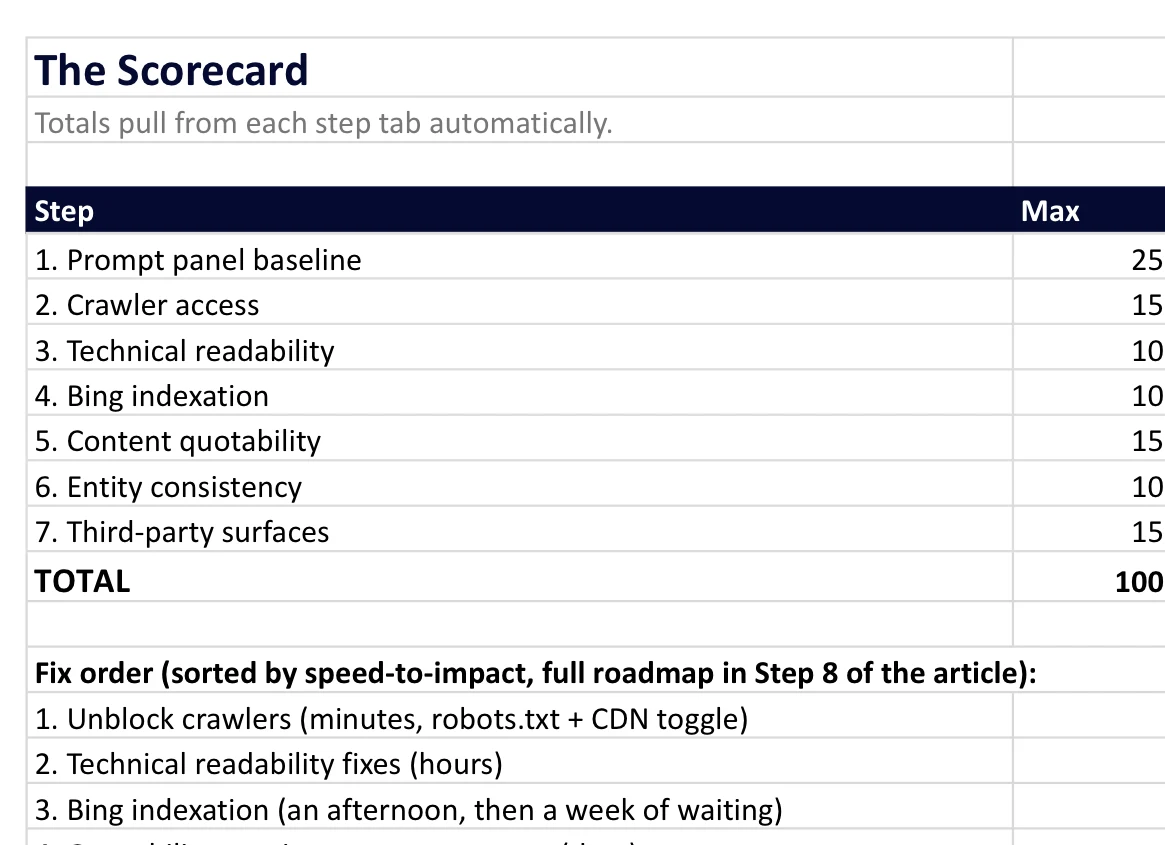
Fill in the scorecard, read your grade band, then fix things in the order below, which is sorted by speed-to-impact rather than by point value. Here is the summary:
| # | Audit step | What it measures | Weight | Your score |
|---|---|---|---|---|
| 1 | Prompt panel baseline | Whether engines name or cite you today | 25 | |
| 2 | Crawler access | Whether answer engines can fetch your pages | 15 | |
| 3 | Technical readability | Whether machines can parse what they fetch | 10 | |
| 4 | Bing indexation | Whether ChatGPT's retrieval layer can find you | 10 | |
| 5 | Content quotability | Whether your pages can be lifted into answers | 15 | |
| 6 | Entity consistency | Whether engines can be confident who you are | 10 | |
| 7 | Third-party surfaces | Whether the sources engines trust include you | 15 | |
| Total | 100 |
Read your total against these bands:
- 80 to 100: Visible. You are in the answers; the work now is defending share and extending into adjacent prompts.
- 60 to 79: Competitive but leaky. One or two steps are dragging you; they are obvious from the scorecard. Fix them this quarter.
- 40 to 59: Partially visible. Engines can see you but rarely choose you, and competitors likely own your best prompts.
- 0 to 39: Effectively invisible to AI engines. Good news: from here, the early fixes produce the steepest gains you will ever see on this metric.
What to fix first
Work in this order, whatever your total:
- Any zero in steps 2 through 4. Crawler blocks and missing indexation are gates: while they are closed, work on everything else is wasted. They are also the cheapest fixes in the audit, measured in hours.
- Quotability on your top five pages. Weeks of rewriting, and it compounds: every future page written answer-first inherits the fix.
- Entity cleanup. A weekend, then done for years.
- Third-party surfaces. Start the outreach now precisely because it is slow; the listicle you get added to this quarter feeds answers for the next two years.
Notice the prompt panel is not on the fix list. Its score is the output, not an input; it moves last, after the others, and that lag is normal. If it never moves, the panel is also how you find that out.
When to Re-Audit, and What Ongoing Tracking Looks Like
Re-run the full eight steps quarterly, and re-run the prompt panel alone monthly: same ten prompts, same four engines, fresh chats, same spreadsheet columns. Consistency is what makes the numbers mean something; a panel you rewrite every month is a new experiment, not a trend.
Expect noise between any two runs. Engines update models, shuffle sources and rephrase answers constantly, so a single month's dip is weather. Three or more runs moving the same direction is climate, and climate is what you manage against. This metric even has a name, AI share of voice, and it is quietly replacing rank tracking as the number that matters; we wrote up how to calculate and track it properly.
Once you are re-running monthly, the manual panel starts to cost real hours, and that is the point where tooling earns its keep. Disclosure before the recommendation: MentionFlow is our own product, so weigh this accordingly. We built it because we were running this exact loop by hand for clients: it samples the major engines daily, tracks your share of voice against competitors and keeps the verbatim receipts, which is precisely the boring, repetitive part of this audit that software should own. If you would rather shop the whole market first, our honest rundown of the best AI visibility tools covers the alternatives, ours included, with the trade-offs stated plainly.
And if you would rather not run any of this yourself: the audit, the fixes and the monthly tracking are the core of our AI SEO engagement, with pricing published like everything else we do.
AI Visibility Audit FAQ
Short answers to the questions we hear most when we walk clients through this.
What is an AI visibility audit?
A structured check of whether AI engines like ChatGPT, Claude, Perplexity and Google's AI Overviews mention, cite or recommend your brand when buyers ask questions in your category, plus whether your site gives those engines the access, structure and third-party evidence they need to do so. The output is a score and a prioritized fix list, not a vague impression.
How often should I run one?
Full audit quarterly, prompt panel monthly. Engines update models and refresh indexes constantly, so single snapshots decay fast. Keep the prompts, engines and spreadsheet columns identical between runs; the trend across three or more runs is the signal, and any one month is mostly noise.
Can I do this myself, or do I need paid tools?
The whole audit runs on free tools and a spreadsheet in an afternoon; that is the point of this page. Paid platforms automate the sampling and give you daily trend lines, which becomes worth paying for once you are re-running monthly and managing against the trend. Establish the baseline by hand first; you will understand the tooling far better for it.
What if my brand is completely invisible in AI answers?
Common, and fixable in a known order: unblock the crawlers, get your key pages into Bing, rewrite your top five pages answer-first, make your description consistent everywhere it appears, then earn presence on the third-party pages the engines already cite. Most brands see first movement within two to three months, because the engines refresh their sources far more often than people assume.
The Short Version
Write ten buying questions and run them across four engines to see where you stand. Confirm the AI crawlers can reach you, your markup is parseable and Bing knows you exist. Grade your top five pages on whether they answer questions directly enough to quote. Make your identity consistent everywhere machines read it, and get yourself onto the third-party pages the engines already trust. Score it out of 100, fix the gates first and the slow levers immediately after, and re-run the panel monthly.
None of it is exotic. It is an afternoon of honest measurement followed by a quarter of ordinary work, and the brands doing it now are compounding a lead on a surface most of their competitors have not started measuring.