

Legal is one of the most expensive corners of search advertising. Market benchmarks have put it among the priciest Google Ads categories for years, and in competitive practice areas a single high-intent click can cost more than most industries pay for a signed customer. Every firm bidding on those clicks is also renting them: the day the budget stops, the phone stops.
Law firm SEO is the alternative. It is the work of making your firm the answer when someone in your city searches "car accident lawyer near me" on Google, and increasingly, when they ask ChatGPT the same question. Done properly it compounds: the page you publish this quarter keeps signing cases years from now.
This guide is the full plan, written for a managing partner or the marketing hire who has to actually run it. It covers what makes legal SEO its own discipline, the Google Business Profile work that decides local pack visibility, the practice area page architecture that does most of the ranking, E-E-A-T for attorneys, reviews and citations, link building that survives scrutiny, the AI search layer that arrived on top of all of it, and what realistic timelines and budgets look like. No filler, no jargon you cannot use.
Why Law Firm SEO Is Different From Every Other Kind
Three things separate legal SEO from SEO in general: Google holds legal content to a higher standard of proof, attorney advertising is regulated by your state bar, and the local competition is about as fierce as it gets in any industry. Ignore any of the three and the other work underperforms.
Google treats legal content as YMYL
Google classifies topics that can significantly affect a person's health, finances, or safety as "Your Money or Your Life" (YMYL) topics, and its official guidance says it gives "even more weight" to strong E-E-A-T (experience, expertise, authoritativeness, and trust) on those topics. Legal advice sits squarely inside YMYL. In practice this means anonymous, agency-mill content about divorce or DUI law is playing on hard mode: Google wants evidence that a credible legal professional stands behind the words. We cover exactly how to provide that evidence in the E-E-A-T section below.
Attorney advertising rules apply to your website
Your website and profiles are attorney advertising in most states, and legal advertising is regulated by state bar associations, most of which model their rules on the ABA Model Rules of Professional Conduct. The recurring theme is simple: no false or misleading communications about you or your services. For SEO copy, the practical implications are:
- Watch "specialist" and "expert" claims. Many states restrict them to lawyers with formal certifications. "Focuses on family law" is safe everywhere; "family law specialist" often is not.
- Handle testimonials and past results carefully. Several states require disclaimers along the lines of "prior results do not guarantee a similar outcome". Do not let a copywriter promise outcomes.
- No guarantees. "We win or you pay nothing" describes a fee structure; "we will win your case" is a problem.
To be clear, this is marketing guidance, not legal advice, and the rules genuinely vary by state. You are the lawyer: run anything borderline past your own bar's advertising rules before it ships. The point for SEO purposes is that legal copy needs a compliance pass that copy in other industries does not, and any agency that has never heard of these rules should worry you.
The competition is ferocious and local
Legal is a category where nearly every competitor is actively investing, because the unit economics justify it: one signed injury case can be worth six or seven figures in fees. That is why legal sits near the top of our list of industries where SEO pays back hardest, and why you should expect the work to be contested. The good news is that the battlefield is local. You are not competing with every law firm in America, only with the firms in your metro that do this properly, and in most markets that is a shorter list than the ad auction suggests.
Google Business Profile: Where Local Legal Cases Are Won
For searches like "personal injury lawyer near me" or "divorce attorney [city]", the local pack (the map with three businesses) sits above the classic organic results, and your Google Business Profile decides whether you are in it. If you do only one thing from this guide, make it this section.
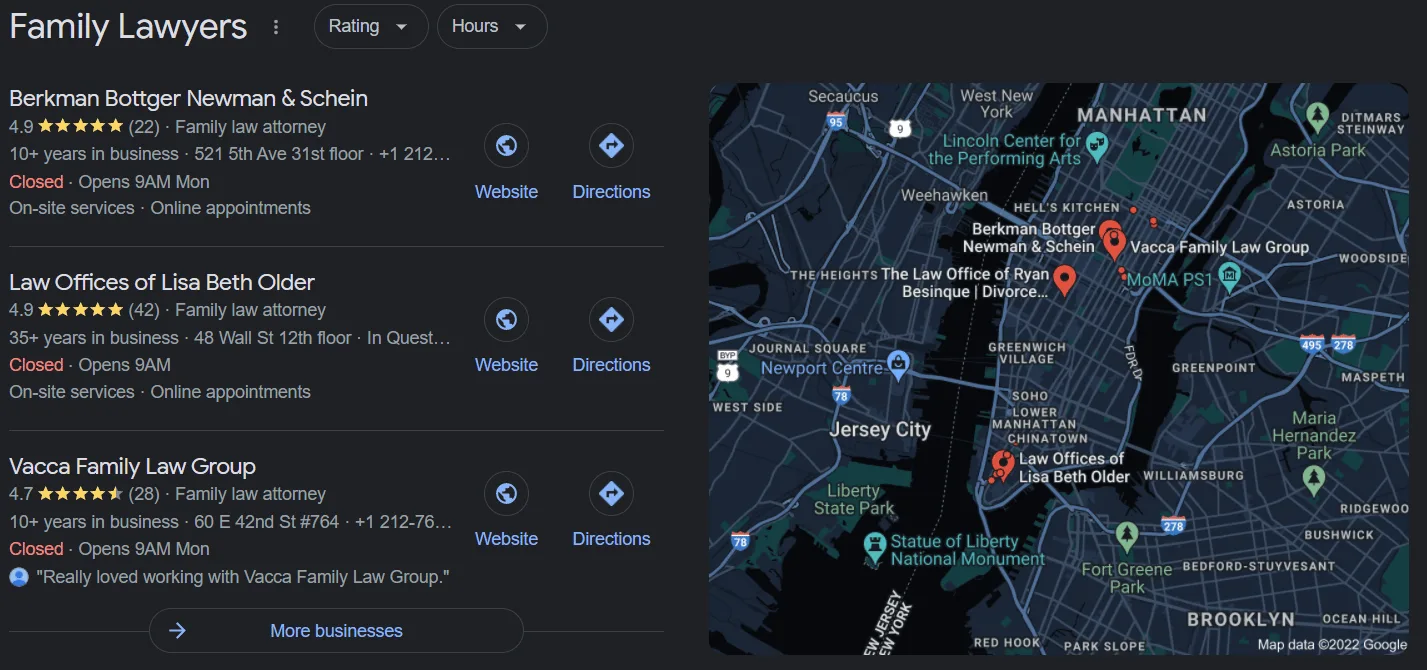
Google states plainly that local ranking is determined by three factors: relevance, distance, and prominence. Relevance is how well your profile matches the search, distance is how far you are from the searcher, and prominence is how well-known your firm is, including your reviews and the links pointing at your site. Google also states there is no way to pay for better local ranking, which is precisely why this channel is worth owning.
Here is what that means for a firm, in order of impact:
- Pick the most specific primary category. "Personal injury attorney" will beat "Law firm" for injury searches. Your primary category should match the caseload you actually want more of; add secondary categories for the rest.
- Complete every field. Hours, services, description, real photos of the office and the attorneys. Google says relevance is driven by complete, detailed business information, and thin profiles lose to complete ones constantly.
- One profile per real office. Individual attorneys at the firm can have their own practitioner profiles, and that is fine. What gets firms suspended is inventing locations: virtual offices, coworking addresses, and a partner's home listed as a "branch". Distance is a real ranking factor and you cannot fake your way around it; a second office is a business decision, not an SEO trick.
- Reviews, constantly. Review count, rating, and your responses feed prominence. This matters enough that it gets its own section below.
- Match your website. Name, address, and phone number identical everywhere, and your GBP should link to a location or practice page that confirms everything the profile claims.
Local SEO is a checklist discipline more than a creative one, which is why we maintain a free, interactive local SEO checklist covering all 38 steps, from profile setup through citations, reviews, and local links. Every step of it applies to a law office. Work through it before you spend a dollar anywhere else.
Practice Area Pages: The Architecture That Does the Ranking
The core of a law firm's site architecture is one dedicated page per practice area per location. Not one "Practice Areas" page listing everything you do, and not a homepage stuffed with every keyword. When someone searches "wrongful death attorney Denver", Google wants to rank a page about wrongful death representation in Denver, and these pages, not blog posts, are what sign clients.
The structure looks like this:
- yourfirm.com/denver-car-accident-lawyer/
- yourfirm.com/denver-truck-accident-lawyer/
- yourfirm.com/denver-wrongful-death-lawyer/
- yourfirm.com/boulder-car-accident-lawyer/ (only if you genuinely serve Boulder)
Each page targets one practice area in one location and gets the depth to deserve its ranking. Here is the template we use, top to bottom:
- A headline that names the practice area and city, followed by a direct opening: who you represent, what you actually do for them, and why you over the next firm. Two paragraphs, no throat-clearing.
- Proof, early. Ratings, notable results (with whatever disclaimer your state requires), years in practice, awards that mean something.
- What happens when they call. The intake process, step by step. People hiring a lawyer for the first time are anxious; the page that removes uncertainty wins the call.
- How fees work. Contingency percentage, flat fee, hourly range, free consultation. Firms hide this and it costs them: fee questions are among the most-searched pre-hire queries in every practice area.
- Answers to the 5–8 questions clients ask before hiring. "How long do I have to file?", "What is my case worth?", "Do I have to go to court?". Real answers, marked up as an FAQ.
- Local specifics. The courts you appear in, state deadlines and statutes that apply, how the process actually runs in your county. This is what a swapped-city template cannot fake.
- The attorneys who handle these cases, linked to their full bios. This is an E-E-A-T anchor, covered below.
- One clear call to action. Phone number and a short form. Not six competing buttons.
One warning that saves firms real pain: generating dozens of near-identical city pages with the location name swapped is exactly what Google's spam policies describe as doorway pages. If you cannot write something genuinely specific about serving that location, you do not need a page for it yet. Ten strong pages beat eighty thin ones, in rankings and in what they say about your firm.
Content That Wins Legal Queries
The content that wins legal SEO answers the questions people ask in the days before they hire, and it is written or reviewed by an attorney. That is the whole strategy; everything else is execution.
Someone rear-ended on the highway does not search "best litigation services provider". They search "what to do after a car accident in Colorado", "how much does a divorce cost in Texas", "is it worth getting a lawyer for a first DUI". Each of those searches is a person deciding whether they need someone like you, and the firm that gives them a straight, competent answer is the firm they remember when they decide the answer is yes.
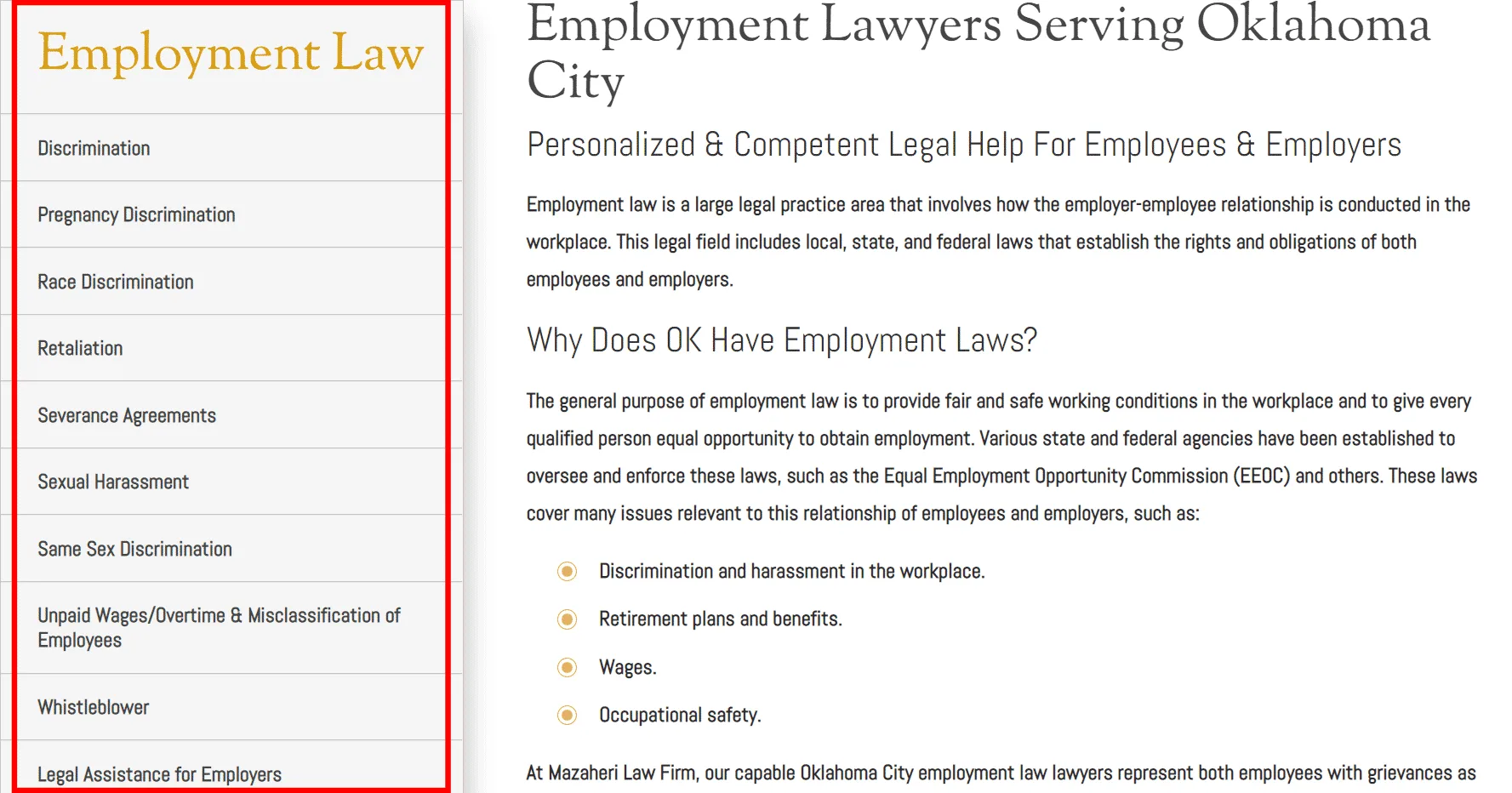
Organize this content in clusters around each practice area page: the money page in the middle, supporting articles answering related questions, all interlinked. A divorce practice in California supports its main page with pieces on filing costs, custody, timelines, and property division under California law.
Three rules keep this honest and effective:
- Keep a local or practice tie. The classic mistake is a Miami firm ranking nationally for a generic legal question and getting traffic from 49 states it cannot serve. Write "how long after a car accident can you sue in Florida", not the national version, unless you genuinely take cases nationally.
- Answer first, elaborate second. Put the direct answer in the first paragraph under each heading. It is better for readers, it wins featured snippets, and it is what AI engines quote.
- Update when the law changes. A statute changes, your content changes, dated visibly. Stale legal content is worse than none: it is a YMYL trust problem and, frankly, a professional one.
E-E-A-T for Attorneys: Prove a Lawyer Stands Behind the Words
Because legal is YMYL, Google actively looks for evidence that credible professionals are behind your content, and law firms have an unfair advantage here: attorneys carry exactly the verifiable credentials Google wants to see. Most firms simply fail to put them on the page.
What this looks like in practice:
- Real attorney bio pages. Bar admissions, jurisdictions, education, years practicing, representative matters, publications, speaking, and community roles. Link each bio to independent verification: the state bar listing, the law school, directory profiles.
- Bylines and review credits on content. Google's guidance explicitly recommends accurate authorship information such as bylines where readers would expect them. Every substantive article should carry "Written by [attorney]" or "Legally reviewed by [attorney]" with a link to the bio, and the named attorney should have genuinely reviewed it.
- Structured data. Mark the firm up as LegalService or Attorney with address and geo, and attorneys as Person entities with their credentials, so the credentials are machine-readable, not just visible.
- A consistent identity everywhere. The same attorney name, firm name, and facts on your site, your GBP, Avvo, Justia, the state bar directory, and LinkedIn. Search engines and AI models cross-reference; contradictions quietly erode trust.
None of this is decoration. On YMYL queries it is often the difference between two competent firms with similar content, and it feeds directly into the AI search layer below, because assistants preferentially cite sources whose expertise they can verify.
Citations and Reviews: The Prominence Engine
Citations and reviews are the two inputs to local prominence you can influence every single week. The plan: consistent business data everywhere your firm is listed, and a steady, ethical flow of genuine Google reviews.
Citations
A citation is any listing of your firm's name, address, and phone number. Cover the general platforms (Google, Apple Maps, Bing Places, Yelp) and the legal-specific directories covered in the next section, then enforce consistency: identical firm name, address format, and phone number everywhere. A firm that has moved offices or renamed after a partner change almost always has a trail of stale listings, and cleaning those up is boring work with a real payoff.
Reviews
Reviews influence local ranking and, more importantly, they are the first thing a potential client reads. Getting them is a process problem: the firms with 300 reviews are not better liked than you, they ask systematically. Make the request part of closing every successful matter, send the direct review link, and have the attorney who handled the case make the ask. Two hard rules:
- Never incentivize or filter. Google's review policies prohibit paying or rewarding for reviews and prohibit selectively soliciting positive ones (review gating). Beyond Google, incentivized testimonials can also be a bar-rules problem in some states. Ask everyone, reward no one.
- Respond without confirming anything. Duty of confidentiality does not pause for Google reviews. Never confirm the reviewer was a client and never discuss facts of a matter, even when a negative review is false. A short, professional reply that invites offline contact protects you and reads well to everyone watching. What prospective clients judge is not the bad review, it is how you handled it.
Link Building for Law Firms
A few dozen links from genuinely authoritative legal and local sources will do more for a firm than hundreds of junk links, and the junk now carries real risk. Prominence, in Google's own definition, includes links from around the web, so this work matters; it just has to be done honestly.
Where the links that matter come from:
- Legal directories with real authority. Avvo, Justia, FindLaw, Martindale-Hubbell, Super Lawyers, Best Lawyers. These serve triple duty: citation, link, and a surface AI assistants frequently cite when recommending lawyers. Complete profiles properly; skip the low-rent general directories that exist only to sell listings.
- Bar associations. State, county, and city bar memberships usually include a member profile and link, as do sections, committees, and CLE speaking. These are links almost no other industry can get and most firms already qualify for.
- Digital PR. Journalists constantly need attorneys to explain the legal angle of the news. Being the local lawyer who returns calls with a usable quote earns links from real news sites, repeatedly. Original data helps too: an analysis of local court filings or crash statistics gives reporters a reason to cite you.
- Local presence. Sponsorships, legal clinics, law school involvement, community organizations. Modest links individually; collectively they look exactly like what they are, a real firm embedded in a real place.
What to skip: bulk guest-post networks, "500 links for $99", comment spam, and private blog networks. Legal is a spam-heavy vertical and Google has seen every version of this. The once-popular scholarship link tactic is also long past its prime; the links are devalued and the .edu pages full of law firm scholarships are a cliché. When evaluating any directory or site offering a link, check whether it has real authority first; our free website authority checker takes about ten seconds per domain.
The 2026 Layer: Winning AI Search
People now ask ChatGPT, Perplexity, and Google's AI Mode things like "best personal injury lawyer near me" and "should I get a lawyer for a first DUI in Ohio", and the assistants answer with specific firm names and citations. The firms that get named are, overwhelmingly, the ones that did everything above properly, because AI answers are assembled from the sources the engines can crawl and trust: your website, your Google Business Profile, legal directories, reviews, and news coverage.
So the foundation is the same. On top of it, four things determine whether you are the cited answer:
- Be parseable. Direct answers under clear headings, FAQ blocks, structured data. An AI engine quoting one paragraph will quote the page that answered the question in one paragraph. This is the same discipline described in our generative engine optimization guide, applied to legal pages.
- Keep your facts consistent. Assistants cross-reference your site, GBP, directories, and reviews before naming you. Conflicting addresses, practice areas, or attorney details make you a risky answer, and models skip risky answers.
- Do not block the crawlers. GPTBot, PerplexityBot, ClaudeBot and the rest cannot cite what they cannot read. Firms block these in robots.txt by accident more often than you would think; here is how to check your AI crawler access in two minutes.
- Measure it. Run the queries a client in your city would ask across the major assistants and note who gets named. Our free AI visibility checker gives you that baseline in about a minute.
One legal-specific note: assistants lean heavily on directories and review platforms when recommending professionals, which is one more reason the Avvo and Justia profiles you built for citations are pulling double duty. This channel is early, which is exactly the argument for moving now: in most metros, no firm owns the AI answers yet.
Timelines, Budgets, and What to Measure
Realistic expectations: local pack visibility usually moves first, often within 2–4 months of fixing your profile, citations, and reviews. Competitive organic rankings for practice area terms typically take 6–12 months, and the hardest personal injury head terms in major metros take longer than that. Anyone promising first-page rankings in 30 days is describing either a keyword nobody searches or a method you will regret.
On budget, these are market-typical bands as of 2026, not quotes, and competitiveness of your practice area and metro moves you within them:
| Firm situation | Market-typical monthly spend |
|---|---|
| Solo or small firm, low-competition market | $1,500 – $3,000 |
| Established firm, competitive metro | $3,000 – $8,000 |
| Personal injury or mass tort, major metro | $8,000 – $20,000+ |
Be suspicious of the bottom of the market: a few hundred dollars a month cannot pay for attorney-reviewed content, real PR, and technical work, so it pays for automated reports and junk links instead. Judge the spend against your case economics. If an average matter is worth $8,000 in fees and SEO brings four extra signed cases a month, the math is not close.
Measure cases, not traffic. Track calls and form fills by page (call tracking makes this trivial), consultations booked, and matters signed, alongside local pack positions, Google Search Console impressions and clicks, review velocity, and your AI visibility baseline. Traffic that never becomes a consultation is a vanity metric; a page that ranks #4 but signs two clients a month is a winner.
Do It Yourself or Hire Help?
The honest answer: a solo or small-firm lawyer with a few hours a week can absolutely run the local layer, the Google Business Profile, reviews, citations, and a handful of strong practice area pages, and in smaller markets that alone beats most competitors. What is genuinely hard to do solo is sustained content production, digital PR, and technical work against firms in contested metros that spend five figures a month. The binding constraint is your billable time, not your intelligence.
If you hire, vet ruthlessly. Google's own guidance on hiring an SEO says it plainly: demand specifics, check references, and walk away from anyone who will not explain exactly what they will do and why. Ask every candidate what YMYL means for legal content and how they handle state bar advertising rules; the silence tells you everything. Our guide to vetting an organic SEO consultant walks through the full process, and we have published our entire SEO process so you can calibrate what a serious answer should sound like. If you would rather have it run for you, our pricing is public too, which is the standard we think every provider should meet.
Law Firm SEO FAQ
How much does law firm SEO cost?
Market-typical pricing runs roughly $1,500–$3,000 per month for a solo or small firm in a low-competition market, $3,000–$8,000 for an established firm in a competitive metro, and $8,000–$20,000+ for personal injury in major cities. Prices in the low hundreds per month cannot fund real work and usually buy automated reports and junk links.
How long does law firm SEO take to work?
Local pack visibility often improves within 2–4 months of fixing your Google Business Profile, citations, and reviews. Competitive organic rankings typically take 6–12 months, and the hardest personal injury terms in major metros take longer. Guarantees of first-page rankings in 30 days are a red flag, full stop.
Can lawyers do their own SEO?
Partly, yes. Claiming and completing your Google Business Profile, building review flow, keeping citations consistent, and publishing solid practice area pages are all doable without an agency, and in smaller markets that is often enough to lead the pack. Competitive content production, digital PR, and technical work are where firms in contested markets bring in specialists. The real question is whether the hours are worth more billed to clients.
Is law firm SEO worth it?
For most consumer-facing practices, yes, because the economics are extreme: high-intent legal clicks cost hundreds of dollars each in the ad auction, while a signed case is often worth thousands to seven figures. A few organic cases a month covers a market-rate budget many times over. The exception is firms whose work comes entirely from referrals and institutional clients who never search.
Does AI search matter for law firms?
Yes. Potential clients ask ChatGPT, Perplexity, and Google's AI Mode for lawyer recommendations today, and the assistants name specific firms based on what they can crawl and trust: your site, profiles, directories, and reviews. Classic SEO builds the foundation; the extra work is parseable pages, consistent facts, open AI crawler access, and actually checking whether you get named.