

Most B2B SEO advice is consumer SEO advice with the logos swapped out. Chase search volume, publish twice a week, celebrate the traffic graph. Then reality shows up: you rank #1 for a keyword with 40 searches a month, three of those searchers book demos, and one closes at $60,000 a year. That one keyword just outperformed a hundred thousand visits of the wrong traffic. B2B SEO is its own game, and it plays by different rules.
We first published this guide in 2020. This is the full 2026 rewrite: what actually makes B2B different, the process we run for clients step by step, how to earn links without spamming inboxes, how to measure pipeline without lying to yourself, and the layer nobody had to think about in 2020, which is showing up when buyers ask ChatGPT instead of Google. None of it is theory. It is the same playbook behind taking one B2B SaaS from 0 to 197,514 monthly organic visitors and growing Deskera from 5K to 120K monthly visitors.
This is also the hub page for our entire B2B library. Every section below links to a deeper guide when you are ready to go further. Bookmark this one, branch out as needed.
What is B2B SEO?
B2B SEO is the practice of ranking your website, and increasingly your brand, for the searches your buyers run at work: while they research a problem, evaluate solutions, build a shortlist, and gather ammunition to convince their boss. The mechanics overlap with any other SEO. The strategy does not, because the person searching is rarely the only person deciding, and the queries that matter often get a few dozen searches a month.
In practice, B2B SEO targets two families of keywords. Commercial keywords are the searches people run when they are actively shopping: "contract management software", "payroll provider for startups", "Salesforce alternatives". Problem keywords are the searches your future customers run before they know your category exists: "how to stop invoice errors", "sales commission structure", "SOC 2 audit checklist". A complete program covers both, in that order. We will get to why.
How B2B SEO is different
Three things separate B2B SEO from everything else: tiny search volumes attached to enormous deal values, sales cycles measured in months, and a buying committee instead of a single buyer. Get these three into your head and most of the strategy below becomes obvious.
Tiny volumes, huge deal values
"Best running shoes" gets hundreds of thousands of searches a month. "Enterprise contract lifecycle management software" might get a few hundred. But every single person typing the second query manages a budget, has a problem, and is holding a shortlist. When the deal behind a keyword is worth five or six figures a year, a keyword tool showing "volume: 90" is not a reason to skip it. It is a reason to build the best page on the internet for it. Volume tables were built for a B2C world. In B2B, you price keywords by the pipeline behind them, not the traffic in front of them.
Sales cycles measured in months
Nobody reads one blog post and signs a $50,000 contract that afternoon. B2B deals stretch across weeks or months of research, internal debates, security reviews, and procurement. That changes what your content has to do. A B2C page needs to convert a visitor once. Your B2B content needs to keep showing up across the whole cycle: the problem article that starts the journey, the comparison page mid-evaluation, the security page during review, the pricing explainer at the end. SEO content is the only sales rep you have that works every stage of the deal simultaneously, at 2am, for free.
The committee: write for the champion and the CFO
Back in 2017, Harvard Business Review reported that the average B2B buying group had grown from 5.4 to 6.8 people. Nobody who sells B2B believes it has shrunk since. What this means for SEO: the person Googling your category is usually a champion, not a signer. They find you, they get excited, and then they have to sell you internally to a manager, a CFO, maybe a security team.
So you write for both. The champion needs comparison pages, honest teardowns, and how-to content that makes them look smart in the Slack thread where they share it. The CFO needs ROI framing, transparent pricing, security and compliance answers, and proof that you will not embarrass whoever recommended you. Most B2B sites only write for the champion, and then wonder why the demos stall in week three. Where SEO sits among all the channels aimed at that committee is a bigger question, and our guide to B2B marketing strategies covers the full menu.
The B2B SEO process, step by step
The short version: start at the bottom of the funnel and work upward. Keyword research on low-volume, high-intent terms first, pain-point content second, comparison pages third, sales-enablement content fourth, and only then the big top-of-funnel education plays. Most teams run this exact sequence in reverse, spend a year building traffic that never converts, and conclude SEO does not work for B2B. It works fine. The order was wrong.
Step 1: Bottom-funnel keyword research
Open a spreadsheet and start with the searches that mean "I am ready to buy": your category plus software, tool, platform, agency, or service. Then "[competitor] alternatives" and "[competitor] vs [competitor]" for every serious player in your space. Then modifiers that signal a segment: "for small business", "for agencies", "for healthcare". Then pricing queries and integration queries, "[category] pricing", "[your tool] + [their tool] integration". These keywords look pitiful in a volume report and they are worth more than everything else on your list combined.
Two sources beat any keyword tool here. First, your sales calls: the exact phrases prospects use to describe their problem are keywords, written down for you by the market. Second, Google Search Console, once you have some data, shows the queries you almost rank for. Use Ahrefs or Semrush to size and prioritize, not to originate. And position matters more than people admit: Backlinko's CTR research found the #1 organic result takes 27.6% of all clicks, with clicks collapsing fast below it. On a 100-search keyword, the difference between #1 and #6 is the difference between a pipeline channel and a rounding error.
For the full keyword research walkthrough, including how we build and prioritize the sheet, our SaaS SEO mega-guide goes several levels deeper.
Step 2: Pain-point content
Now build content around the problems your product solves, phrased the way a stressed practitioner phrases them at 4pm on a Thursday. If you sell expense management, that is "how to stop chasing receipts from employees", not "what is expense management". The generic "what is X" glossary post has more volume and less value: it attracts students, competitors, and people writing their own blog posts. The pain-point query attracts someone living the problem, and the page that names their pain precisely, then shows the fix, converts far out of proportion to its traffic.
The bar for this content is subject-matter truth. Interview your customers, your sales engineers, your support team. A 1,200-word page that says something true and specific beats a 3,000-word page assembled from the top ten results. This is the craft half of the discipline, and our B2B content marketing guide is the deep dive on doing it repeatedly without burning out your team.
Step 3: Comparison and alternatives pages
Comparison pages are the highest-intent content you will ever publish, because the searcher has already decided to buy something and is choosing between names. Build a "[Competitor] alternatives" page for every real competitor and a "[You] vs [Competitor]" page for each one you meet in deals. The counterintuitive rule: be honest. Say plainly where the competitor wins, which segments you are wrong for, and who should not buy from you. Buyers have read a hundred rigged comparison tables where the host wins every row, and they discount them all. The vendor who admits a weakness earns trust on every other claim, and trust is the actual conversion mechanism on these pages.
Step 4: Sales-enablement content
Some of your most valuable pages will never rank for anything, and that is fine. Pricing explainers, security and compliance pages, ROI breakdowns, implementation timelines, migration guides: this is the content your champion forwards to the rest of the committee, and it is the content the CFO reads before approving the spend. Think of it as SEO for the forwarded link. It closes deals your ranking content opened. If your sales team keeps answering the same question over email, that question is a page, whether or not a keyword tool has ever heard of it.
Step 5: Briefs, production, and the publishing rhythm
Every page starts with an outline: the target keyword, the search intent, the structure that intent demands, and the angle that makes your version worth citing. Write the brief before the draft and half your quality problems disappear, because writers stop guessing. Our free content brief generator builds SEO outlines in about a minute if you want a starting point. Then publish on a rhythm you can sustain for a year. One genuinely strong page a week compounds. Ten thin pages a week compound too, in the wrong direction. And if you sell software specifically, the whole motion, positioning through content through conversion, is laid out in our B2B SaaS marketing guide.
Account relevance beats traffic
The metric that matters in B2B SEO is not how much traffic you get. It is who the traffic is. Two hundred monthly visits from operations directors at mid-market logistics companies will outperform twenty thousand visits from students, job seekers, and fellow marketers, every single quarter. Traffic is only a proxy, and in B2B it is a leaky one.
This is the vanity trap: growth charts that go up and to the right while pipeline stays flat, because the content was chosen by search volume instead of by buyer. The fix is to run the check at the keyword level before you write. Would our ideal customer type this? Would we want a sales call with the person who did? If the answer is no twice, the keyword is a distraction no matter how big the number next to it is.
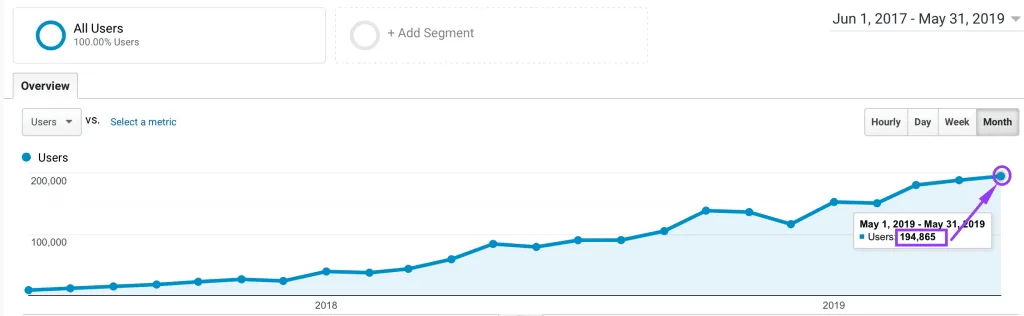
Traffic and relevance are not enemies, to be clear. When the strategy starts from buyer intent, scale follows. The growth below came from a B2B SaaS client where we cut irrelevant topics from the plan entirely and rebuilt around what their actual buyers search, including commercial keywords with ad clicks selling above $20. The full teardown is in the SEO case study.
Technical SEO for B2B: the basics that matter
Technical SEO will not win you rankings by itself, but broken technical SEO quietly caps everything else you do. The good news: most B2B sites are small, a few hundred pages at most, so this is a focused cleanup, not a permanent retainer.
The list that covers 90% of cases: make sure Google can crawl and index every page that matters, and nothing that does not (one indexable version of the site, staging locked away, no duplicate page sprawl). Submit a sitemap through Search Console and actually check the index coverage report monthly. Keep the site fast enough to pass Core Web Vitals, then stop optimizing speed and go write something, because milliseconds do not close deals. Keep every important page within three clicks of the homepage. Add Organization, Article, and FAQ schema so machines can parse who you are and what each page answers. And one 2026 addition: check that your robots.txt is not blocking AI crawlers, because a blocked crawler means an AI engine that cannot cite you. More on that below.
If you are not a 300-page site but a 30,000-page one, the technical game changes completely: crawl budget, faceted URLs, internationalization. That world is covered in our enterprise SaaS SEO guide.
Link building for B2B: original data and digital PR
The links that move B2B rankings in 2026 are earned by publishing things worth citing, not by asking strangers for favors. Mass guest posting and paid link farms are worse than useless now: at best they do nothing, at worst they mark your site as a manipulator. The honest route also happens to be the effective one, which is a rare alignment worth exploiting.
The single best B2B link asset is original data, because you are one of the few players who has any. Anonymized product usage stats, a survey of 500 people in your buyer's role, a benchmark report you refresh annually: journalists, analysts, and every content writer in your industry need numbers to cite, and the citation comes with a link. One genuinely original stat can earn more referring domains in a quarter than a year of outreach emails. Digital PR is the distribution half: package the finding as a story, pitch the trade publications your buyers actually read, and let the industry press do the linking. Free tools work on the same principle. A calculator or checker that solves a real task in your niche earns links continuously, without a single pitch, for years. Partner and integration pages round it out: every company you integrate with has a reason to link to you, and those are the most natural links in your industry.
The 2026 layer: GEO, or being the answer when buyers ask AI
Here is what changed since this guide was first written: your buyers now build shortlists inside ChatGPT and Perplexity before they ever see a Google results page. A founder asks "best CRM for a 10-person sales team", gets five names in a paragraph, and the vendors not in that paragraph were eliminated without knowing a search happened. Generative engine optimization, GEO, is the work of being in the paragraph.
The traffic is smaller than Google's, but it is disproportionately valuable. Semrush's research on AI search found the average AI search visitor is worth 4.4x the average traditional organic search visitor, with a projection that AI search visitors could surpass traditional search visitors in 2028. That fits what you would expect: someone who arrives after an AI walked them through the options shows up pre-researched and close to a decision. And the influence does not always show as a click. Similarweb research covered by SparkToro found that when AI assistants mention a brand, direct visits and branded searches for that brand rise, meaning AI answers drive demand your analytics will file under "direct".
The practical work overlaps heavily with everything above, which is the reassuring part. AI engines retrieve from web search and cite pages that rank, answer directly near the top, and get corroborated by third parties. So: keep your entity facts consistent everywhere you are described, structure key pages so the answer sits in the first lines under a question-shaped heading, earn the third-party mentions that make engines trust you, and do not block their crawlers. Then measure it like a channel. Run your ten most important buying questions through the major engines monthly and log who gets named. Our free AI visibility checker will show you where you stand in about a minute, and the full playbook, including what is snake oil, is in our generative engine optimization guide.
Measuring B2B SEO: honest pipeline attribution
Let us start with the truth most vendors will not say: clean, complete SEO attribution does not exist in B2B, and anyone showing you a dashboard that claims otherwise is showing you fiction. Six people research the deal, one fills out the form. The journey runs through a blog post in March, a Slack recommendation in May, an AI answer in June, and a branded search in July. Your analytics sees the last step and calls it "direct". Accepting this is not defeatism. It is the precondition for a measurement setup you can actually trust.
The pragmatic stack looks like this. First, put "How did you hear about us?" on every demo and signup form, as a free text field, and read the answers weekly. Self-reported attribution is imprecise and it is still the single most honest signal you have; when people write "Googled you" or "ChatGPT recommended you", believe them. Second, track which pages and keywords touched each closed deal in your CRM, first touch and last touch both, and treat the result as directional evidence rather than gospel. Third, for your bottom-funnel pages, measure pipeline per page: demos and opportunities sourced or assisted, not sessions. Fourth, watch branded search volume and direct traffic as your brand-demand proxy, because that is where dark-funnel influence surfaces. Report all of it as a range with named assumptions. In B2B SEO, a precise number is usually a wrong number wearing a suit.
And notice what falls out of the reporting: rankings and traffic become diagnostics, useful for debugging the machine, while the numbers that go to leadership are pipeline influenced, demos sourced, and revenue touched. The moment your SEO reporting leads with sessions, you are back in the vanity trap from earlier.
How long does B2B SEO take, and what does it cost?
Honest timelines first: expect the first meaningful results in 3 to 6 months, and the compounding curve, where organic becomes one of your primary pipeline channels, in 12 to 24 months. This is structural, not a vendor excuse. Ahrefs studied how long ranking actually takes and found that 72.9% of pages in Google's top 10 are more than three years old, with only about 6% of pages making the top 10 within a year of being published. The silver lining for B2B specifically: your bottom-funnel keywords are usually less contested than consumer terms, so the commercial pages tend to move first. That is one more argument for the bottom-funnel-first sequence, since it front-loads the revenue.
On cost, ranges rather than false precision. Working with a qualified agency runs roughly $1,000 to $5,000 per month in most niches, and $5,000 to $15,000 in genuinely competitive categories; we break down how to vet vendors, and what those tiers buy, in our guide to B2B SEO agencies. In-house, the real cost is a senior person who has done this before, writer capacity with subject-matter access, a toolset, and a budget for the data and PR assets that earn links. Whichever route you take, the budgeting mindset matters more than the number: B2B SEO is a 12+ month investment with compounding returns, not a campaign with an end date. If you want to see how we price it, our plans are public.
B2B SEO FAQ
How long does B2B SEO take to work?
Bottom-funnel pages on low-competition commercial keywords can start producing demos in 3 to 6 months. The compounding curve, where organic becomes a primary pipeline channel, typically takes 12 to 24 months. Ahrefs found 72.9% of top-10 pages are over three years old, so the timeline is structural. Start with the commercial keywords so the earliest wins are revenue, not just traffic.
How much does B2B SEO cost?
A qualified agency runs roughly $1,000 to $5,000 per month in most niches, and $5,000 to $15,000 where competition is fierce. In-house, budget for a senior SEO lead, writer capacity, tools, and link-earning assets. Suspiciously cheap retainers are usually AI content resold at a markup, and they cost more than they save.
Is B2B SEO still worth it now that buyers ask ChatGPT?
More than before, because the same work now pays on two surfaces. AI engines retrieve and cite the well-structured, corroborated pages that classic SEO produces, and Semrush's research found the average AI search visitor is worth 4.4x a traditional organic visitor. The sites losing to AI answers are the ones that only ever published thin top-of-funnel content.
What's the difference between B2B SEO and B2B content marketing?
B2B SEO wins rankings and AI citations for what buyers actively search. Content marketing is the wider discipline: newsletters, LinkedIn, podcasts, and sales-enablement pieces that never need to rank. Run them from one strategy, because the same customer research feeds both. Our B2B content marketing guide covers the other half.
Should we do B2B SEO in-house or hire an agency?
In-house wins if you have a senior operator who has done it before and writers with real access to subject-matter experts. An agency wins when you need the playbook and production capacity immediately. Either way, demand documented B2B results and look at whether their keyword thinking starts at the bottom of the funnel. Traffic screenshots alone prove nothing.