

Keyword research is where SaaS SEO programs are won or lost. Pick the right 50 keywords and every page, brief, and link you build afterward pulls toward revenue. Pick the wrong ones and you can execute flawlessly for a year and have nothing to show for it except traffic that never signs up.
This is the full keyword research process we run at Apollo Digital, written as the deep-dive companion to our complete SaaS SEO guide. That guide covers the whole program; this one goes all the way down on the step that decides whether the rest of it makes money. It's the same process behind growing Novorésumé into a multi-million-visitor organic channel and taking a BPM SaaS from 0 to 200,000 monthly organic visitors in under two years.
Seven steps, in the order we actually run them:
- Start bottom-funnel with the SaaS page-type map
- Mine jobs-to-be-done language, not feature names
- Score intent before volume
- Map every keyword to exactly one page
- Run a competitor gap analysis
- Add the AI-search layer
- Turn the list into a quarter-by-quarter roadmap
Step 1: Start Bottom-Funnel With the SaaS Page-Type Map
Start your research with the six page types closest to a purchase decision: comparison, alternatives, category, use-case, integration, and pricing keywords. Their volumes look embarrassing next to top-funnel terms, and they will out-earn them anyway, because everyone searching them is days or hours from choosing a vendor.
The best thing about bottom-funnel SaaS keywords is that they follow patterns so predictable you can enumerate most of your market's set in an afternoon. You don't discover these keywords so much as fill in a template:
| Page type | Query pattern | Example | How to find them |
|---|---|---|---|
| Comparison | [you] vs [competitor], [rival A] vs [rival B] | "monday.com vs Asana" | Type each competitor's name plus "vs" into Google and let autocomplete finish it; pull "vs" URLs from competitor sitemaps |
| Alternatives | [competitor] alternatives | "HubSpot alternatives" | One keyword per incumbent your buyers defect from; your sales calls tell you which incumbents those are |
| Category | best [category] software | "best CRM software" | G2 and Capterra category names are the canonical list of how buyers name your market |
| Use case | [category] for [industry or role] | "CRM for real estate agents" | Autocomplete "[category] for", your customer segments, competitors' /solutions/ pages |
| Integration | [category] that works with [tool] | "time tracking that syncs with QuickBooks" | Your own integrations directory; every integration is a keyword |
| Pricing | [category] pricing / cost | "help desk software pricing" | One per category term you target; late-stage searches from buyers with a budget |
Two of those discovery methods deserve a closer look, because they're the ones teams skip.
Autocomplete is a list of real queries, free
Google Autocomplete is the most underrated keyword tool in existence because it isn't guessing. Google's own explanation of the feature is explicit: predictions are built from "real searches that happen on Google", surfacing common and trending queries that match what you've typed. When "vs Pipedrive" appears after a competitor's name, someone is running that search, whether or not your volume tool admits it.
The routine: take each pattern from the table and type the stem into an incognito window. "[Competitor] vs", "[category] for", "[category] pricing". Then run the alphabet trick, appending "a", "b", "c" after the stem to force new predictions. Twenty minutes per pattern, and you'll surface use-case and integration queries that tools report as zero volume but that your buyers demonstrably type.
Competitor mining gets you 80% of the list in an hour
Run your three or four closest competitors through Ahrefs or Semrush and filter their organic keywords for "vs", "alternatives", "best", "pricing", and "for". What comes back is their revenue map, published in public. Copy out everything relevant, skip their brand terms, and you have the bulk of your bottom-funnel universe before lunch. No tool budget? Crawl their sitemaps for /vs/, /compare/, /alternatives/, and /solutions/ URL patterns instead; the page slugs are the keywords.
Resist the urge to start up-funnel because the volume numbers look better there. The problem-and-education keywords matter, but they come later, as cluster support around pages that already convert. Winning "what is CRM" while losing "CRM for real estate agents" is how SaaS blogs end up with 60,000 readers and nine trials.
Step 2: Mine Jobs-to-be-Done Language, Not Feature Names
The keywords that convert describe the job your buyer is trying to get done, in their words, not yours. Nobody searches your feature vocabulary. Zero people type "kanban-native orchestration layer" into Google; they type "how to manage client projects without email". Your product gets hired to do a job, and the buyer describes that job in plain, often frustrated, language.
This is the single most common failure we see in SaaS keyword lists: pages built around the product's nouns instead of the buyer's verbs. A resume builder's most valuable keyword isn't "resume builder"; it's "how to make a resume", because the product is the literal answer to that job. That one reframe built most of Novorésumé's organic channel.
Feature keywords aren't worthless. They become docs, help content, and comparison-table rows. They just can't be the spine of the strategy, because the demand isn't phrased that way.
The buyer's actual vocabulary is sitting in five places you already have access to:
- Sales and demo calls. The first five minutes, where the prospect explains what broke. Pull transcripts and highlight every phrase that describes a problem.
- Support tickets and onboarding questions. How users phrase what they're trying to do when nobody is polishing their language.
- Win/loss and cancellation reasons. "We switched from X because" sentences are alternatives keywords with the serial numbers still on.
- Competitor reviews on G2 and Capterra. Read the 1-star and 5-star reviews of every competitor. Angry customers write in exact queries: "couldn't get reports that show [x]", "too expensive for a small team".
- Reddit and niche communities. Search your category and competitors' names. The thread titles are conversational keywords, and these same threads are what AI engines read when they build shortlists.
If you can get 20 minutes with five recent customers, ask these and transcribe the answers verbatim:
- What were you using before us, even if it was a spreadsheet?
- What was the moment you decided to look for something new?
- What did you actually type into Google or ChatGPT when you started looking?
- What almost stopped you from signing up?
- How would you describe what we do to a colleague, in one sentence?
Question three routinely produces keywords no tool ever suggested. Translate every job statement into query form ("we kept double-booking crews" becomes "scheduling software for field teams", "how to stop double-booking jobs") and add them to the sheet alongside the page-type keywords from step 1.
Step 3: Score Intent Before Volume
When a 30-searches-a-month comparison keyword and a 3,000-searches-a-month definition keyword compete for the same slot on your roadmap, the comparison keyword wins. Volume is the most seductive and least trustworthy number in keyword research, and building a SaaS roadmap by sorting on it is the most expensive default in SEO.
Two reasons to distrust it. First, the conversion math: thirty searchers comparing two named vendors contain more revenue than three thousand students, job-seekers, and idly curious people looking up a definition. A tiny fraction of a decision-stage audience beats a rounding error of an informational one, and the decision-stage page is also cheaper to rank.
Second, volume tools structurally undercount exactly the keywords SaaS lives on. Ahrefs' own analysis of its U.S. database found 2.3 billion keywords with fewer than 10 monthly searches, almost 93% of all keywords in the database, against just under 18,000 keywords with volumes above 100k. The long tail isn't a niche; it's nearly the entire distribution, and your "0 volume" use-case and integration queries live inside it. We've watched keywords reported as zero volume close five-figure annual contracts.
So score intent explicitly instead of implying it from volume. Here's the framework we use: rate every keyword 1 to 3 on three dimensions, in this order, and use volume only to break ties.
| Dimension | 3 points | 2 points | 1 point |
|---|---|---|---|
| Intent | Names competitors, pricing, or the category ("X vs Y", "best [category]") | Describes a job with software implied ("how to track billable hours") | Informational, no purchase implied ("what is time tracking") |
| Business fit | Your ideal segment self-selecting ("[category] for [your best vertical]") | Adjacent buyers you can serve | Audience that will never pay you |
| Winnability | Weak or outdated pages ranking; sites your size in the top 10 | Mixed SERP, a gap in quality you can exploit | Entrenched giants and review platforms wall to wall |
Sort by intent, then fit, then winnability. A 9/9 keyword with no measurable volume outranks a 5/9 keyword with 10,000 searches on any rational SaaS roadmap. One more input if your site has history: Google Search Console. Filter for queries where you already rank positions 5 to 20 with real impressions; those are pre-validated keywords where half the work is already done, and GSC gives you the data for free, from your own site, with none of a third-party tool's sampling error.
Step 4: Map Every Keyword to Exactly One Page
Every page targets one primary keyword, and every keyword lives on exactly one page. Most of the "we rank nowhere and don't know why" audits we run turn out to be mapping failures: two pages splitting one query between them, so neither ranks.
Group keyword variants by SERP, not by phrasing. If Google returns essentially the same results for "CRM for realtors" and "real estate CRM", that's one page with one primary keyword and the variant in an H2. If the results differ meaningfully, that's two pages. The SERP is the ground truth for what Google considers one intent; five minutes of checking beats any clustering tool's guess.
The map itself is a spreadsheet: primary keyword, intent score from step 3, page type from step 1, target URL (existing or planned), secondary keywords, status. If you'd rather not build it from scratch, grab our free automated keyword research template, which is the exact sheet we use with clients.
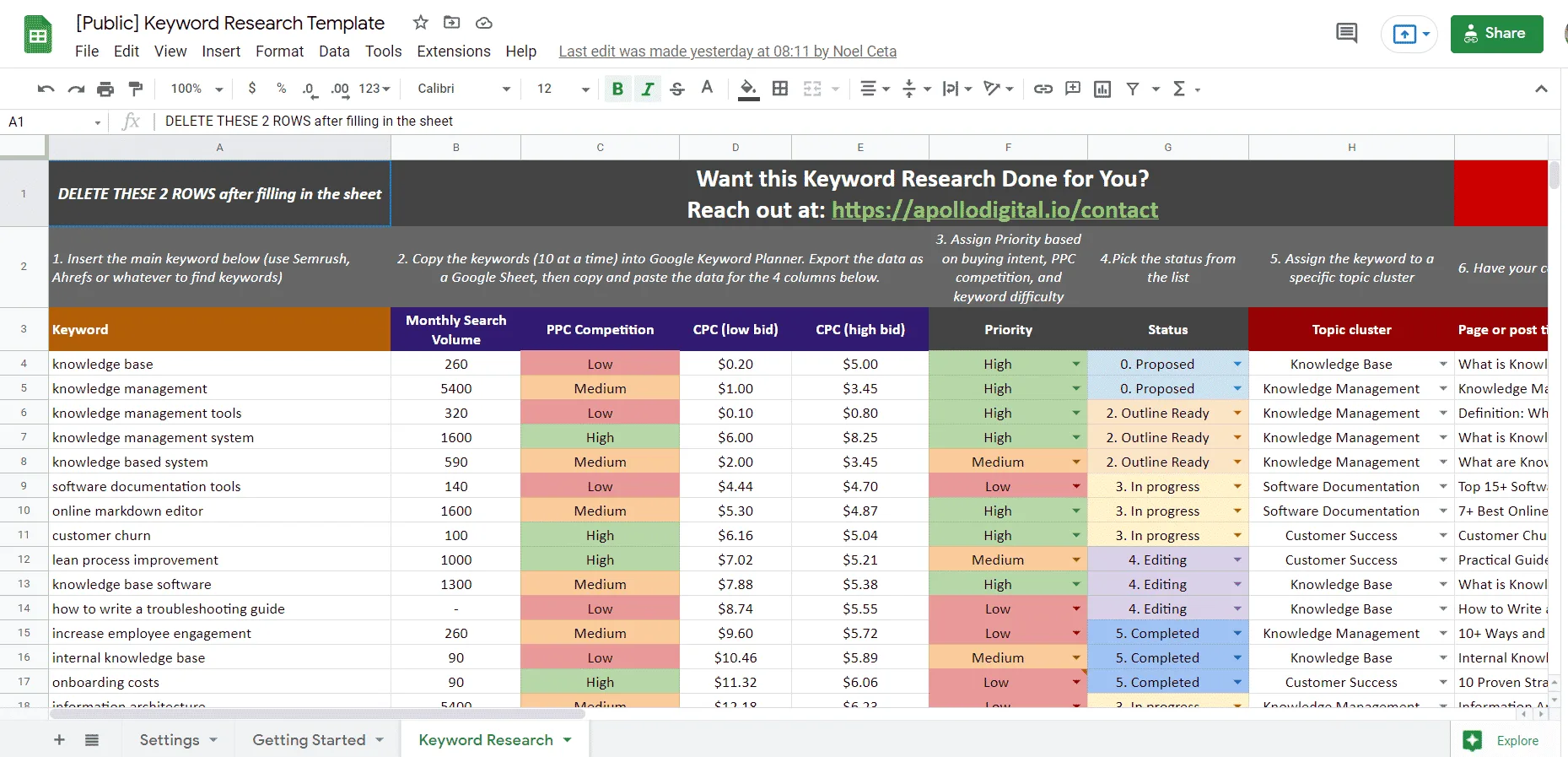
Before any new page gets a slot on the map, run the cannibalization checks:
- Search site:yourdomain.com "keyword". If a page already targets the query, improve it instead of competing with it.
- Check GSC's Pages report per query. Filter Performance by the exact query and open the Pages tab. Multiple URLs collecting impressions for one query means Google can't decide which page to rank, and split signals rank worse than consolidated ones.
- Watch for URL flip-flopping. A keyword whose ranking URL keeps alternating between two pages in your rank tracker is cannibalizing. Merge the pages and 301 the loser, or re-differentiate their intents so each owns a distinct query.
Once the map is set, each page's structure follows from it: primary keyword in the title and H1, variants and subtopics as H2s, and a direct answer at the top of every section. We've written up the exact page-level process in our content outline guide, and this discipline, one keyword, one page, one outline, is what makes the roadmap in step 7 executable instead of aspirational.
Step 5: Run a Competitor Gap Analysis
A competitor gap analysis lists the money keywords your competitors rank for and you don't, and with the right tool it takes about an hour. It's the fastest way to find proven demand you're missing, as long as you treat the output as candidates to score rather than orders to follow.
The walkthrough we run for every new client:
- Pick your SERP competitors, not your product competitors. Google five of your money keywords and note which domains keep appearing. The company you fight for deals and the sites you fight for rankings are often different lists, and the second list is the one that matters here.
- Run the gap report. Content Gap in Ahrefs or Keyword Gap in Semrush: show keywords where two or more competitors rank in the top 10 and you don't. Requiring two competitors filters out their one-off accidents.
- Strip brand terms. You will never outrank Pipedrive for "Pipedrive login", and it doesn't matter. Delete every keyword containing a competitor's name, except the "vs" and "alternatives" patterns, which are exactly the ones you want.
- Filter for money modifiers first. "vs", "alternatives", "best", "pricing", "for", "integration", "template". Tag each surviving keyword with its page type from step 1 and score it with the step 3 framework. The high-intent gaps go straight onto the roadmap.
- Make a second pass for clusters. Sort each competitor's pages by estimated traffic. Their top pages reveal which topic clusters and free-tool plays are carrying their program, which feeds your up-funnel planning later.
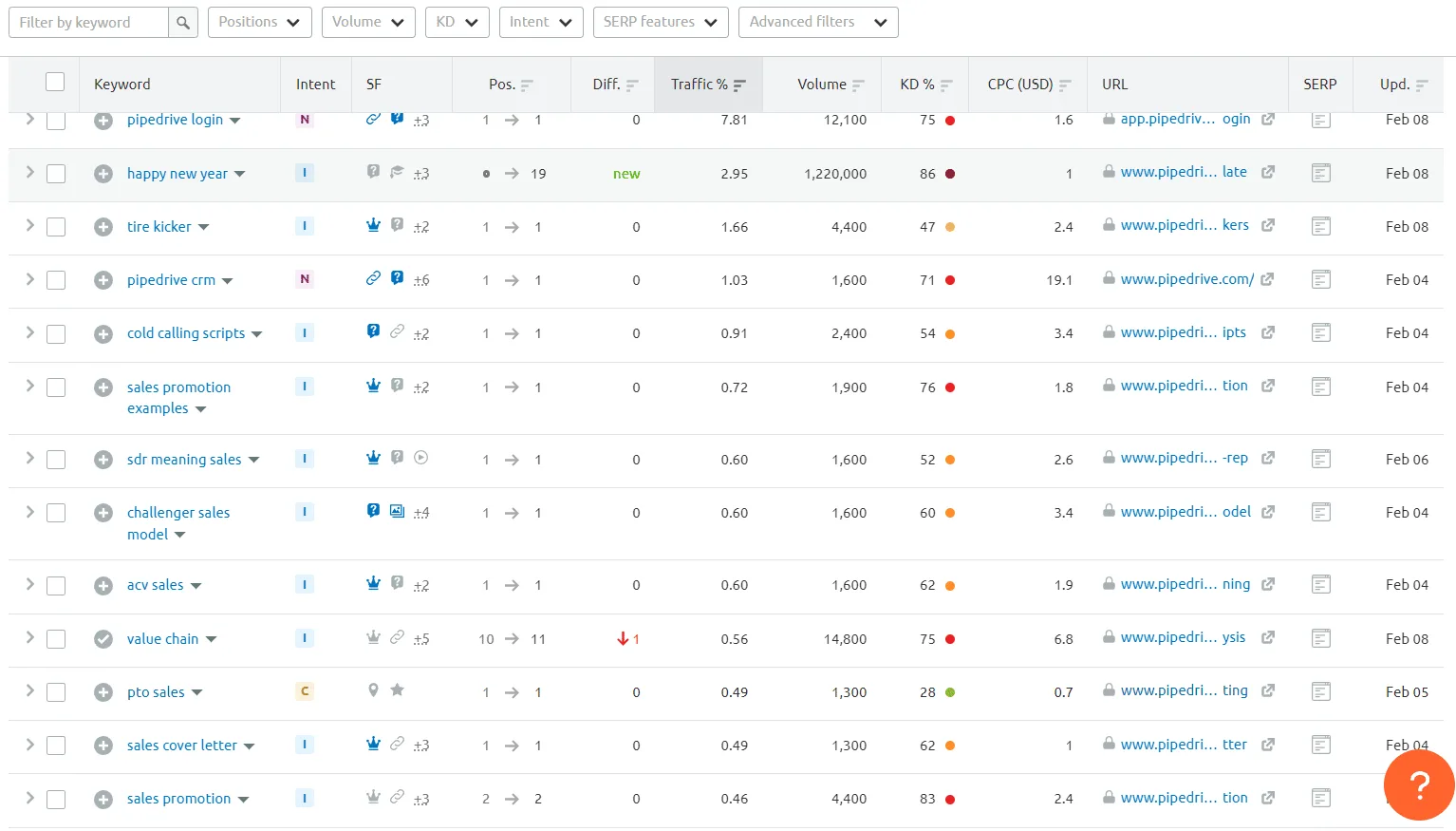
No tool budget? The manual version works, it's just slower: crawl competitor sitemaps for money-page URL patterns, run their category terms through autocomplete, and hand-check the SERPs for your top 50 keywords to see who owns them.
One honest caveat: a gap analysis sets your floor, not your ceiling. Competitors' keyword lists contain their mistakes, and the keywords nobody in your market targets yet, usually the jobs-to-be-done language from step 2, are routinely the highest-ROI pages you'll ship. Copy the proven demand; win on the demand only you've noticed.
Step 6: Add the AI-Search Layer
In 2026, keyword research has a second surface: the questions your category gets asked inside ChatGPT, Perplexity, and Google's AI Mode. Those conversations end in shortlists, the shortlists drive trials, and none of it shows up in a volume column. If your keyword research stops at Google queries, you're researching a shrinking fraction of how buyers actually pick software.
This changes keyword selection in two concrete ways.
First, informational keywords are now worth less than their volume implies. Ahrefs analyzed 300,000 keywords and found that the presence of an AI Overview correlated with a 34.5% lower clickthrough rate for the top-ranking page compared to similar informational queries without one. Definition-style queries are precisely where AI Overviews appear most, so a "what is [category]" keyword should be discounted twice in your scoring: once for weak intent, once because even the number one ranking now captures far fewer of those searchers. Bottom-funnel and comparison queries, where searchers still want to see the evidence before paying, hold their click value far better.
Second, a growing share of your demand is conversational and invisible to tools. Ahrefs calls this the conversational long tail: queries phrased as full sentences to AI assistants, with effectively zero measurable search volume but real demand behind them. Nobody types "best CRM for a 4-person real estate team that hates data entry" into Google, but people ask assistants exactly that, every day.
So we add a prompt research pass to every keyword project:
- Build a prompt list from buyer language. Take the step 2 interview answers and the step 1 patterns and phrase them the way people talk: "best [category] for [segment] under [constraint]", "[competitor] alternatives that can [job]", "is [category] worth it for a [company type]".
- Run the list monthly in ChatGPT, Perplexity, and Google's AI Mode. Record which products get named and, in Perplexity especially, which sources get cited.
- Treat the cited sources as keywords. If the engines keep citing a specific roundup, a review category, or a Reddit thread, being present there is now part of your keyword strategy, alongside ranking your own pages.
- Weight your roadmap toward citable page types. Comparison pages with honest pros and cons, use-case pages with direct answers under clear headings, and category roundups are what generative engines quote. A direct two-sentence answer at the top of every H2 isn't just good for readers; it's the format models lift.
The full playbook for this layer, including how engines choose sources and what to fix first, is in our guide to generative engine optimization. For keyword research purposes, the takeaway is simpler: your keyword universe is now queries plus prompts, and the prompt half is where your competitors aren't looking yet.
Step 7: Turn the List Into a Keyword-to-Content Roadmap
The output of keyword research is not a list; it's a publishing queue with dates on it. A scored, mapped keyword sheet that never becomes a schedule is the most common way this whole process dies, so the last step is converting the map into a quarter plan someone is accountable for shipping.
Prioritize in four tiers, straight from your step 3 scores:
- P1: high intent, winnable now. Comparison, alternatives, use-case, and integration pages where the SERP is soft. These ship first, no exceptions.
- P2: high intent, hard. Category head terms with entrenched competition. Start them early because they take longest, but never at P1's expense.
- P3: cluster support. The jobs-to-be-done and problem keywords that build topical authority around your money pages and feed internal links to them.
- P4: everything else. Top-funnel volume plays. Fine eventually; fatal first.
Here's what a first quarter typically looks like for a SaaS starting from a thin site, as a structure to adapt rather than a template to copy:
| When | Ship | Why this order |
|---|---|---|
| Weeks 1–2 | Finished keyword map, cannibalization audit, briefs for the first eight pages | Briefs before drafts; the map is the contract |
| Month 1 | Comparison and alternatives pages (P1) | Closest to revenue, smallest set, fastest to write honestly |
| Month 2 | Use-case and integration pages, plus the category roundup | Extends bottom-funnel coverage while month 1 pages index |
| Month 3 | First pillar page with 3–4 supporting cluster posts; refresh anything already moving in GSC; re-run the gap analysis | Starts the authority build on top of a converting base |
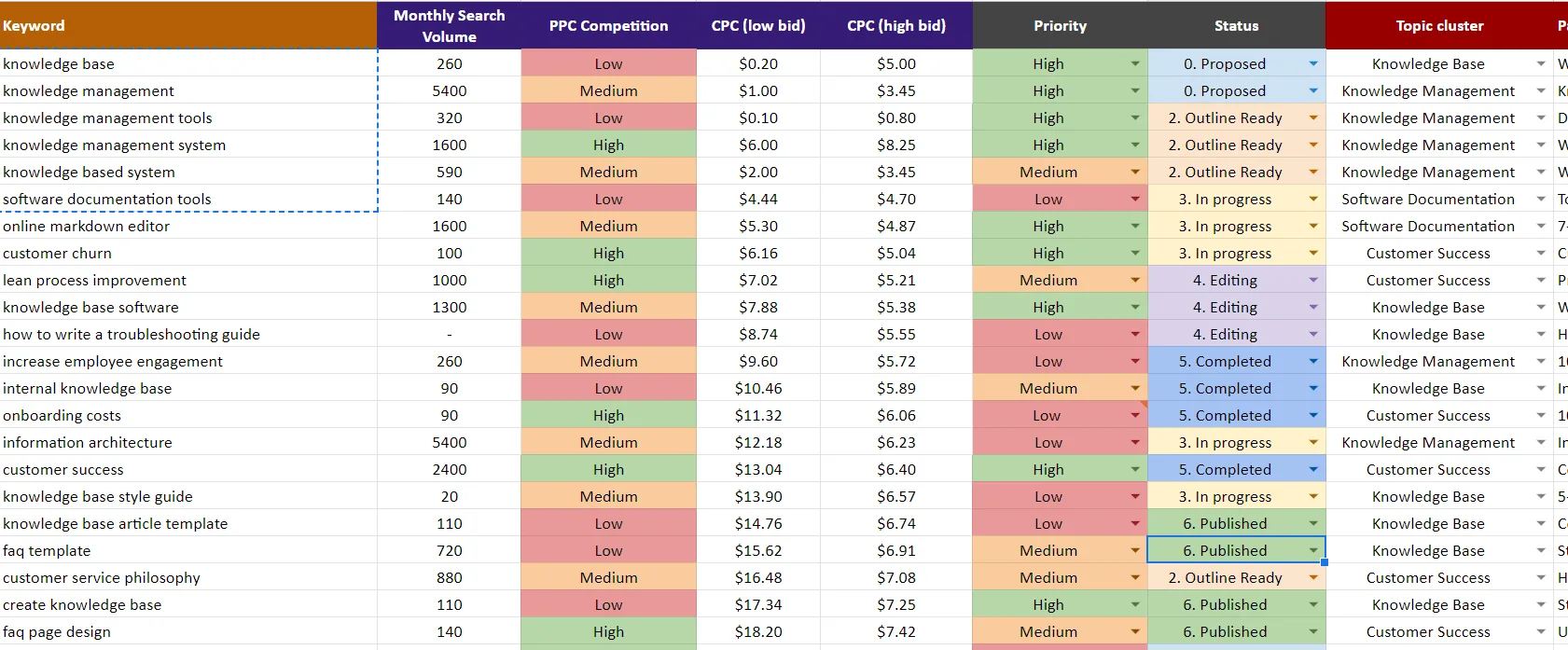
Every keyword that reaches the queue gets a brief before it gets a draft: target keyword, intent, outline, internal links, and the angle that justifies the page existing. Our free content brief generator turns a keyword into that skeleton in a couple of minutes, and the outline process covers the rest. From there it's a production problem, and we've documented how the whole engine runs, briefs, writers, review, refresh cycles, in our SaaS content marketing guide.
Two scale notes. If you're a larger operation sitting on thousands of pages, prioritization inverts: your biggest keyword wins usually come from fixing and consolidating what exists rather than adding net-new pages, and our enterprise SaaS SEO breakdown covers that variant. And whatever your size, re-run this process on a schedule: a quarterly refresh of the gap analysis, GSC opportunities, and prompt tests, plus a full annual rebuild. Markets rename themselves faster than keyword sheets get updated.
The Tool Stack, Honestly
One paid SEO tool, Google Search Console, and a spreadsheet cover 90% of this process. The keyword tool industry would prefer you believed otherwise, so here's the honest version:
- Ahrefs or Semrush, one, not both. You need it for the gap analysis, SERP data, and difficulty estimates. The overlap between the two tools is near-total for keyword research; pick whichever your team already knows.
- Google Search Console, free and chronically underused. Your own query data, position 5 to 20 opportunities, and cannibalization checks, with no sampling error. For an existing site, GSC finds more shippable wins than any paid tool.
- The free layer. Google Autocomplete for real query discovery, G2 and Capterra for category language, Reddit for buyer phrasing, and Google Keyword Planner if you want a second opinion on volume ranges.
- Our free stuff. The keyword research template for the map, and the content brief generator for turning winners into briefs.
What no tool does is score intent, judge business fit, or interview your customers. The software handles retrieval; the judgment is the actual work, which is why a founder with GSC and this process beats an intern with every subscription in the industry.
SaaS Keyword Research FAQ
The questions we field most often when we present keyword maps to clients.
How many keywords does a SaaS company actually need?
Fewer than most teams think. For a typical SaaS, 50 to 150 keywords mapped one-to-one to pages covers the first year of serious work, because the bottom-funnel set (comparisons, alternatives, use cases, integrations, pricing) is finite and enumerable. The goal is not a 5,000-row export; it's a short list where every keyword has a page, a priority, and a reason to exist.
Should I target keywords that show zero search volume?
Yes, when the intent is obvious. Volume tools round the long tail to zero: in Ahrefs' U.S. database, keywords with fewer than 10 monthly searches make up almost 93% of all keywords. Bottom-funnel SaaS queries live in exactly that bucket, and queries typed into AI assistants never register volume at all. If the words describe your buyer's job or name your competitors, the reported volume is the least important thing about the keyword.
What tools do I need for SaaS keyword research?
One paid SEO tool (Ahrefs or Semrush, not both), Google Search Console, and a spreadsheet cover 90% of the process. The rest is free: Autocomplete, G2 and Capterra categories, Reddit, and your own sales calls. Our content brief generator handles the keyword-to-brief handoff. No tool scores intent for you; that judgment is the actual work.
How often should I redo keyword research?
Refresh quarterly, rebuild annually. Each quarter, re-run the competitor gap analysis, check Search Console for queries you rank 5 to 20 for, and re-test your AI prompt list, since ChatGPT and Perplexity answers shift monthly. Once a year, redo the process end to end: new competitors, new integrations, and new buyer language accumulate faster than most roadmaps assume.
The Short Version
SaaS keyword research in 2026 is a sequence: enumerate the bottom-funnel page types, mine the words buyers actually use, score intent before volume, give every keyword exactly one page, steal the gaps your competitors proved, add the prompts AI engines answer, and turn all of it into a dated queue. Run in that order, it's a week of work that directs a year of content.
It's also only step one. What happens after the map, architecture, content engine, technical foundations, links, and the AI layer, is the rest of the program, and it's all in our complete SaaS SEO guide. Read that next, or skip the reading and have us run the whole thing.