

Interior design might be the best-fit local industry for SEO that still mostly ignores it. The service is local, the average project is worth five or six figures, and the buying process starts with a search: someone standing in a dated kitchen typing "interior designer near me", or increasingly, asking ChatGPT who they should hire. The studios that show up own that moment. Everyone else waits for referrals.
This is not theory for us. We ran the full playbook for a luxury interior design firm and published every step in our interior design SEO case study. Per that write-up, the client ranked #1 for "interior designer" and "interior design agency" in Park City, Bozeman, Big Sky, and Amenia, and organic search now drives around 30 leads a month. This guide is the same playbook, generalized so you can run it for your own studio.
It covers why interior design and search fit together so well, the local foundations that decide map visibility, the portfolio problem that sinks most designer websites, keyword strategy, the content that actually wins clients, reviews and Houzz, link building for design firms, the AI search layer that arrived on top of all of it, and what realistic timelines look like. No filler, no jargon you cannot use.
Why SEO Works Unusually Well for Interior Design
Three properties make interior design an exceptional SEO vertical: clients search locally with high intent, projects are high-ticket so a handful of leads funds everything, and your portfolio is a content asset most local businesses would kill for. Very few industries have all three at once.
Start with the economics. A full-service residential project routinely runs into five or six figures in fees and procurement. That means an SEO channel does not need to produce hundreds of leads to transform the business; three to five qualified inquiries a month is a different company. It is the same math that makes legal and home services such strong SEO categories, which is why design-adjacent trades keep showing up in our breakdown of the industries that benefit most from SEO.
Then there is intent quality. Someone searching "interior design firm park city" has a property, a budget, and a decision in progress. Compare that with Instagram, where your audience is mostly other designers and people collecting inspiration for a project they will never fund. Social fills the top of your funnel with admiration; search fills it with buyers.
And the proof exists in public. In the engagement documented in our case study, year one produced 2,770+ monthly visitors from cold search and 210+ leads, roughly 17 to 18 per month, and the firm's page reports the channel has since grown to about 30 leads a month and an extra $3M in revenue across two years. Those numbers came from the exact steps in the rest of this guide.
Local Foundations: Google Business Profile for a Design Studio
For searches like "interior designer [city]", the local pack (the map with three businesses) sits at or near the top of the page, and your Google Business Profile decides whether you are in it. If you do only one thing from this guide, make it this section.
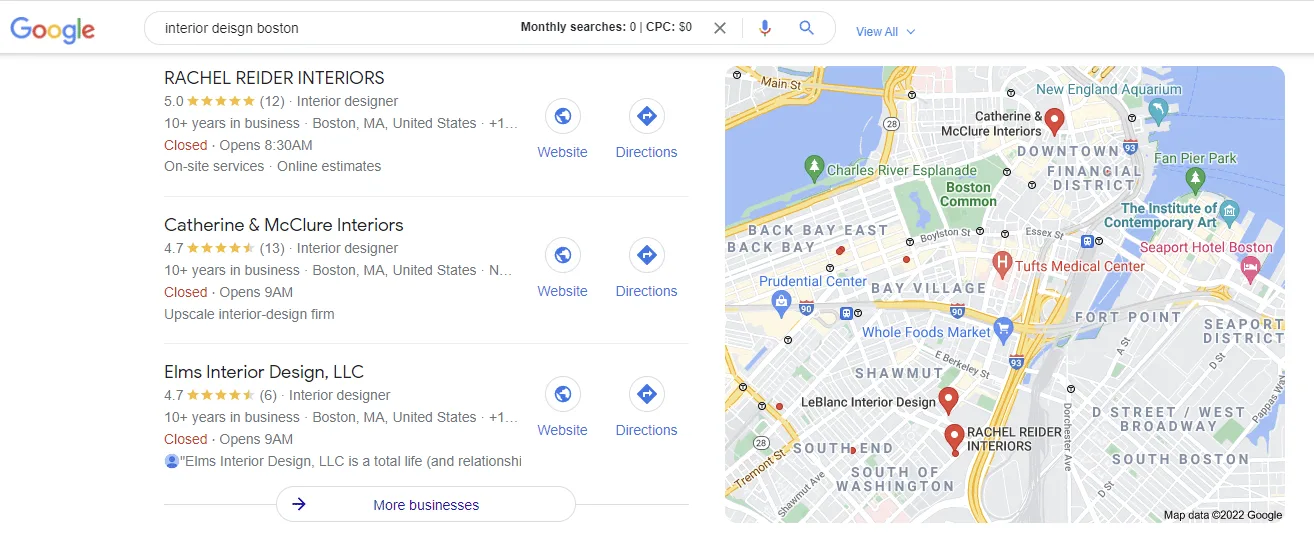
Google states plainly that local ranking comes down to three factors: relevance, distance, and prominence. Relevance is how well your profile matches the search, distance is how close you are to the searcher, and prominence is how established you look, including reviews and links. Google also says you cannot pay for better local ranking, which is exactly why this surface is worth owning.
For a design studio specifically:
- Pick "Interior designer" as your primary category. Not "Consultant", not "Design agency". Add secondary categories only if they match real services, like kitchen remodeling if you genuinely run renovations.
- Work-from-home and by-appointment studios still qualify. If clients do not visit your address, set the profile up as a service-area business and hide the street address. You can still rank in the areas you serve.
- Treat photos as a ranking asset. This is a visual category and profiles compete on their photo grids. Upload real project photography, not stock, and keep adding as projects complete. Your portfolio is an advantage a plumber can never match; use it.
- One profile per real studio. If you genuinely operate offices in multiple cities, each gets its own profile, which is exactly how the multi-state client in our case study was set up. What gets businesses suspended is inventing locations with coworking addresses to fake proximity.
- Complete every field. Services, description, hours, booking link. Thin profiles lose to complete ones constantly.
Local SEO is a checklist discipline more than a creative one, which is why we maintain a free, interactive local SEO checklist covering all 38 steps, from profile setup through citations, reviews, and local links. Every step applies to a design studio. Work through it before you spend a dollar anywhere else.
Location and Service Pages: The Architecture That Ranks
The organic side of local rankings comes down to one dedicated page per service per city you genuinely serve. Not a homepage stuffed with every city name, and not a single "Services" page listing everything. When someone searches "interior designer bozeman", Google wants to rank a page about interior design in Bozeman, and these pages, not blog posts, are what book consultations.
The structure looks like this:
- yourstudio.com/interior-designer-park-city/
- yourstudio.com/interior-designer-bozeman/
- yourstudio.com/kitchen-design-park-city/ (only if kitchens are a real service line)
Building out exactly this kind of location page architecture was the core of the strategy in our case study, and it is what carried the #1 rankings in four different cities. What goes on each page, top to bottom:
- A headline naming the service and city, then a direct opening: who you design for, the styles and project types you take, and why you over the next firm.
- Projects from that market. Two or three completed projects in or near that city, with photos and short write-ups. This is the local proof a swapped-city template cannot fake.
- Local specifics. Mountain homes and ski properties read differently from brownstones and coastal builds. Write about the architecture, property types, and trades you actually work with in that market.
- Process and fees. What an engagement looks like, phase by phase, and how you charge: flat fee, hourly, percentage of budget. Designers hide this and it costs them; fee questions are among the most-searched pre-hire queries in the category.
- One clear call to action. A consultation booking link, not six competing buttons.
One warning: generating dozens of near-identical city pages with the location name swapped is doorway-page spam in Google's eyes, and it reads as desperate to humans too. If you cannot show work in a market or say something true about serving it, you do not need a page for it yet. Four strong pages beat forty thin ones, in rankings and in what they say about your studio.
The Portfolio Problem: SEO for Image-Heavy Websites
Here is the uncomfortable truth about most designer websites: your portfolio is your best asset offline and your biggest liability online. Search engines rank text, and the typical portfolio site is a set of gorgeous, wordless galleries with file names like IMG_4021.jpg, wrapped in a slow theme. Fixing this is the highest-leverage technical work in interior design SEO, and it has three parts.
Give every project a page with real words
A project page that ranks is not twelve photos and a one-line caption. It is a titled, written piece: "Mountain Modern Great Room in Big Sky", with 300 to 600 words covering the brief, the constraints, the decisions, and the materials. That text is what lets the page rank for style and room searches, it is what AI assistants can quote, and clients genuinely read it. You made a hundred decisions on that project; writing down eight of them is not a chore, it is marketing you already paid for.
Do image SEO properly
Google Images is a real discovery channel in this category, and Google publishes exactly how it wants images handled: descriptive file names, alt text that actually describes the image, and images placed near relevant text. In practice:
- File names that describe the room: park-city-mountain-modern-kitchen.webp, not final_v3_edit.jpg.
- Alt text that says what is in the frame: the room, the style, the notable materials. Honest description, not keyword stuffing. It also makes your site accessible, which you should want anyway.
- Images next to the words about them. A photo inside a written project page carries context a naked gallery image never gets.
Make the site fast anyway
Image-heavy sites fail Core Web Vitals by default, because nobody resized the 8 MB hero export. The fix list is short and boring: compress and resize every image, serve modern formats like WebP or AVIF, lazy-load everything below the fold, and put static assets on a CDN. This exact work, compression, lazy loading, and a CDN, was step one of our case study engagement, because none of the content strategy matters if the site takes eight seconds to paint.
Keyword Strategy for Interior Designers
Interior design keywords fall into three buckets, and you should build for them in this order: service-times-city keywords that book consultations, style-and-room keywords that get your portfolio discovered, and question keywords that build trust before the inquiry.
- Service x city (the money keywords). "Interior designer park city", "interior design firm bozeman", "salt lake city interior design". Volumes look small next to national terms, and that fools people: each of these searches is a homeowner with a live project, and a #1 ranking converts a meaningful share of them for years. The keyword list in our case study was built almost entirely from this bucket.
- Style x room (the portfolio keywords). "Mountain modern interior design", "japandi living room", "small kitchen remodel ideas". Searchers here are earlier in the journey, but these are the queries your written project pages and galleries can rank for, and they are how people who have never heard of you end up saving your work.
- Questions (the trust keywords). "How much does an interior designer cost", "interior designer vs decorator", "is hiring an interior designer worth it". Lower urgency, enormous influence: the studio that answers these honestly is the one remembered when the answer becomes yes.
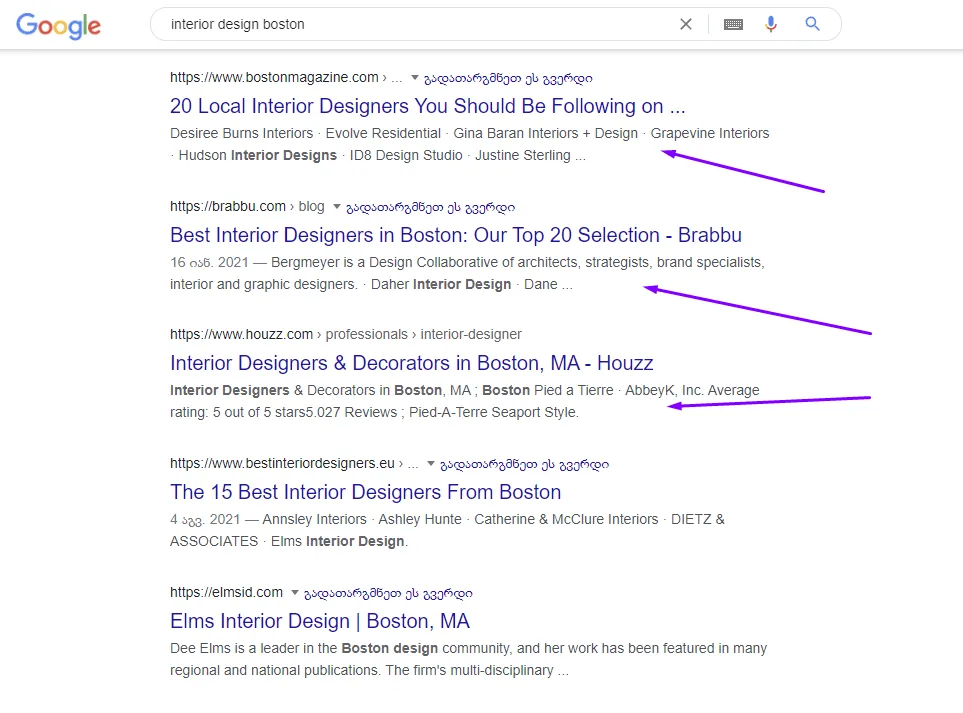
Look at what actually ranks for these terms before writing anything. For "interior design [city]" the first page is usually a mix of magazine listicles, the Houzz directory, and one or two firms. You beat that mix three ways: win the local pack above it, rank your own location page within it, and get your studio named inside the listicles that already rank. That last one is link building, covered below.
Content That Wins: Project Stories, Before and After, Cost Guides
The content that wins interior design SEO answers the questions people ask in the weeks before they contact a designer, using the projects you have already finished as the raw material. You do not need a content team; you need to stop treating finished projects as ten photos and a caption.
- Project case studies. The written project pages from the portfolio section double as your content engine. The brief, the budget band, the problem in the floor plan, the decision that solved it. One honest project story does more convincing than any amount of "we blend timeless elegance with modern sensibility" copy.
- Before and after. The single most persuasive format in the category, and most studios throw it away by never shooting the before. Institutionalize it: every project gets before photos on day one. A before-and-after page targets renovation and remodel queries and holds attention like nothing else you can publish.
- Cost guides. "How much does an interior designer cost in [city]" gets searched in every market, and almost every designer refuses to answer it, hoping to explain pricing on a call. The studio that publishes real ranges and explains what drives them wins the click, the trust, and usually the consultation. Prospects who cannot afford you filter themselves out, which is also a win.
- Process explainers. "What does a full-service interior designer actually do", "e-design vs full service", "how to prepare for a design consultation". First-time clients are nervous about scope and cost; the site that removes uncertainty gets the call.
One structural rule across all of it: put the direct answer in the first paragraph under each heading, then elaborate. It is better for readers, it wins featured snippets, and it is what AI engines quote.
Reviews, Houzz, and Directories
The priority order is: Google reviews first, Houzz second, general directories third. Reviews feed the prominence part of local ranking and are the first thing a prospect reads; directories exist to confirm you are real and to catch searches your own site cannot.
On reviews, the studios with 60 reviews are not more loved than you; they ask systematically. Design has natural high-emotion moments built into the process, so use them: ask on reveal day, and ask again when you deliver the professional photos, with the direct review link in the same message. The principal designer should make the ask personally. Never pay for or filter reviews, and respond to every one, including the rare bad one, like a professional being watched by future clients, because you are.
On Houzz: we checked, and in 2026 it is still an active, review-driven directory of interior design professionals, with verified-hire badges and thousands of firm profiles, and its directory pages still rank for many "interior designers in [city]" searches. That earns it a real place in the plan: a complete profile with your best projects and a steady flow of client reviews gets you a citation, a link, and visibility inside a result you cannot outrank with your own site. What it does not earn is the center of your strategy. Houzz is rented land; your website is the asset you own, and it is what Google and AI assistants cite directly.
Beyond Houzz, cover the basics: Google, Apple Maps, Bing Places, Yelp, and any legitimate local business directories in your market. Then enforce consistency. Your studio name, address, and phone number should be identical everywhere; search engines and AI models cross-reference these listings, and contradictions quietly erode trust in every system that decides whether to show you.
Link Building for Interior Design Firms
Design firms have an easier link building path than almost any local business, because you produce something the press actually wants: finished interiors. Most studios never use this advantage. The links that matter come from four places:
- Project PR. Regional magazines, city publications, and shelter media run home features constantly and need a pipeline of photogenic projects. Pitch completed projects with professional photography and the story behind them. One published feature is a strong editorial link plus the kind of brand mention AI assistants notice.
- The listicles that already rank. Search "best interior designers in [your city]" and note who publishes the results. Those pages sit on the first page for the exact term you want, and most of their authors update annually. Getting included is often one polite, well-evidenced pitch.
- Trade and supplier relationships. Builders, architects, cabinet makers, and showrooms you work with all have websites with project galleries and partner pages. Mutual credits on shared projects are natural, relevant links both sides deserve.
- Community and industry presence. Showhouses, design weeks, local sponsorships, association memberships, and awards. Individually modest; collectively they look like what they are, a real firm embedded in a real design community.
What to skip: bought guest posts, "300 links for $99", and directory networks that exist only to sell listings. A dozen real links from press, partners, and platforms like Houzz will outperform hundreds of junk links, without the risk.
The AI Layer: When Clients Ask ChatGPT for a Designer
Homeowners now ask ChatGPT, Perplexity, and Google's AI Mode things like "who is the best interior designer in Park City" and "how much should I budget for a designer for a 3,000 square foot house", and the assistants answer with specific firm names. The firms that get named are overwhelmingly the ones that did everything above properly, because AI answers are assembled from sources the engines can crawl and trust: your website, your Google Business Profile, Houzz, press coverage, and reviews.
So the foundation is the same, and on top of it four things decide whether you are the cited answer:
- Be parseable. Direct answers under clear headings, real text on project pages, FAQ blocks, structured data. An assistant quoting one paragraph quotes the page that answered the question in one paragraph. This is the discipline in our generative engine optimization guide, applied to a design studio.
- Keep your facts consistent. Same studio name, cities served, and services on your site, GBP, Houzz, and press mentions. Models cross-reference before naming you, and contradictions make you a risky answer.
- Do not block the crawlers. GPTBot, PerplexityBot, and ClaudeBot cannot cite what they cannot read, and portfolio-site templates block them by accident more often than you would think.
- Measure it. Run the queries a client in your city would ask and see who gets named. Our free AI visibility checker gives you that baseline in about a minute.
This channel is early, which is the argument for moving now: in most design markets, no studio owns the AI answers yet.
Timelines, Measurement, and Whether to Hire Help
Realistic expectations: local pack visibility usually moves first, often within 2 to 4 months of completing your profile, citations, and review flow. Competitive organic rankings for "interior designer [city]" typically take 6 to 12 months, faster in smaller markets and resort towns than in major metros. For calibration, the strategy in our case study rolled out over nine months, and its page reports year one closed with 210+ leads and #1 rankings in multiple cities. Anyone promising first-page rankings in 30 days is describing either a keyword nobody searches or a method you will regret.
Measure inquiries, not traffic. Track consultation requests, form fills, and calls by page, alongside local pack positions, Google Search Console impressions and clicks, review velocity, and your AI visibility baseline. A page that ranks #3 but books two consultations a month beats a #1 that books none, and traffic that never becomes a project inquiry is a vanity metric.
On doing it yourself: a principal designer with a few hours a week can absolutely run the local layer, the Google Business Profile, reviews, a Houzz profile, and a handful of strong location pages, and in smaller markets that alone beats most competitors. What is hard to do solo is sustained content production, digital PR, and technical work, which is where studios in contested markets bring in specialists. If you hire, vet ruthlessly: our guide to choosing an organic SEO consultant walks through exactly what to ask, and our own pricing is public, which is the standard we think every provider should meet.
Interior Design SEO FAQ
How long does interior design SEO take to work?
Local pack visibility often improves within 2 to 4 months of fixing your Google Business Profile, citations, and reviews. Competitive organic rankings for "interior designer [city]" terms typically take 6 to 12 months, with smaller markets and resort towns moving faster than major metros. Guarantees of first-page rankings in 30 days are a red flag, full stop.
Is Houzz still worth it for interior designers in 2026?
Yes, as a supporting channel. Houzz still runs an active directory of design professionals with verified hires and client reviews, and its pages still rank for many local designer searches, so a complete profile earns you a citation, a review surface, and borrowed visibility. It is not a substitute for your own website, which is the asset you control and the one search engines and AI assistants cite directly.
How much does interior design SEO cost?
Market-typical retainers run roughly $1,000 to $2,500 per month for a single-market studio and $2,500 to $6,000 or more for firms competing across multiple cities or in an expensive metro. Judge it against project economics: when an average engagement is worth five or six figures, a few qualified inquiries a month covers the budget many times over. Prices in the low hundreds per month buy automated reports and junk links, not work.
Does AI search matter for interior designers?
Yes. Clients ask ChatGPT, Perplexity, and Google's AI Mode for designer recommendations today, and the assistants name specific firms based on what they can crawl and trust: your site, profiles, directories, press, and reviews. Classic SEO builds that foundation; the extra work is parseable pages, consistent facts, open AI crawler access, and actually checking whether you get named.