

Growth marketing is the practice of growing a company by running structured experiments across the entire customer journey, from first visit to referral, instead of just pouring more people into the top of the funnel. That's the definition. The practice, done honestly, is less glamorous than the conference talks: it's a backlog, a scoring model, a weekly cadence, and a lot of tests that lose.
This guide is the version of growth marketing we'd want to read before building a growth function in 2026. No "10x hacks", no screenshots of someone else's hockey stick. Here's the map:
- What growth marketing is, versus traditional marketing and growth hacking
- The full-funnel model: AARRR, modernized for 2026
- The experimentation engine, step by step, including the traffic math nobody mentions
- Channel strategy: compounding channels versus rented ones, plus the AI layer
- Team and tooling at each stage, and how to measure any of it
- A short FAQ
What Is Growth Marketing (and What It Isn't)?
Growth marketing is a system for improving every stage of the customer journey through measured experiments. It differs from traditional marketing in scope (the full funnel, not just awareness and leads) and in method (continuous testing, not campaign calendars). It's a discipline, not a job title, and most of it is unglamorous iteration.
The cleanest way to define it is against its two neighbors, because the three get blended together constantly:
| Traditional marketing | Growth marketing | Growth hacking | |
|---|---|---|---|
| Scope | Awareness and acquisition | The full funnel, through retention and referral | Wherever the next outsized win might be |
| Method | Planned campaigns, quarterly cycles | Continuous experiments, weekly cycles | One-off tactics and loopholes |
| Success looks like | Reach, leads, brand lift | A compounding metric moving quarter over quarter | A spike, occasionally a durable loop |
| Fails when | Nobody checks what the leads did next | Traffic is too thin for the tests being run | The "hack" was really product-market fit |
Traditional marketing isn't the villain here. Brand campaigns, PR, and events do work that experiments can't, and mature companies need both. The honest criticism is narrower: a team that measures itself on leads has no reason to care whether those leads activate, stick around, or ever pay. Growth marketing exists to own that whole chain.
Growth hacking deserves the most honesty. The term described something real: scrappy, engineering-led acquisition wins from companies that couldn't afford ads. But most famous "hacks" worked because they amplified products people already loved, and the label has since been stapled onto everything from referral programs to spam. The tactics are worth studying, and we've broken down eleven real ones in our growth hacking examples post. Just don't build a strategy out of them. A hack is a lottery ticket; growth marketing is the paycheck.
The Full-Funnel Model: AARRR, Modernized
Growth marketing operates on five funnel stages: acquisition, activation, retention, referral, and revenue. The framework is nearly two decades old, and it still works, with one modernization: retention is the center of the model now, not step three of five. Everything else in this article assumes you're working these five stages deliberately.
Here's each stage, with the question it answers and a concrete example of an experiment that belongs there:
Acquisition: how do strangers find you?
Acquisition covers every channel that puts your product in front of new people: search, ads, social, partnerships, AI assistants. The classic acquisition experiment is bottom-funnel content: a B2B software company ships comparison and alternatives pages for every competitor its buyers evaluate, because those searchers are days from a decision, then measures signups per page rather than traffic. The mistake at this stage is treating volume as the goal; 40,000 readers who bounce are worth less than 400 who match your buyer.
Activation: do new users reach the value?
Activation is the moment a new user first experiences what they came for, and it's usually the highest-leverage stage in the whole funnel because everything downstream depends on it. Define it precisely. A project management tool might define activation as "created a project and invited two teammates within seven days", then experiment on everything between signup and that moment: fewer onboarding fields, a pre-filled sample project, a checklist, a well-timed nudge. Improving signup-to-activation from 30% to 40% lifts every cohort you ever acquire, from every channel, forever.
Retention: do they come back?
Retention is whether users return and keep getting value, and it's the stage that decides if growth compounds or leaks. The economics are lopsided: research by Bain's Frederick Reichheld, published in Harvard Business Review, found that increasing customer retention rates by 5% increases profits by 25% to 95%. A concrete retention experiment: an e-commerce brand analyzes reorder timing, finds most repeat purchases happen around day 40, and tests a replenishment email at day 35 against the generic monthly newsletter. Acquisition poured into a product with poor retention is the leaky-bucket problem, and no channel fixes it.
Referral: do users bring users?
Referral turns your retained users into an acquisition channel. The standard experiment is a double-sided incentive (both the referrer and the invitee get something) tested against a single-sided one, measured on invites sent and invites converted. The honest caveat: referral programs amplify love, they don't create it. If your product's net promoter energy is lukewarm, an incentive produces coupon hunters, not customers. Fix retention first; referral experiments come after users demonstrably stick.
Revenue: does usage turn into money?
Revenue experiments optimize how value converts to cash: pricing page structure, trial length, plan boundaries, annual-versus-monthly framing, expansion prompts when an account hits a plan limit. Example: a SaaS with a 14-day trial tests a "book a teardown call" offer to trials that activated but didn't convert, measured on paid conversion, not calls booked. Teams underinvest here because pricing feels sacred; it's usually the fastest revenue lever in the whole stack.
Why the modernization matters: the original AARRR ordering reads like a pipeline, so teams work it left to right and spend 80% of their energy on acquisition, the most visible and most expensive stage. In practice the order of leverage is usually activation and retention first, then revenue, then acquisition, then referral. Fill the bucket's holes before paying for more water.
The Experimentation Engine, Step by Step
The engine that powers all of this is a loop: build a hypothesis backlog, score it, run the top experiment, analyze honestly, roll out or kill, document, repeat weekly. Any team of any size can run this loop. Here's each step, including the traffic math most guides skip:
- Build a hypothesis backlog. Every idea enters in one format: "Because we observed [evidence], we believe [change] will improve [metric] by roughly [amount]." The evidence half is what separates a backlog from a wishlist. Sources: funnel drop-off reports, session recordings, support tickets, sales call notes, churn interviews, competitor teardowns. Ten well-evidenced hypotheses beat a hundred brainstormed ones.
- Score with ICE. Rate each hypothesis 1 to 10 on Impact (how much the metric moves if it works), Confidence (how strong the evidence is), and Ease (how cheap it is to test), then average and sort. ICE is not science; two people will score the same idea differently, and that's fine. Its job is to kill pet projects and force the "why do you believe this" conversation before anything ships.
- Define the test before you launch it. Write down the success metric, the minimum improvement you'd act on, and the run time, in advance. A test defined after the results are in always "wins". Change one meaningful variable when traffic allows; when it doesn't, test bold redesigns rather than button colors, because small changes are undetectable at small scale (see step 4).
- Respect the traffic math. This is the honesty most growth content skips: A/B testing has a minimum scale, and most companies aren't at it. Detecting a 20% relative lift on a 3% conversion rate at standard significance thresholds needs roughly 13,000 visitors per variant; run your own numbers through Evan Miller's sample size calculator before trusting any result. If a page gets 2,000 visits a month, that test needs over a year, which means the answer is: don't A/B test it. Make bigger, more opinionated changes, compare before and after periods while watching a guardrail metric, and lean on qualitative signal (five user recordings will tell you more than an underpowered test ever will). An underpowered A/B test isn't rigor, it's a random number generator with a dashboard.
- Analyze and decide: roll, iterate, or kill. Let the test run its predefined course; checking daily and stopping the moment it "hits significance" is how teams ship noise. Then make one of three calls: roll it out, iterate on the idea with a sharper variant, or kill it and move on. Expect most experiments to lose or come back flat. That's not failure, that's the base rate, and a team that never reports losing tests is reporting fiction.
- Document everything in an experiment log. One row per test: hypothesis, screenshots, dates, result, decision. This log is the actual asset the engine produces. It stops the team from re-running last year's failed idea, it onboards every future hire, and after a year it's a proprietary map of what your specific audience responds to. A spreadsheet is enough.
Cadence holds it together: a single weekly growth meeting where the team reviews live experiments, closes finished ones with a decision, and launches the next ones from the top of the backlog. Two to four experiments in flight is plenty for most teams. Velocity matters more than any individual result, because the wins are unpredictable but the learning is cumulative.
Channel Strategy: Compounding Channels vs Rented Ones
Every acquisition channel is one of two kinds: compounding channels, where the work builds an asset that keeps producing after you stop paying for it, and rented channels, where results stop the day the spend does. A sane 2026 strategy uses rented channels for speed and learning, and compounding channels for the long-term cost curve. Confusing the two is how companies end up addicted to an ad platform that raises rents every year.
Compounding channels: SEO and content, an owned email list, community, and product-led loops like free tools and templates. Rented channels: paid search, paid social, and, more subtly, social media reach, since the algorithm owns your distribution even though the posting is free.
Rented channels are not the enemy. Paid ads are the fastest way to test messaging, validate that a keyword converts, and buy pipeline while slower assets mature. The failure mode is treating them as the strategy instead of the bridge, because rented reach gets more expensive as competition grows, while compounding assets get cheaper per visitor every quarter.
Where SEO and content fit: for most B2B and SaaS companies, organic search is the strongest compounding channel available, because the buyer arrives mid-question with intent you can map page by page. It's also slow, and anyone who says otherwise is selling something: Google's own guidance is four months to a year before you see benefit. The full playbooks are their own articles; we've written the B2B marketing guide for the strategy layer and the SaaS SEO guide for the channel itself.
The 2026 AI layer
AI search visibility is now a real acquisition channel, not a curiosity. ChatGPT passed 900 million weekly active users in early 2026, and on Google itself, Ahrefs measured a 34.5% lower clickthrough rate on the top organic result when an AI Overview sits above it. The shortlist conversation that used to happen across ten blue links increasingly happens inside one generated answer, and the brands named in that answer win by default.
Treat it like any other channel in the engine: baseline where you stand by asking ChatGPT, Perplexity, and Google's AI Mode the questions your buyers ask, then run experiments on the inputs (machine-quotable pages, presence on the review sites and roundups the engines read, consistent facts about your product everywhere it's described). The full discipline is called GEO, and our generative engine optimization guide covers it end to end.
And the honest version of "AI in the growth stack": in 2026, AI is genuinely good at the production layer of growth work. It drafts ad and landing page variants in minutes, summarizes a thousand support tickets into themes, writes the analysis query you couldn't, and prototypes a test page before lunch. What it cannot do is choose your strategy or generate a differentiated position; point it at your funnel without judgment and you'll ship the same generic experiments as everyone else, faster. AI collapsed the cost of running experiments. That makes the scarce skill deciding which experiments deserve to exist, which is the one part of this article no tool does for you.
Team and Tooling: What a Growth Function Needs at Each Stage
Match the investment to the stage: before product-market fit you need no growth hires, after it you need one strong generalist, and only at scale do you need a dedicated pod. Hiring ahead of that curve is one of the most common and expensive growth mistakes we see.
Stage 1: pre product-market fit. Growth is the founder's job. The work is talking to users and finding a repeatable reason people stay; a growth hire at this stage optimizes a funnel that's about to change shape entirely. Tooling: a basic analytics setup and a spreadsheet.
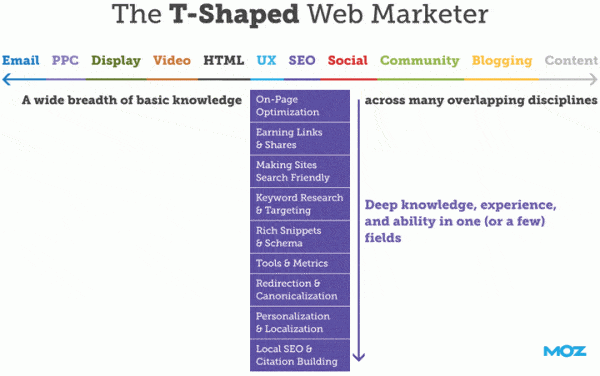
Stage 2: post product-market fit. This is the moment for your first growth hire: a T-shaped generalist who has broad competence across channels, depth in one or two, and enough analytical skill to run the experiment engine solo. One good generalist plus a weekly cadence outperforms a premature team every time. What that person looks like and how to interview for them is its own topic; our growth manager guide covers the role, the skills, and the hiring process in detail.
Stage 3: scale. When experiments are regularly blocked waiting on engineering or design, embed the capability: a growth lead, an engineer, a designer, and an analyst, working as a pod with its own backlog. Marketing doesn't disappear; brand, content, and comms keep running alongside. The pod exists so a test that needs code ships in days, not quarters.
Tooling, honestly, in order of need: an analytics foundation (GA4 plus a product analytics tool like Amplitude, Mixpanel, or PostHog), a lifecycle email tool, session recordings, and an A/B testing tool only once your traffic clears the math from step 4 above. Later, a data warehouse when the tools stop agreeing with each other. The pattern to avoid is tool sprawl: a growth stack you don't use is a subscription line item, and a disciplined spreadsheet beats an ignored platform every single week.
Measurement: North-Star Metrics and Cohort Thinking
Measure a growth program with one north-star metric, a handful of input metrics per funnel stage, and cohort analysis. Not a dashboard of forty KPIs, which is just a place where accountability goes to hide.
The north-star metric is the single number that best captures value delivered to customers: weekly active teams for a collaboration tool, completed orders for a marketplace, nights booked for a travel product. The test for a good one: if this number grows, the business must genuinely be healthier. Revenue usually fails that test as a north star because it lags, and vanity metrics like signups fail it because they can grow while the product dies. Each AARRR stage then gets one or two input metrics the team can actually move, and every experiment names which input it's aimed at.
Cohort thinking is the second habit, and it's what separates teams that understand their growth from teams that stare at averages. Group users by their start month and track each group's retention over time. Averages lie: a "stable" monthly active user count can hide new signups replacing churned ones at a dead-even rate, which is a treadmill, not growth. The retention curve tells the truth. If each cohort's curve flattens out at some healthy level, you have product-market fit and acquisition spend builds on rock. If every curve slides toward zero, stop buying traffic and fix retention, because you're renting your user base month to month.
Definitions matter here: CAC, LTV, churn, expansion revenue, and payback period all have precise meanings and popular wrong versions. We've written up the 13 SaaS metrics that matter, with formulas, so we won't repeat them; if your team debates what "churn" means, start there.
Growth Marketing FAQ
Short answers to the questions that come up most.
What is growth marketing?
Growth marketing is the practice of growing a company by running structured experiments across the entire customer journey: acquisition, activation, retention, referral, and revenue. Where traditional marketing plans campaigns to fill the top of the funnel, growth marketing treats every stage as something you can measure, test, and improve.
What is the difference between growth marketing and growth hacking?
Growth marketing is the ongoing system: a backlog of hypotheses, a prioritization model, and a weekly testing cadence across the full funnel. Growth hacking is the hunt for individual outsized wins, usually clever acquisition tactics. Hacks can be real, but most famous ones amplified products people already loved. The system is what you can actually operate; see our growth hacking examples for the tactics side.
Do I need a growth team to do growth marketing?
No. Before product-market fit, growth is the founder's job and a hire is premature. After product-market fit, one T-shaped growth manager running a weekly experiment cadence is enough for most companies. A dedicated pod with an engineer, designer, and analyst only makes sense once experiments are regularly blocked by other teams' roadmaps.
How long does growth marketing take to show results?
Individual experiments on conversion, activation, or lifecycle email can show results in weeks. Compounding channels are slower: Google's own guidance says SEO needs four months to a year, and referral loops need a retained user base before they produce much. A realistic expectation is a working experiment cadence in one quarter and visible compounding in two to four.
The Short Version
Growth marketing in 2026 is a system, not a bag of tricks: five funnel stages worked in order of leverage (activation and retention before more acquisition), an experiment engine with a weekly cadence and honest math, channels split deliberately between rented speed and compounding assets, and measurement built on one north star and cohort curves. AI now sits on both sides of it, as a new acquisition surface worth optimizing for and as a production tool that makes judgment the scarce input.
None of it is fast, and most individual experiments will lose. Run the loop anyway. The teams that win aren't the ones with the cleverest hack; they're the ones still shipping tests in month nine, with a log of everything they've learned and a couple of compounding channels quietly getting cheaper behind them.