

Most SEO content fails at the writing stage, not the strategy stage. The keyword research was fine. The brief was fine. Then the draft came back as 2,000 words of confident filler, and the page it became now sits on page four, converting nobody.
The person who writes your content is the highest-leverage hire in your entire SEO program, and also the easiest one to get wrong, because almost anyone can call themselves an SEO content writer and most of the market is mediocre. We've worked with well over a hundred freelance writers across our own blog and client projects, and published 4,500+ articles across 30+ industries, so we've seen the full quality spectrum up close.
This guide covers the whole decision, in order:
- What an SEO content writer actually does (and how the role differs from a copywriter)
- The five skills that separate good writers from the rest
- A step-by-step hiring process built around a paid test brief
- What writers cost in 2026, freelance and in-house, with sourced numbers
- How AI changed the job, honestly
- How to manage writers so quality goes up instead of drifting down
What Does an SEO Content Writer Actually Do?
An SEO content writer researches and writes long-form pages built to rank for a specific search query and fully answer the intent behind it. The job is equal parts research, structure, and prose: understand what the searcher is trying to do, gather accurate information, and organize it so both a skimming human and a parsing machine can extract the answer fast.
In a typical engagement, the deliverables look like this:
- Articles written from briefs. The strategist picks the target query and hands over a brief; the writer turns it into a publishable draft that matches the intent and the outline.
- On-page elements. Title tag, meta description, heading structure, image alt text. Good writers deliver these with the draft, not as an afterthought.
- Internal link suggestions. The writer flags where the new piece should link to existing pages and where existing pages should link back.
- Refreshes. Updating decaying articles is now a permanent share of the job, often a third or more of a mature program's output.
Two roles get confused with this one, and the confusion produces bad hires. A copywriter writes conversion assets: landing pages, ads, emails, sales pages. That craft is persuasion in few words, and it transfers poorly to 2,500-word informational content, in both directions. A generalist blogger writes what's interesting rather than what's searched; the prose can be lovely and the traffic will still be zero, because nobody queried the topic.
Equally important is what an SEO content writer does not do: keyword strategy, technical SEO, or link building. If you need someone to decide what to write and why, you need a strategist first, and we've written a separate guide on how to hire an SEO expert for exactly that. Hiring a writer without a strategy just produces well-written pages about the wrong topics.
What Good Looks Like: The 5 Skills That Separate the Top 10%
The writers who produce content that ranks share five specific skills: research depth, search-intent reading, structural discipline, on-page fundamentals, and honest AI-tool use. Fluent prose is table stakes; these five are what you actually screen for.
1. Research depth
Ask a great writer where any claim in their draft came from and they can tell you: a primary source, a named study, a subject-matter expert they messaged, their own testing. Weak writers research by reading the top three ranking articles and paraphrasing them, which is how the entire first page of Google ends up saying the same thing. Content that only restates what already ranks gives Google, and now AI engines, no reason to surface it.
2. Search-intent reading
Before writing a word, a good writer looks at what currently ranks for the target query and asks what the searcher is actually trying to do. Is the intent to learn, to compare, to buy? Does the SERP reward a how-to, a listicle, a tool page? A writer who drafts a 3,000-word essay for a query where every ranking page is a quick checklist has already failed, regardless of prose quality.
3. Structural discipline
Rankable content answers the question directly under each heading, then elaborates. It front-loads conclusions, uses descriptive H2s and H3s, breaks walls of text with lists and tables, and can be skimmed in 30 seconds without losing the argument. This matters double in 2026 because AI assistants quote pages that are structured for extraction; buried answers don't get cited.
4. On-page fundamentals
Not technical SEO, just the basics that live inside a document: a title tag that earns the click, headers that map to subtopics, natural keyword usage, sensible internal links. You want a writer who does this by reflex and never keyword-stuffs, because stuffing hasn't worked in a decade and still shows up in samples constantly.
5. Honest AI-tool use
In 2026 the question isn't whether a writer uses AI; nearly all of them do. The question is whether they use it honestly. The good ones use models for outlining, first-pass drafting, and rewriting, then verify every fact, add original information, and tell you exactly how they work. The bad ones paste your brief into a chatbot, invoice you, and let you discover the hallucinated statistics after publication. Screen for disclosure, not abstinence.
One more trade-off worth knowing before you write the job post: for technical niches, it's usually faster to teach a subject-matter expert how to structure SEO content than to teach a generalist writer your subject. A developer who writes decently will beat a polished generalist on developer-tools content almost every time, because readers and ranking systems both reward demonstrated expertise.
How to Hire an SEO Content Writer, Step by Step
The process that works is: write a job post that filters for you, source from three or four channels at once, cut hard on samples and rates, then decide with a short paid test brief scored against a rubric. Expect 100 to 300 applicants from a public posting and expect two or three to be worth testing. That ratio is normal, not a sign you did anything wrong.
Step 1: Write a job post that does the filtering
State your niche, the content type (long-form, brief-driven articles), expected monthly volume, and a rate range. Vague posts attract everyone, and "everyone" is exactly the pile you're trying to avoid. Collect applications through a form: name, portfolio link, per-word rate, three samples, and one short question that requires actually reading the post ("which of our articles would you have written differently, and why?"). The question alone filters out the mass-appliers.
We hire for this role ourselves; our SEO content writer listing shows exactly what we screen for, down to the requirements list.
Step 2: Source from multiple channels at once
No single job board has the good writers, so post in several places and work referrals in parallel:
- ProBlogger's job board, still the highest signal-to-noise for content roles
- Upwork, huge volume, so your filters have to do the work
- r/HireaWriter and niche communities where writers in your space hang out
- LinkedIn, best for finding writers already publishing in your niche rather than waiting for applicants
The strongest channel is none of these: it's bylines. Find articles in your niche that you genuinely rate, check who wrote them, and email those people directly. A writer you found through their published work is pre-vetted in a way no application ever is.
Step 3: Cut fast on samples and rates
Filter the pile with four cuts, in order. Cut anyone with no long-form samples; short listicles don't predict the ability to hold an argument for 2,500 words. Cut anyone with no samples in or near your niche. Cut the extreme low end on rates; in our experience anyone charging 1 to 3 cents per word either needs heavy hand-holding or produces drafts that cost more to fix than to replace. And cut samples with the tells of unedited AI output: hedge-everything paragraphs, invented-sounding statistics with no sources, and that unmistakable smooth emptiness where every sentence is grammatical and none of them says anything.
Step 4: Run a paid test brief
This is the step most people skip, and it's the only one that actually predicts performance. Portfolio samples show you the best editing a writer has ever received. A test shows you what they produce for your topics, on your deadline, from your brief.
Give every finalist the same brief, capped at about 1,000 words of output so you're not burning anyone's week. A usable test brief contains:
- Target query and intent. The exact search you want to win and what the searcher is trying to accomplish.
- The reader. Who they are, what they already know, what decision they're trying to make.
- The angle. The one argument this piece makes that the current top results don't.
- An outline. H2s and H3s with a line of direction under each, so scope disputes can't happen after the fact.
- Direct-answer requirement. Every H2 opens by answering its own heading.
- Sources. What to cite, what to avoid, and a no-unsourced-statistics rule.
- Internal links and word range. What "done" means, precisely.
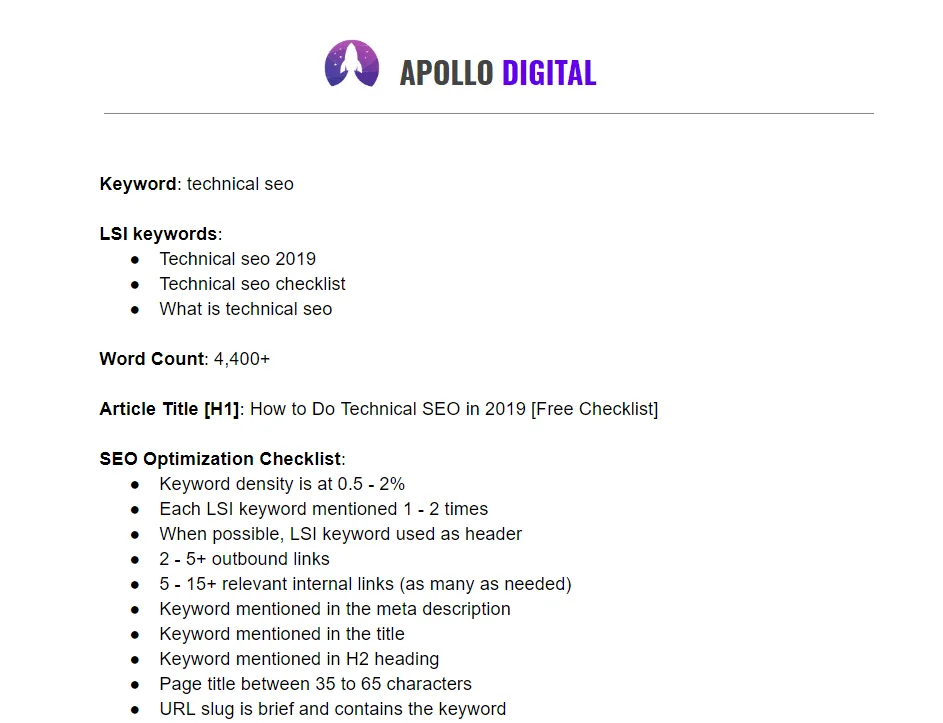
If building briefs from scratch sounds like a chore, our free content brief generator produces one in about a minute, and our guide to writing content outlines covers the manual method. Pay for the test at the writer's normal rate regardless of outcome. It's a rounding error next to the cost of a bad hire, and serious writers rightly decline unpaid "tests" that look like free labor.
Step 5: Score the test like an editor, not a fan
Read the drafts against a rubric, not against a vibe:
| Criterion | Weight | What you're checking |
|---|---|---|
| Research and accuracy | 30% | Are claims true, sourced, and specific? Spot-check three facts. |
| Intent and brief match | 25% | Does it answer the query and follow the outline without drifting? |
| Structure | 20% | Direct answers up top, skimmable, no filler paragraphs. |
| Edit effort | 15% | How many changes per 100 words before you'd publish this? |
| On-page basics | 10% | Title, headers, internal links handled without being asked. |
Two soft signals matter as much as the rubric. Did the writer ask a clarifying question before starting? Good ones almost always do. And did they push back anywhere the brief was wrong? A writer who spots a flaw in your outline and says so is showing you the judgment you're actually paying for.
Red flags that end the conversation regardless of score: guaranteeing rankings, refusing a paid test while pointing at samples, portfolios where every piece reads identical, being unable to explain where a claim came from, or delivering obvious raw model output as finished work.
What SEO Content Writers Cost in 2026
For freelance work, plan on 10 to 30 cents per word for a capable writer, more for genuine specialists; for staff roles, plan on roughly $60,000 to $90,000 for a dedicated writer in the US market, more once the role includes strategy. Anyone quoting far below those ranges is usually selling you an editing bill in disguise.
The best public benchmark for professional freelance rates is the Editorial Freelancers Association's 2026 rate chart, based on a survey of over 1,100 working editorial freelancers: blog writing lands at 25 to 45 cents per word depending on arrangement, or roughly $75 to $100 per hour. That's the established-professional end of the market; the broader freelance pool prices lower. Market-typical tiers, from what we've seen across a decade of hiring:
| Tier | Per word | 2,000-word article | What you actually get |
|---|---|---|---|
| Content mill | Under $0.05 | Under $100 | Drafts that need rewriting; the savings are an illusion |
| Capable generalist | $0.05 to $0.15 | $100 to $300 | Publishable with real editing; fine for broad topics |
| Experienced SEO writer | $0.15 to $0.40 | $300 to $800 | Brief-to-publish with light edits; the EFA range sits here |
| Subject-matter specialist | $0.40 to $1.00+ | $800 to $2,000+ | Expertise your competitors can't fake; finance, health, dev tools |
On the in-house side, Superpath's 2025 salary survey of 316 full-time content marketers put the median at $100,000, with early-career roles (0 to 3 years) averaging around $75,000. That covers content marketers broadly, including strategy and management; pure writing roles typically come in below the median, which is where our $60,000 to $90,000 planning range comes from.
The honest version of the quality-versus-price curve: paying more does not guarantee quality, but paying very little nearly guarantees its absence. The curve is steep and unreliable at the bottom, then flattens; the jump from 3 cents to 15 cents buys a transformation, while the jump from 40 cents to 80 cents buys expertise you only need in niches where being wrong is expensive. The most costly content is the cheap article you publish, watch underperform for six months, and then pay someone competent to rewrite. You've now paid twice and lost half a year of compounding.
In-house versus freelance is mostly a volume question. Below roughly eight articles a month, freelancers win on flexibility and you're not paying for idle capacity. Above that, in a single niche, a staff writer wins: per-article cost drops, and domain knowledge compounds in ways you can't rent. The hybrid that many serious teams land on is one in-house editor who owns the quality bar, briefing a small bench of freelance specialists.
How AI Changed the Job in 2026
AI didn't eliminate the SEO content writer; it repriced the job. Drafting, the part that used to consume most of a writer's hours, is now nearly free. Everything a model can't do reliably (original research, fact verification, lived experience, a defensible opinion, accountability) became the job description. Typing speed is worthless in 2026. Judgment has never been worth more.
Two working models have emerged, and both are legitimate. The first is the writer who uses AI as an accelerant: outlines, first passes, rewrites, all human-verified before anything ships. The second is the editor-of-AI, a role that's genuinely new: someone who runs a model-heavy pipeline and whose entire value is the quality bar, the fact-checking, and the injection of original information the model doesn't have. What is not legitimate is the third model you'll meet constantly in hiring: prompt, paste, invoice. That's not a writer, that's a markup on a chatbot subscription you already own.
What still requires a human, concretely: information that doesn't exist in training data (interviews, proprietary data, actually using the product you're writing about), claims grounded in experience rather than aggregation, taste in what to cut, and a name attached to the facts. Those map exactly to what Google says it rewards. Its spam policies don't prohibit AI-generated content; they target scaled content abuse, mass-produced pages that add nothing regardless of how they were made. Unedited model output at volume is precisely that, and sites running the prompt-paste-publish play have been getting caught in every core update since 2024.
We'll say plainly what plenty of agencies won't: we use AI in our own pipeline, for outlines, research assistance, and first passes, and humans own every fact, every claim, and the voice of everything we publish. That's the standard we'd tell you to hold your writers to, and the practical hiring implication is a nice shortcut: one of the best test-brief variants in 2026 is handing a candidate a mediocre AI draft and asking them to make it publishable. It tests exactly the skill you're buying now, which is judgment.
Managing SEO Writers for Quality
Hiring well buys you a good first month; the system you run decides every month after. Quality comes from three loops: a brief in front of every article, structured feedback on every draft, and a refresh cadence that keeps writers attached to results. Writers don't drift toward mediocrity because they stop caring; they drift because nobody's process told them what excellent looks like here.
Briefs cap quality. No article gets written without one, and the brief's quality is the ceiling of the article's quality. A weak brief ("write about X, 2,000 words") outsources your strategy to your writer, which is not what you hired them for. The same brief-first workflow sits inside the SEO process we run for clients; briefs are the step that makes every downstream step predictable.
Feedback compounds; silent fixes don't. Edit the first three pieces from any new writer heavily, in comments, with reasons, rather than quietly fixing and publishing. Writers who see why something changed stop making that mistake; writers who never see the edits repeat it forever, and you end up doing two jobs at the higher salary. Keep a living quality checklist of your recurring standards (direct answers under headings, no unsourced statistics, intent match) and hold every draft against it. The bar we edit toward is documented in our guide on how to write SEO content that ranks; handing a writer something like that on day one saves ten rounds of feedback.
Refreshes close the loop. Writing isn't finished at publish. Put your writers on a refresh cadence, reviewing their own pieces quarterly against rankings and updating the ones that are decaying. This does two things at once: it protects traffic you already earned, and it forces writers to see how their work actually performed, which is the fastest education in SEO writing that exists. A writer who has watched their own page climb after a restructure never writes a buried answer again.
And retention, briefly, because good writers are scarcer than good clients: pay on time, brief properly, give bylines where you can, and share the traffic numbers. Every good writer we've kept for years stayed for the process as much as the rate. The ones who leave bad processes are the ones worth keeping.
SEO Content Writer FAQ
Short answers to the four questions we hear most from teams making this hire.
How much does an SEO content writer cost?
Capable freelancers typically charge 10 to 30 cents per word, and the EFA's 2026 rate chart puts professional blog writing at 25 to 45 cents, so roughly $200 to $900 for a 2,000-word article, with specialists above that. Staff-wise, Superpath's 2025 survey put the median content marketing salary at $100,000, with early-career roles near $75,000 and pure writing roles usually below the median. Rates under 5 cents a word tend to cost more in editing than they save. If you'd rather buy finished output, our managed SEO pricing includes the writing.
Can AI replace an SEO content writer?
No, but it replaced part of the job. Drafting is cheap now, so the writer's value moved to research, verification, original information, and judgment, which models don't supply on their own. Google's spam policies punish scaled, unhelpful content however it was made, and raw model output at volume is exactly that. Hire writers who use AI openly and own every fact that ships.
How do I evaluate an SEO content writer before hiring?
Run a paid test brief instead of trusting samples. Same brief for every finalist, about 1,000 words, with the query, reader, angle, and outline defined, then score on research accuracy, intent match, structure, and edit effort. Samples show the best editing a writer ever received; a test shows what they produce for you. Our free content brief generator will build the test brief in a minute.
Should I hire in-house or freelance?
Freelance first, in-house at volume. Around eight or more articles a month in one niche, a staff writer gets cheaper per article and their domain knowledge compounds. Below that, freelancers win on flexibility. The common end state for serious teams is a hybrid: an in-house editor who owns quality, plus a bench of freelance specialists.
The Short Version
An SEO content writer turns search intent into pages that rank, which makes them the difference between an SEO strategy and an SEO result. Screen for five things: research depth, intent reading, structure, on-page reflexes, and honest AI use. Never hire from samples alone; run a paid test brief and score it like an editor. Budget 10 to 30 cents a word for capable freelance work, real salaries for real staff, and treat anything dramatically cheaper as an editing bill you haven't received yet.
Then manage the hire like the asset it is: brief every piece, edit out loud, refresh on a cadence. If you want to see what that system produces at full scale before building your own, the process we run for clients is documented end to end, numbers included.