

Straight up, before anything else: we make one of the tools on this list. MentionFlow is ours, and yes, it sits at number one. Every roundup in this category is written by someone with skin in the game, most just do not say so. So here is the deal. I will disclose our thing plainly, tell you what it does well and where it is still thin, then give the competitors a genuinely fair look, because the right pick depends on your budget, your engines, and how deep you actually want to go. Judge for yourself.
Quick reason this matters, in case AI visibility is a new phrase for you. A growing chunk of buyers now start their research inside an AI answer. They ask ChatGPT, Claude, Perplexity or Google's AI Overviews for the best tool in your category, and the model hands back a short list. If your brand is not on that list, you are invisible to that buyer, and the worst part is you cannot fix a problem you cannot see. Profound, one of the tools below, reckons more than 100 million people now search with AI every day. Whatever the exact number, the behaviour is real and it is not slowing down.
So what does an AI visibility tool actually do? At the core, it runs a set of prompts against the AI engines on a schedule, records which brands get named and which sources get cited, and turns that into a trend you can manage. It is share of voice tracking for the AI era. If that idea is new to you, read that piece first and this whole page will make a lot more sense.
Two kinds of tool, and why the prices swing so hard
One thing worth understanding before you compare prices, because it explains why some of these tools cost four times what others do. There are two camps.
The first is prompt-sampling tools. You define the prompts you care about, the tool runs them against live engines on a schedule, and it scores the answers. MentionFlow, Peec, Otterly, Profound and the Semrush toolkit all work this way. Cost scales with how many prompts you track, across how many engines, how often.
The second is index-based. Ahrefs Brand Radar is the clearest example. Instead of running your prompts, it queries a giant pre-built index of prompts and responses it has already collected. You get enormous breadth and basically zero setup, but by default you are looking at a snapshot of a big shared dataset rather than your exact prompt list running today. Custom prompts exist, but as a capped add-on.
Neither camp is better in the abstract. They answer slightly different questions. Prompt-sampling asks did my prompts mention me today. Index-based asks how visible is my brand across everything people actually search. Knowing which question you care about saves you a lot of money.
Last bit of orientation. Do not take engine counts at face value. Every vendor counts models, surfaces and API variants differently, so a tool advertising ten engines and one advertising four might cover almost the same ground. What actually matters is whether the specific engines your buyers use are in there, which across this whole post means ChatGPT, Claude, Perplexity and Google's AI Overviews at a minimum.
The quick comparison
Here is the short version. Every price below is the entry tier from each vendor's own pricing page, last checked on 10 August 2026. Read the sections under the table before you decide anything, because the cheapest number rarely tells the whole story.
| Tool | Engines it tracks | Starts at | Best for |
|---|---|---|---|
| MentionFlow (ours) | ChatGPT, Perplexity, Gemini, AI Overviews, AI Mode, Claude, Copilot, Grok + more (pick 4; full lineup on Advanced) | $89/mo | Teams and agencies wanting competitor share of voice with the raw answers kept |
| Profound | ChatGPT, Claude, Perplexity, Gemini, AI Overviews, Copilot, Grok | $99/mo (yearly, ChatGPT only) | Enterprise programs that want real prompt-demand data |
| Ahrefs Brand Radar | AI Overviews, AI Mode, ChatGPT, Gemini, Perplexity, Copilot, Grok | $398/mo | SEO teams in the Ahrefs ecosystem wanting index scale |
| Peec AI | ChatGPT, Perplexity, Gemini, AI Overviews, AI Mode, Copilot (pick 3) | €85/mo | EU marketing teams and GEO agencies wanting clean benchmarking |
| Otterly.AI | ChatGPT, AI Overviews, Perplexity, Copilot (Claude, Gemini, AI Mode extra) | $29/mo | SMBs wanting the cheapest way in, plus page audits |
| Semrush AI Toolkit | ChatGPT, Gemini, Perplexity, AI Overviews, AI Mode (Claude, Grok on Enterprise) | $99/mo per domain | Existing Semrush users adding AI data to classic SEO |
Two caveats on that table. Peec bills in euros, so the number is not directly comparable to the dollar prices around it. And engine coverage almost always depends on the plan, several tools gate Claude, Gemini or AI Mode behind a higher tier or a paid add-on, so read each section for the catch rather than trusting the headline list.
1. MentionFlow (ours, disclosed)
That is us, so weight everything in this section accordingly. Here is the honest case anyway.
MentionFlow watches how your brand shows up in AI answers: how often you get mentioned, in what position, with what sentiment, and how your share of voice moves against the competitors you name. You choose which engines to track, four slots on the Starter and Growth plans and the full lineup on Advanced, with Claude sampled weekly by default, and the methodology page documents eleven surfaces in real detail: eight search-grounded engines, ChatGPT, Gemini, Google's AI Overviews, AI Mode, Copilot, Perplexity, Claude and Grok, plus three memory-only models. Eleven is still an engine count, and I warned you about engine counts a few paragraphs up. The number that matters is which surfaces actually get sampled and how, and each of those has the methodology written down behind it. I would rather show you the plumbing than a round number.
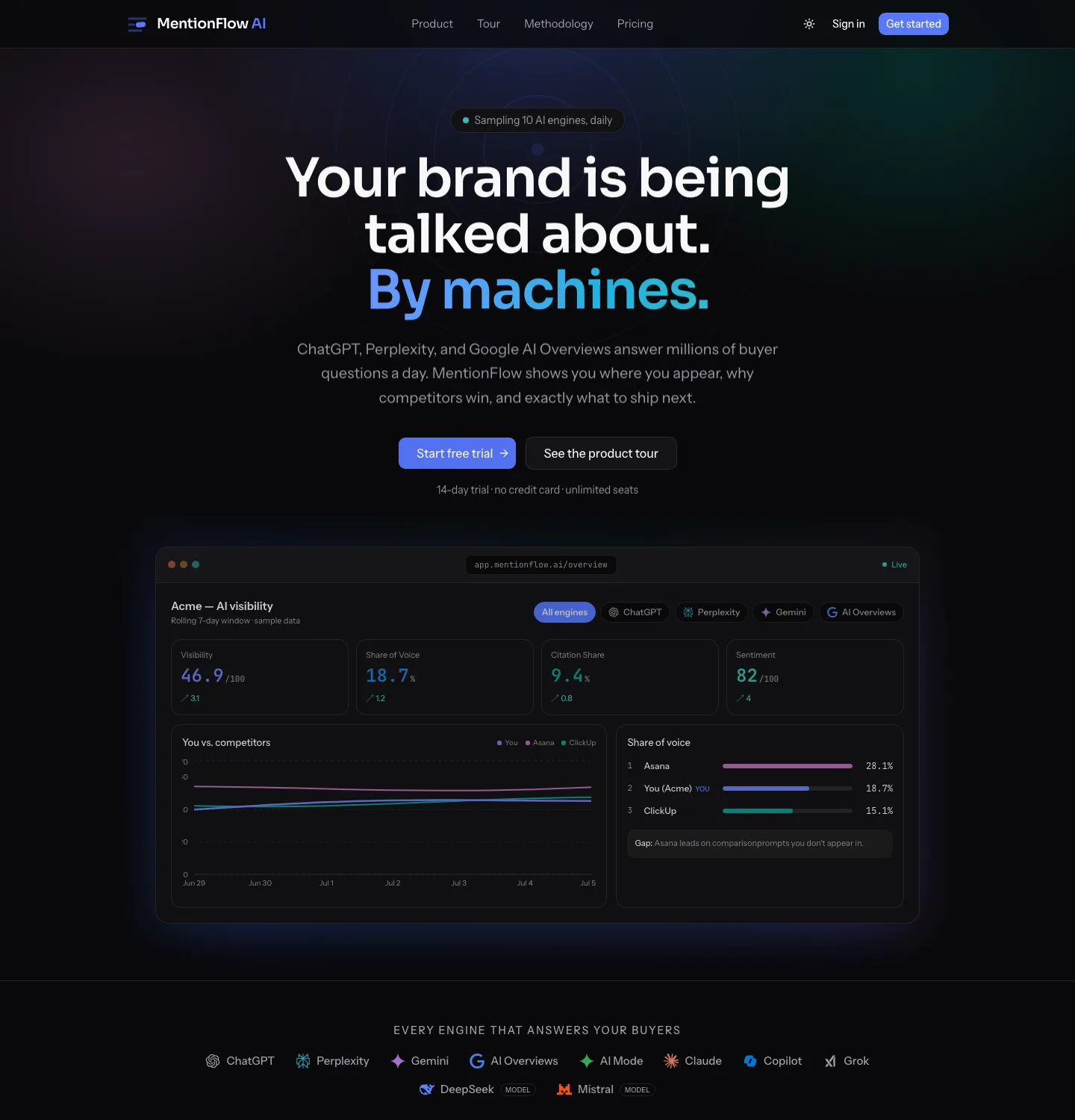
The part we actually care about is the receipts. Behind every score, MentionFlow keeps the verbatim answer each engine gave, so you can read exactly what it said and which source it cited instead of you, not just watch a number wobble. Our own one-liner for it is "a receipt behind every answer," and it is the honest scoreboard we wanted for our clients and could not find at a sensible price. It also samples the real consumer surfaces wherever they diverge from the developer APIs, live chatgpt.com sessions and real Google results pages rather than sanitized API output, while Perplexity and Claude run through their official APIs, which the methodology page states plainly. That matters more than it sounds: MentionFlow reports that official-API ChatGPT answers agreed with the live surface on brand presence only 42 to 67 percent of the time. Those are our own published numbers, not an outside audit, so take them as a claim, but the methodology page shows the working behind them.
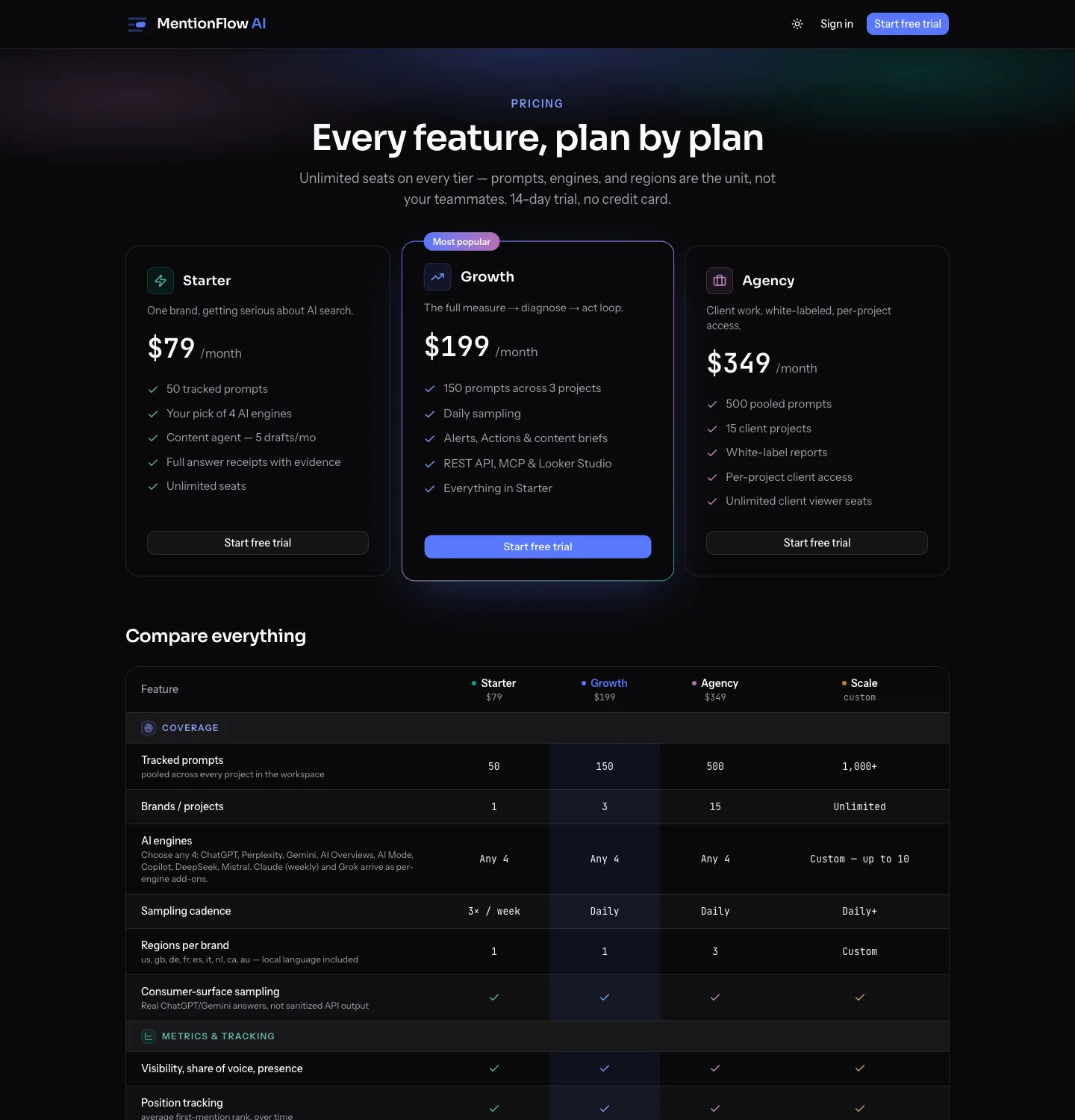
Pricing is public: Starter at $89/mo for 50 tracked prompts with daily sampling, Growth at $199/mo for 150 prompts plus Looker reporting, and Advanced at $499/mo for 350 prompts with API access. Agencies get white-label client reports and seats are never billed per head. There is a 14-day trial with no card, which is the part I would actually use.
Who it fits: in-house teams and agencies that want daily tracking and competitor share of voice without an enterprise contract or a procurement cycle. Who it does not fit: if you need a giant suite with a dozen seats and a dedicated success manager, the heavier platforms below suit you better. And the honest limitation, because this is a no-BS list: MentionFlow is new, so there is no third-party review coverage to lean on yet. A search for reviews today turns up nothing independent. You would be trusting the published methodology and your own trial, not a wall of G2 stars. See it at mentionflow.ai, or book a call and we will run your panel so you see real numbers first.
2. Profound
Profound is the most heavyweight name in the category, aimed squarely at enterprise. It is a full answer-engine platform: brand monitoring across the AI answers, plus a feature called Prompt Volumes that estimates what people are actually asking AI in your space, autonomous agents that generate optimised content, and crawl analytics showing which AI bots are hitting your site. Reviewers keep singling out Prompt Volumes as the thing you cannot really get elsewhere, real demand data rather than prompts you guessed at.
The money behind it is serious. Profound raised a $96M Series C at a $1 billion valuation in February 2026, per Fortune, on top of an earlier Sequoia-led round. Fortune's reporting on the raise names customers like Ramp, MongoDB, DocuSign and Indeed, and it carries a 4.6 out of 5 on G2 at the time of writing. On engines it covers a wide set including ChatGPT, Claude, Perplexity, Gemini, Google AI Overviews, Copilot and Grok, though worth knowing, the entry plan only tracks ChatGPT.
Pricing is public despite some reviews claiming it had gone custom-only. Starter is $99/mo billed yearly, but that buys ChatGPT tracking only, 50 prompts and one seat. Growth is $399/mo billed yearly for three engines and 100 prompts. Everything above that, multiple brands, single sign-on, SOC 2, is custom Enterprise.
Where it falls short: it is enterprise-shaped in every way. Reviewers mention a steep learning curve and automated reporting that takes work to tame, and for a solo marketer or a small team it is hard to justify the spend and the setup. Who should pick it: bigger brands treating AI visibility as a standing program with a budget line and someone to own it. If that is you, it belongs on the shortlist.
3. Ahrefs Brand Radar
If you already pay for Ahrefs, start here, because this may be part of what you are already holding. Brand Radar is Ahrefs' AI visibility product, and it is the clearest example of the index-based approach. Rather than run your prompts, it sits on what Ahrefs calls the largest AI visibility database: more than 475 million monthly prompts, built from real search-backed prompts rather than synthetic ones. Broken out by engine, that index covers Google AI Overviews, AI Mode, ChatGPT, Copilot, Gemini, Perplexity and Grok, with AI Overviews alone accounting for the vast majority of the volume. You search it instantly with basically no setup, which is the whole appeal. One honest gap in that engine list, though: Claude is not in it, so if tracking Claude specifically matters to you, note that.
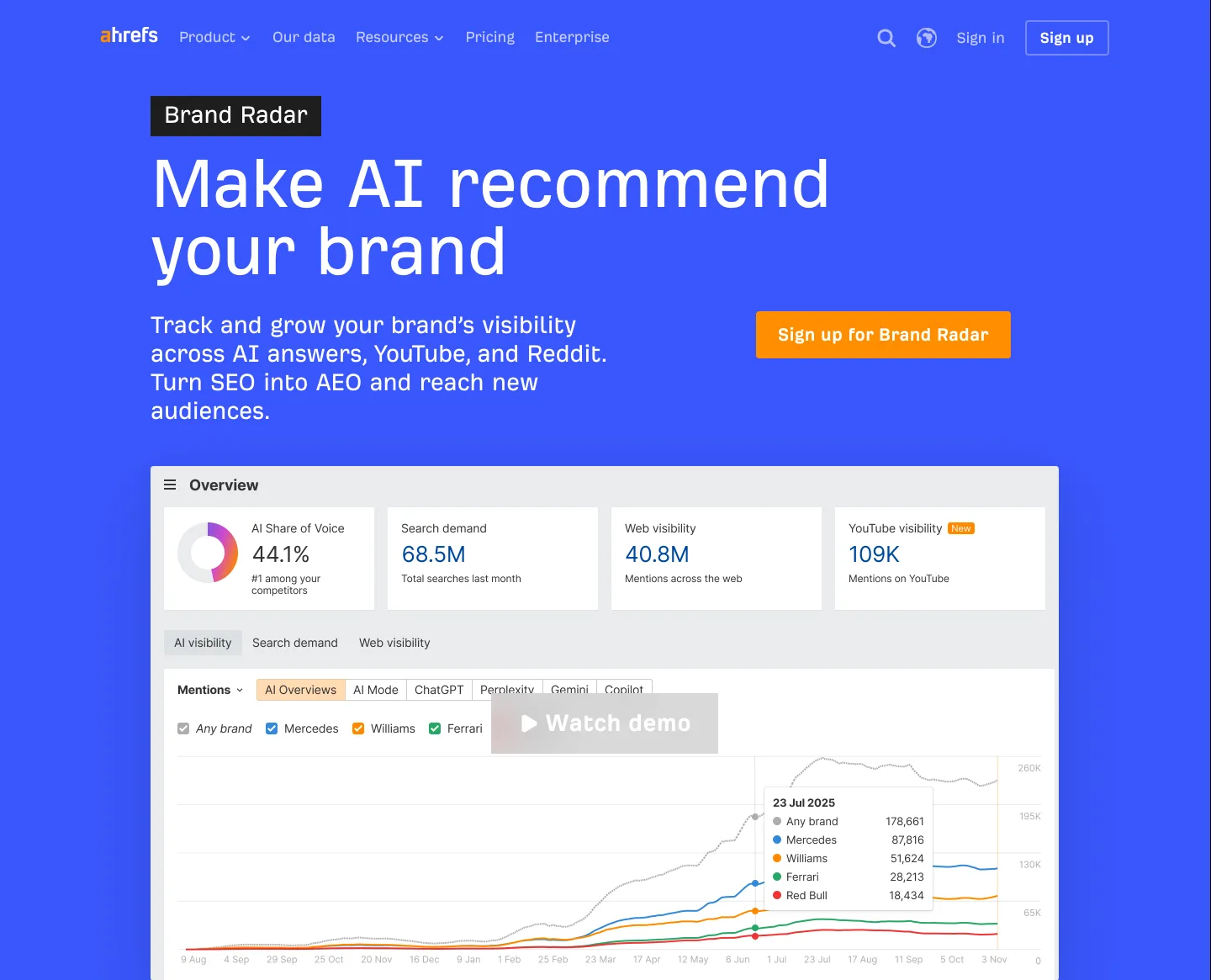
Ahrefs' own page shows two standalone tiers: Select Platforms at $398/mo, which covers the AI Overviews and AI Mode, ChatGPT, Perplexity, Copilot and Gemini indexes plus 2,500 checks a month for your own custom prompts, and All Platforms at $699/mo for the full index. Here is the thing to check, though. Several third-party reviews say Brand Radar is really an add-on that needs a paid Ahrefs base plan underneath it, which would push the all-in cost closer to $828/mo. Ahrefs' page presents the tiers as standalone, and I could not reconcile the two, so if this is your budget, confirm it with Ahrefs directly before you sign.
Where it falls short: because it is index-first, it is a snapshot of a shared dataset rather than your exact prompts running live, and at least one review found it under-reported mentions compared with manual testing, with no per-answer context or sentiment scoring. The structural point is fair even if that reviewer's specific numbers come from a single source. Who should pick it: SEO teams already living in Ahrefs who want breadth and instant answers, and who value dataset scale over watching a custom prompt list day by day.
4. Peec AI
Peec is focused purely on AI search analytics, with a strong European footprint and euro pricing, and it has become a bit of a practitioner favourite for one reason: its competitive benchmarking and citation-source analysis are clean and genuinely useful. It tracks your visibility, position and sentiment across the engines, shows which competitors are winning the same prompts, and breaks down the domains getting cited by type, so you can see whether the models are leaning on user-generated content, editorial or corporate sources to answer questions in your space. Lily Ray, VP of SEO Strategy at Amsive, is quoted on their site saying it shows how the models are framing their brand.
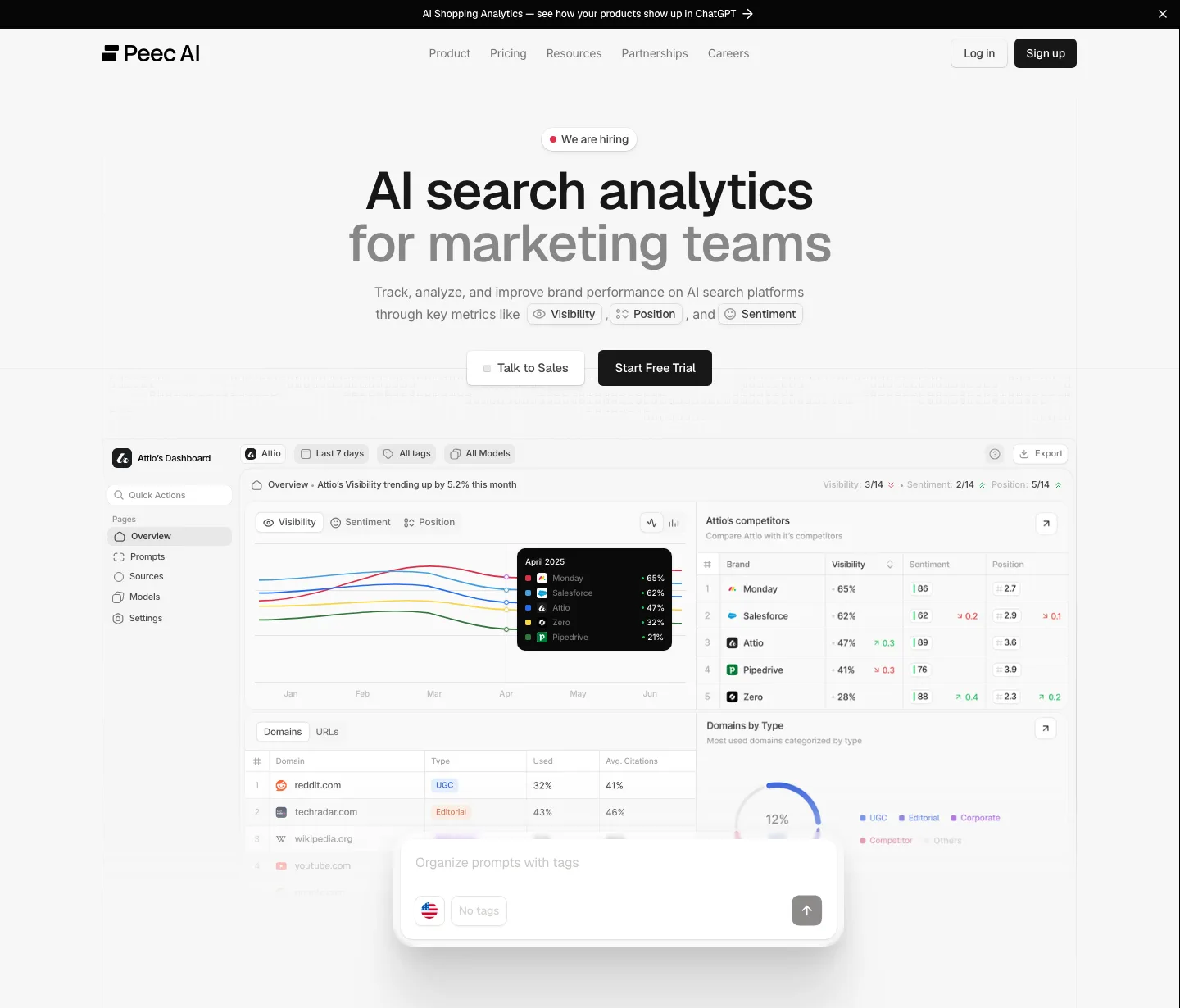
On engines, the self-serve plans give you six to choose from, ChatGPT, Google AI Mode, AI Overviews, Copilot, Perplexity and Gemini, and you pick three. Claude, GPT-5 Search and a few others are Enterprise-only. Pricing is in euros and rendered a little awkwardly on their site, so for the record, checked on 10 July 2026: Starter is €85/mo for 50 prompts and one project, Pro is €205/mo for 150 prompts across two projects, Advanced is €425/mo for 350 prompts with the Looker Studio connector, and Enterprise is custom. Ignore the €89 and €199 numbers floating around third-party blogs, those are stale. Peec claims 2,000+ marketing teams use it, with logos like Zalando, Squarespace and Hugo Boss, and a 4.9 on G2, though that score is an own-site claim I could not confirm independently.
Where it falls short: it is monitoring-only. There are no content or optimisation tools, no traffic or revenue attribution, and the API is gated to the Enterprise tier, so on the self-serve plans you are measuring, not acting. Who should pick it: SEO and content managers, and GEO agencies, especially in Europe, who want focused, accurate benchmarking and do not need the tool to also write the fixes.
5. Otterly.AI
Otterly is the cheapest credible way into this category, and that alone makes it worth knowing. It monitors your brand in AI answers, tracks which prompts trigger a mention and which links get surfaced next to you, and, unlike the pure monitors, it also runs GEO URL audits that score your pages for AI-readiness and tell you what to fix. That combination of monitoring plus crawlability audits at a low price is its real hook.
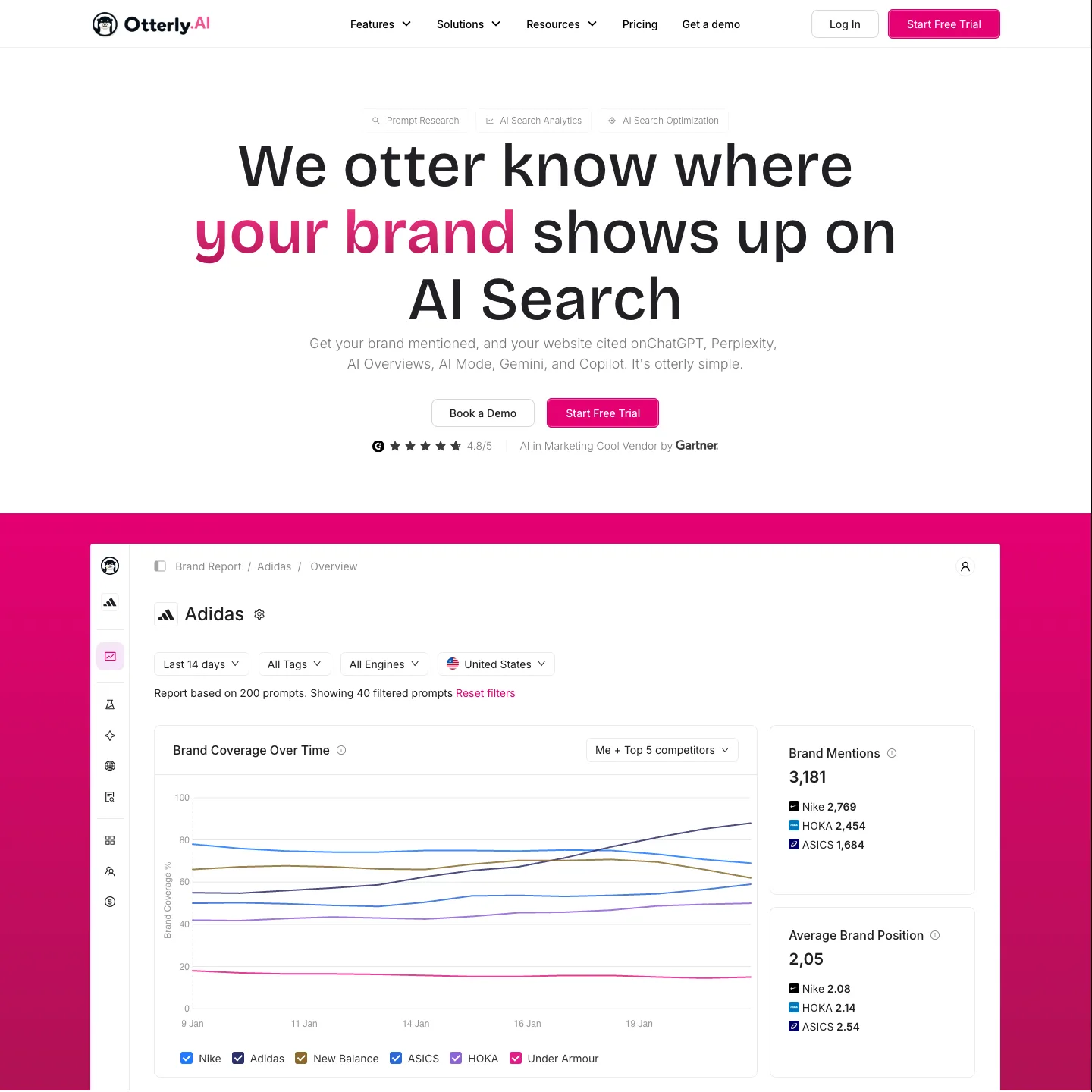
The base plans track four engines, ChatGPT, Google AI Overviews, Perplexity and Microsoft Copilot. Google AI Mode, Gemini and Claude are paid add-ons on top. Pricing starts at $29/mo for the Lite plan, which gets you 15 prompts across those four engines with daily tracking. Standard is $189/mo for 100 prompts plus API access and 5,000 GEO URL audits a month, and Premium is $489/mo for 400 prompts. Annual billing knocks about 15 percent off, and there is a free 14-day trial with no card. Otterly says 30,000+ marketing pros use it, names customers like Garmin, Opera and Avis, and shows a Gartner Cool Vendor badge and a 4.8 on G2 on its site.
Where it falls short, and this is the important bit: the pricing is per prompt per engine, so it burns down faster than the headline suggests. A hundred prompts across several engines is hundreds of capture events, and the engines you probably care most about, Gemini and AI Mode, cost extra on top of that. Users also report the data taking a while to refresh after you edit prompts. Who should pick it: SMB marketing and content teams, and agencies, who want to answer the basic question of whether they show up at all before committing to anything heavier, and who like the bonus of the page-level audits.
6. Semrush AI Visibility Toolkit
The pitch here is simple: AI visibility data sitting right next to the classic SEO data most teams already use. If Semrush is already your home base, the AI Visibility Toolkit adds AI analysis, brand perception tracking, prompt research and an AI-readiness site audit without you leaving the tool or learning a new one. One piece of corporate news worth knowing, because you will see it in the header: Adobe completed its acquisition of Semrush on 28 April 2026, in a deal worth roughly $1.9 billion, so the product now sits inside Adobe.
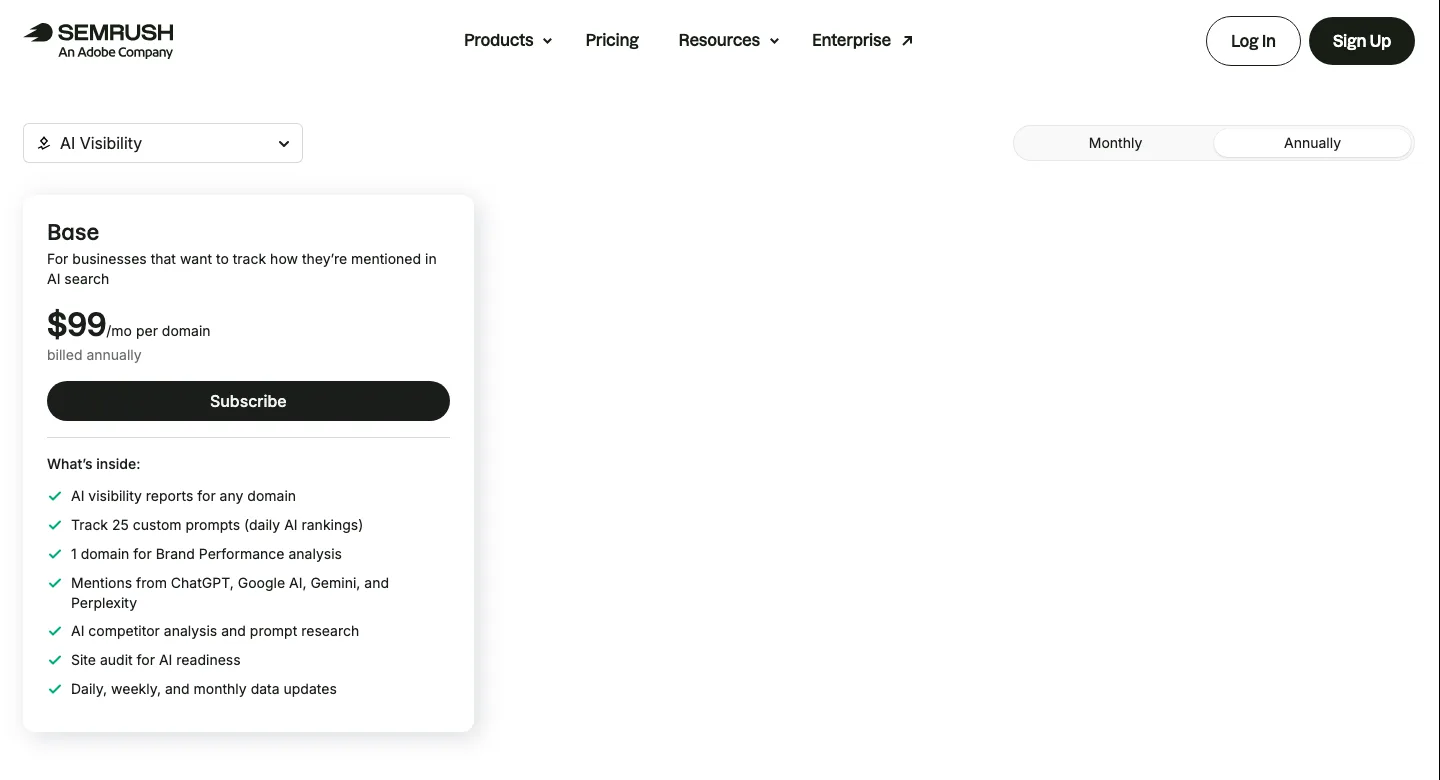
Engines on the base plan cover ChatGPT, Google AI (both AI Overviews and AI Mode), Gemini and Perplexity. Claude and Grok are promised on the Enterprise tier only. Pricing is $99/mo per domain, billed annually. That gets you AI visibility reports, 25 custom prompts tracked daily, competitor analysis and prompt research, and the site audit. Additional domains are another $99/mo each, and the top tier is a sales demo.
Where it falls short: 25 tracked prompts per domain on the base plan is thin if you have a real prompt set to watch, the Claude and Grok coverage being Enterprise-only is a genuine gap given how the buyers you care about split across engines, and the per-domain pricing multiplies fast if you run a portfolio or an agency book. Who should pick it: existing Semrush users who want a competent AI layer bolted onto the SEO workflow they already run, and who can live inside the 25-prompt base limit or pay to lift it.
So which one should you actually buy?
Cut through the marketing with a few questions and the decision gets a lot easier.
How often does it sample? AI answers shift between runs, so anything checking weekly is mostly measuring noise. Daily is the floor for a number you can trust, and it is worth confirming what a plan's default cadence actually is rather than what the marketing implies.
Does it track your competitors on the same prompts, at the same time? Your own mention count means little without the share around it. That is the whole point of share of voice, and it only works if your rivals are measured the same way you are.
Does it keep the verbatim answers? A score tells you that you dropped. The actual answer text tells you why, and which source got cited instead of you. That is the difference between a dashboard you stare at and a task list you can act on.
Are the engines your buyers use actually covered on the plan you are pricing? Half these tools gate Claude, or Gemini, or AI Mode behind a higher tier or an add-on. Check the specific engines that matter to you are in the plan you are costing, not just somewhere on the feature page.
And can you afford to run it every month for a year? Share of voice is a trend, not a snapshot. The tool you will still be paying for in twelve months beats the flashier one you cancel in two.
One more option before you spend anything: we have put the first pass online for free. Our AI visibility checker grades a domain A to F on the technical side, crawler access, llms.txt, structured data, sitemap, and the AI crawler checker shows which AI bots your robots.txt is blocking, a problem our crawler access guide covers in depth. Both are one-scan tools, no tracking over time, so treat them as a health check rather than a substitute for anything above. But they will tell you in about a minute whether you have a problem worth paying to measure.
If you want to sketch your prompt list before you pay anyone, we built a free prompt panel builder that gives you a starting set for your category. And whichever tool you land on, remember it only measures the problem. Moving the number is the actual work, and it is the same GEO fundamentals every time: be retrievable, get corroborated, keep your entity clean, stay fresh. If you would rather have the measuring and the moving handled together, that is our AI search optimization service, with MentionFlow doing the tracking underneath. And if you are still deciding whether any of this matters for you yet, run the free DIY AI visibility audit first and see what the engines say about you today. Either way, pick the one you will still be running next year, and start.