

For about twenty years the SEO scoreboard was your keyword ranking. Position three for "best CRM software," track it, grind it toward position one. That scoreboard is quietly cracking, because a lot of your buyers never see ten blue links anymore. They ask ChatGPT, Claude, Perplexity, or Google's AI Overviews a question and read one answer that names two or three brands. If none of them is you, your ranking did not save you, because nobody scrolled far enough to find it.
Here is the part that should get your attention. When Google shows an AI summary, people click a normal search result on 8% of visits versus 15% when there is no summary, and they click a link inside the summary just 1% of the time, per Pew Research Center. The answer itself is doing the work, and the click you used to count is leaking away.
Before you panic, the honest framing is that this is small and growing fast at the same time. AI tools sent 1.13 billion referral visits to top sites in June 2025, up 357% year over year (Similarweb, reported by TechCrunch), against 191 billion from Google in the same month, so on raw traffic AI is still a rounding error. Conductor data puts AI at about 1% of overall web traffic across ten industries. The catch is that the 1% behaves better than the 99%. Semrush found the average AI search visitor is 4.4 times as valuable as a visit from traditional organic search by conversion rate, and Microsoft Clarity data across more than 1,200 sites showed LLM visitors signing up at 1.66% versus 0.15% from search. Small, fast, and it converts, which is the kind of channel you want to be early on.
The trouble is you cannot manage what you cannot see, and analytics barely sees this. Most people read the AI answer and never click, so Google Analytics tells you almost nothing about whether the engines recommend you. To see that, you have to measure inside the answers, and the metric that does it is AI share of voice.
What AI share of voice actually means
Share of voice is an old advertising idea: out of all the attention in your category, what slice is yours. Point it at AI answers and it gets concrete. Take the questions your buyers actually ask, run them across the engines, and count how often each brand gets named. Your share of voice is your mentions divided by everyone's mentions in your competitor set. If ten questions across four engines give you forty answers, those answers name brands sixty times in total, and eighteen of those mentions are yours, that is 30%. Tally your two main rivals the same way and you have a scoreboard that matches how buying decisions get made in 2026.
The reassuring part is that the whole industry basically agrees on this. Otterly writes the formula out as your brand mentions divided by total brand mentions times 100, and gives the example of 20 mentions out of 200 being a 10% share. Profound defines share of voice as a score comparing your mentions to competitors' across every response it tracks. Peec calls it the percentage of your mentions against all tracked brands. Ahrefs Brand Radar bases it on how often brands are mentioned or cited across ChatGPT, Perplexity, Gemini, Copilot, and Google's AI Overviews and AI Mode. Different logos, same core arithmetic: your mentions over all the mentions.
Where they split is weighting and honesty. Ahrefs weights each mention by the Google search volume of the query, which it calls impressions, so a mention on a high volume question counts for more, while Otterly, Peec, and Profound mostly count raw mentions. There is also a transparency gap: Ahrefs and Otterly publish their formulas, while Profound and Peec describe the metrics in words but do not publish the actual math in their public docs as of August 2026. That is not a scandal, but it means you are trusting a black box, so ask what is inside.
One honest note: any tool that weights by Google search volume is assuming people ask AI the same things they Google, in the same proportions. Ahrefs says so plainly, disclaiming any validated link between Google search volume and how often a query gets asked inside an AI tool. It is a reasonable model, not a measurement.
Last bit of vocabulary: being mentioned means the answer names your brand in the text, being cited means it links your domain as a source. You can have one without the other, so track both, because they move for different reasons and you fix them in different ways.
Why rank tracking cannot see any of this
Rank tracking measures the position of a page in a list. Share of voice measures whether you are in the conversation at all. Those are not the same thing, and the gap between them is where brands get quietly deleted.
Picture ranking third for a big commercial keyword. In classic search that is a good day. But when the same query triggers an AI Overview or a Perplexity answer, the engine reads a handful of sources and writes one paragraph that names two competitors and not you. Your page is still ranked third; it just is not in the answer anyone reads. Rank tracking reports green while reality is red, and only a share of voice count catches it, because it looks at what the answer said instead of where a link sits.
Your analytics has the same blind spot from the other direction. The engines can recommend you all day, and because almost nobody clicks, it barely moves your referral numbers. This channel sends influence, not visits, so watching referrals alone you will conclude AI does not matter right up until a competitor owns every answer in your category.
How to measure your AI share of voice by hand this week
You do not need to buy anything to start, and honestly you should run it by hand at least once so you understand what any tool is later counting for you. Budget an hour and a spreadsheet. Here is the loop.
Step 1: Build a prompt panel
A prompt panel is just the fixed list of questions you are going to ask every engine, every month. Aim for ten to fifteen real buying questions, the kind a person types when they have a budget and a problem, not keyword phrases. Mix three flavors: broad category questions like "best project management software for agencies," direct comparisons like "Asana vs Monday for a small team," and problem questions like "how do I stop my team missing deadlines." Those three pull different brand lists, and you want all of them. If writing ten from scratch feels like a chore, our free prompt panel builder generates a starter set from five fields and hands you a scoring sheet to fill in.
Step 2: Run the panel across the engines
Run every question in ChatGPT with web search turned on, in Claude, in Perplexity, and in Google with AI Overviews. That spread matters, because the engines retrieve and cite differently, and a brand that owns ChatGPT can be invisible in Gemini. Use a fresh chat every single time so a previous answer does not bias the next one, and stay logged out where you can, so your own history does not flavor the results.
One warning: the same question asked twice can give you two different brand lists, and that is normal. On our own tracked brands at MentionFlow, brand presence stayed the same from one day to the next about 92.6% of the time, but the daily flip rate still ran from roughly 4% on Perplexity up to 11% on Google's AI Overviews. So a single run is an anecdote. Ask each question two or three times and record what shows up more often than not.
Step 3: Score every answer
For each answer, mark four things in your sheet: whether you appear, which competitors appear, roughly where you land in the list, since being the first brand named beats being the fifth, and which sources got cited. Then tally. Your mentions divided by all the brand mentions you logged is your share of voice, and the same count for each rival gives you the competitive picture. The simpler share of answers you appear in at all is worth a column too, since it is the plainest baseline you have. Do not skip the cited sources, because they are a map of the pages the engines already trust in your category. Those citations cluster: in Similarweb's gen AI citation data, Wikipedia is the most cited domain at 6.2% of citations, with Reddit second at 5.2%. If you are absent from where the engines already pull, that is your first fix.
Step 4: Repeat it monthly
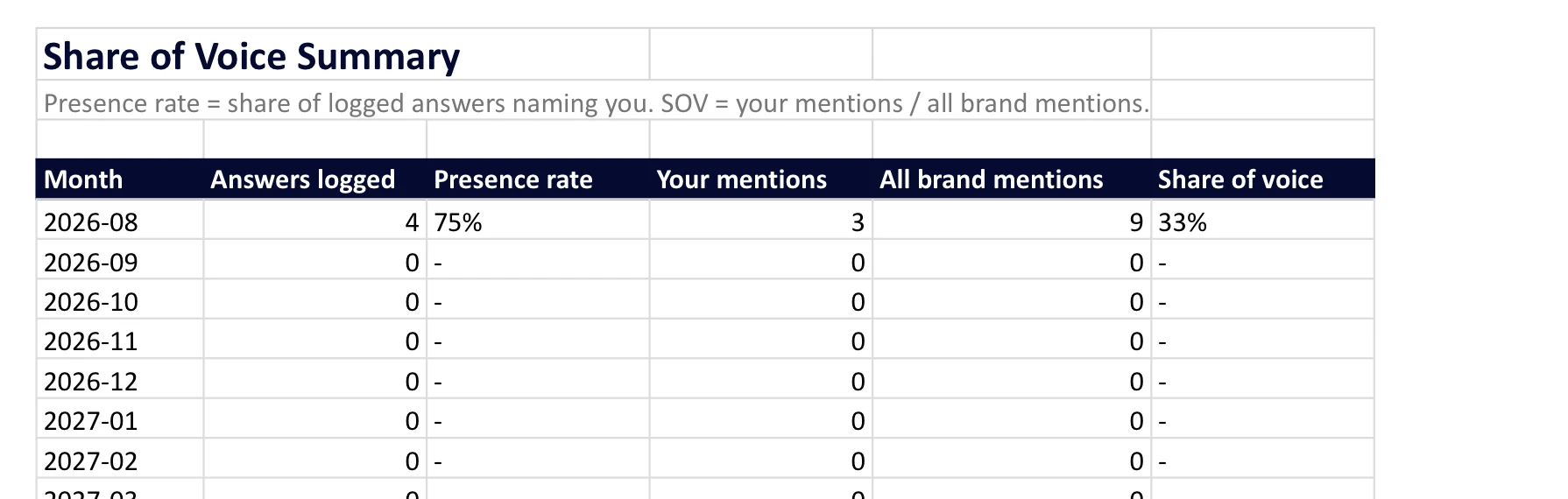
Do the loop once and you have a baseline. Do it on the same day every month and you have the only trend line that matters right now: whether your slice of the AI conversation is growing or shrinking. If you want the full spreadsheet walkthrough, we wrote it up in our DIY AI visibility audit.
What actually moves the number
Once you are measuring it, how do you make it climb? Four levers do most of the work, none of them tricks.
Retrievability comes first. The engines run a search and quote what they find, so a page that answers the question cleanly and ranks in the ordinary sense is the one that gets pulled into the answer. If your best answer is buried three scrolls down under a vague heading, it does not get quoted. Classic SEO is the price of admission here, not dead. So is crawler access, since a page GPTBot cannot fetch cannot be quoted either; our free AI crawler checker shows in seconds which engines your robots.txt is blocking.
Corroboration is second, and it is the big one. Engines trust brands that other sources vouch for. Getting named in the review sites, listicles, and community threads the models already read moves your share of voice more than almost anything on your own domain. Earning a mention on a page the engines already quote is worth more than a dozen posts on a site they have never touched. We wrote up the full playbook for that in how to get cited by ChatGPT.
Entity clarity is third. The model has to be confident about who you are, what you sell, and who you serve. When your own site, your profiles, and outside directories disagree about the basics, the engine hedges, and a hedging engine names someone safer instead of you.
Freshness is fourth and underrated. Answers lean on recently updated pages and recent reviews, so a brand whose last review landed two years ago reads as dormant no matter how good the product is. All four levers are just generative engine optimization in practice, and share of voice is simply the number all that work is trying to move. For a quick read on where you stand, our free AI visibility checker grades your site on 16 of these checks in about a minute.
How MentionFlow automates the same loop
I will be straight with you: what follows is our own product, so read it with that in mind. The manual method above is real and worth running. Its weakness is that it is a snapshot taken by hand, and as you just saw, AI answers wobble between sessions, engines, and days. To get an honest number you have to sample the same prompts repeatedly and average, across four or more engines, ideally every day. That is a mind-numbing amount of copy and paste to do by hand, which is the exact reason we built MentionFlow.
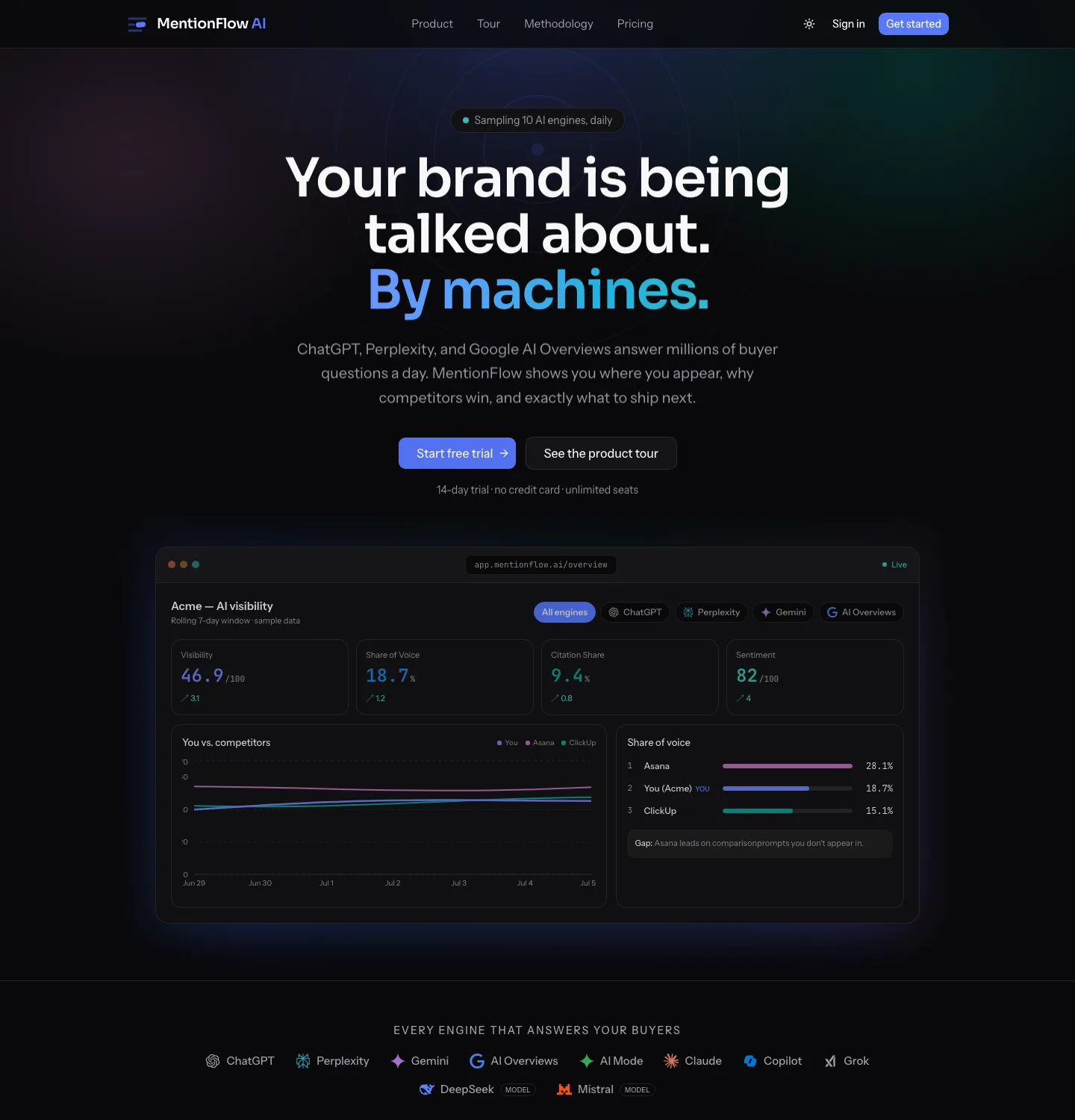
It runs your prompt panel automatically across up to eleven engines (ChatGPT, Perplexity, Gemini, Google AI Overviews, Google AI Mode, Claude, Copilot, Grok, DeepSeek, Mistral, and Llama; every plan runs your pick of four at a time), samples on a rolling window instead of once, and stores every raw answer as a receipt so you can see exactly what each engine said and which source it cited instead of you. It reports the same share of voice you would tally by hand, plus the metrics around it.
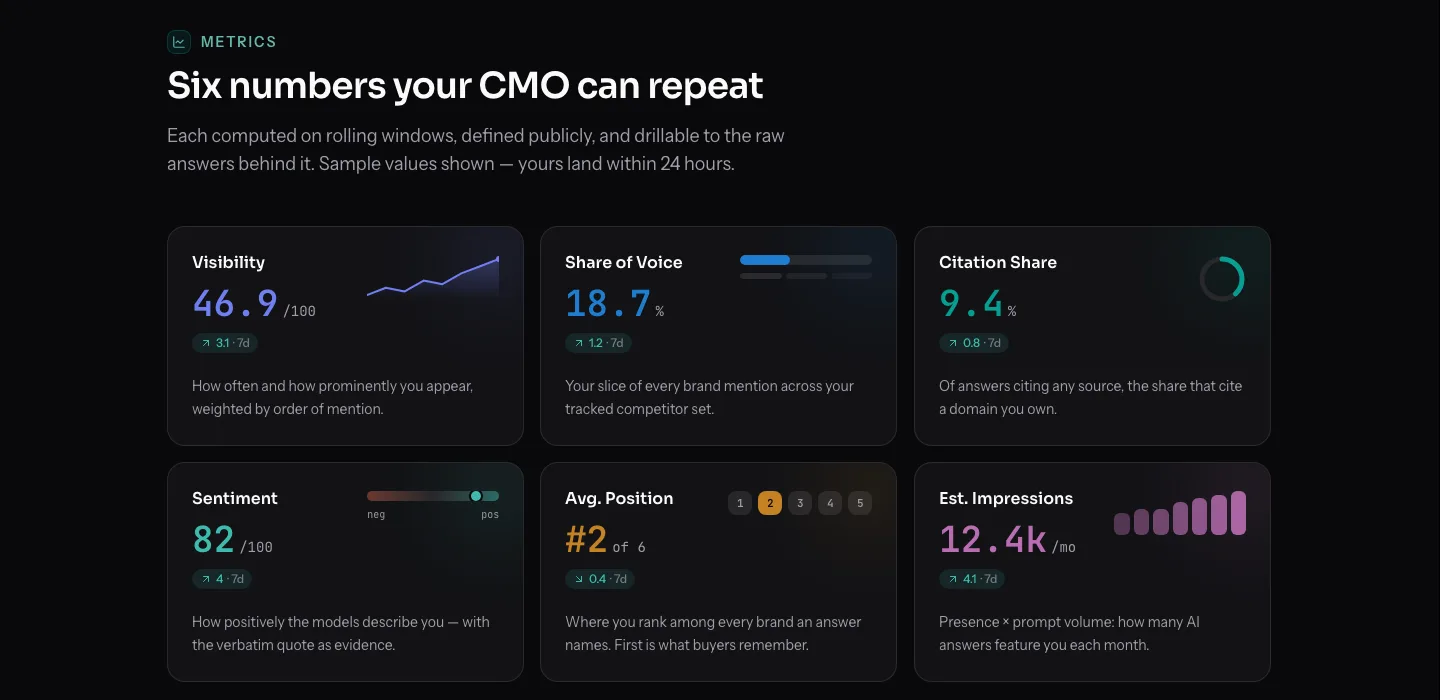
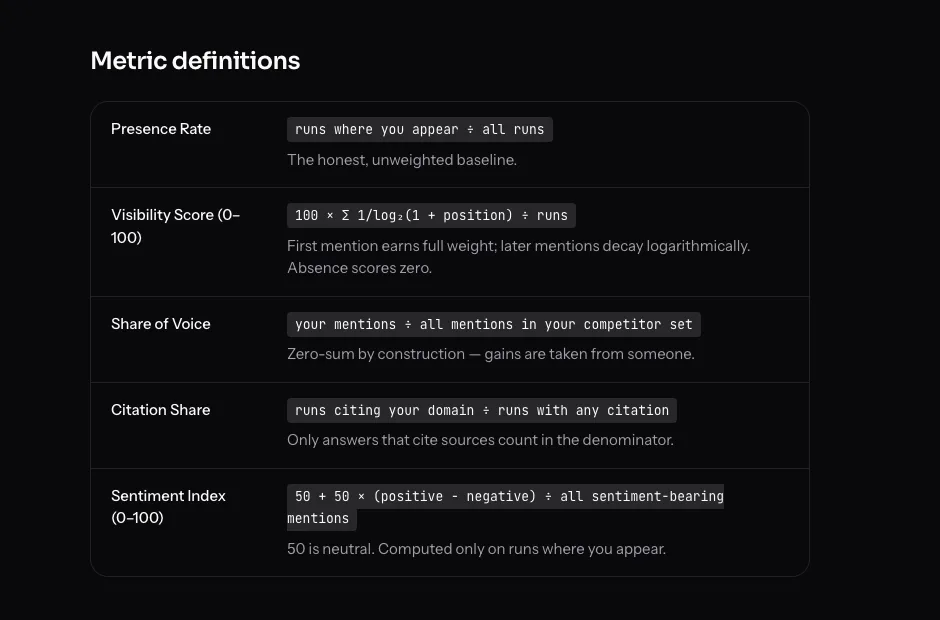
Two things we did on purpose, both places where measurement usually breaks. First, the math is public. The methodology page writes out every formula, including a visibility score that weights your position in the list logarithmically, and share of voice defined simply as your mentions over all mentions in your competitor set. As the page puts it, share of voice is "zero-sum by construction," so your gain is someone else's loss.
Second, it samples the consumer surface, not just the tidy official APIs, because those two do not agree. In our own bake-off the official ChatGPT API matched the real consumer answer on brand presence only 42% to 67% of the time, ran a web search on 8% of calls versus 100% on the real surface, and cited roughly one source where the real answer cited thirteen or fourteen. Measure the API and you are measuring a different product than your buyers use. Claude is the one exception: we sample it by API and only weekly, because each Claude answer costs roughly forty times as much as one from the other engines, a cadence the methodology page documents instead of hiding.
On prompt volume we do the same thing Ahrefs does and are equally upfront about it. Estimates show up as ranges, and the site flatly states there is no validated link between Google search volume and how often a prompt gets asked inside an AI tool. A modeled band is honest; a precise looking single number would be a lie.
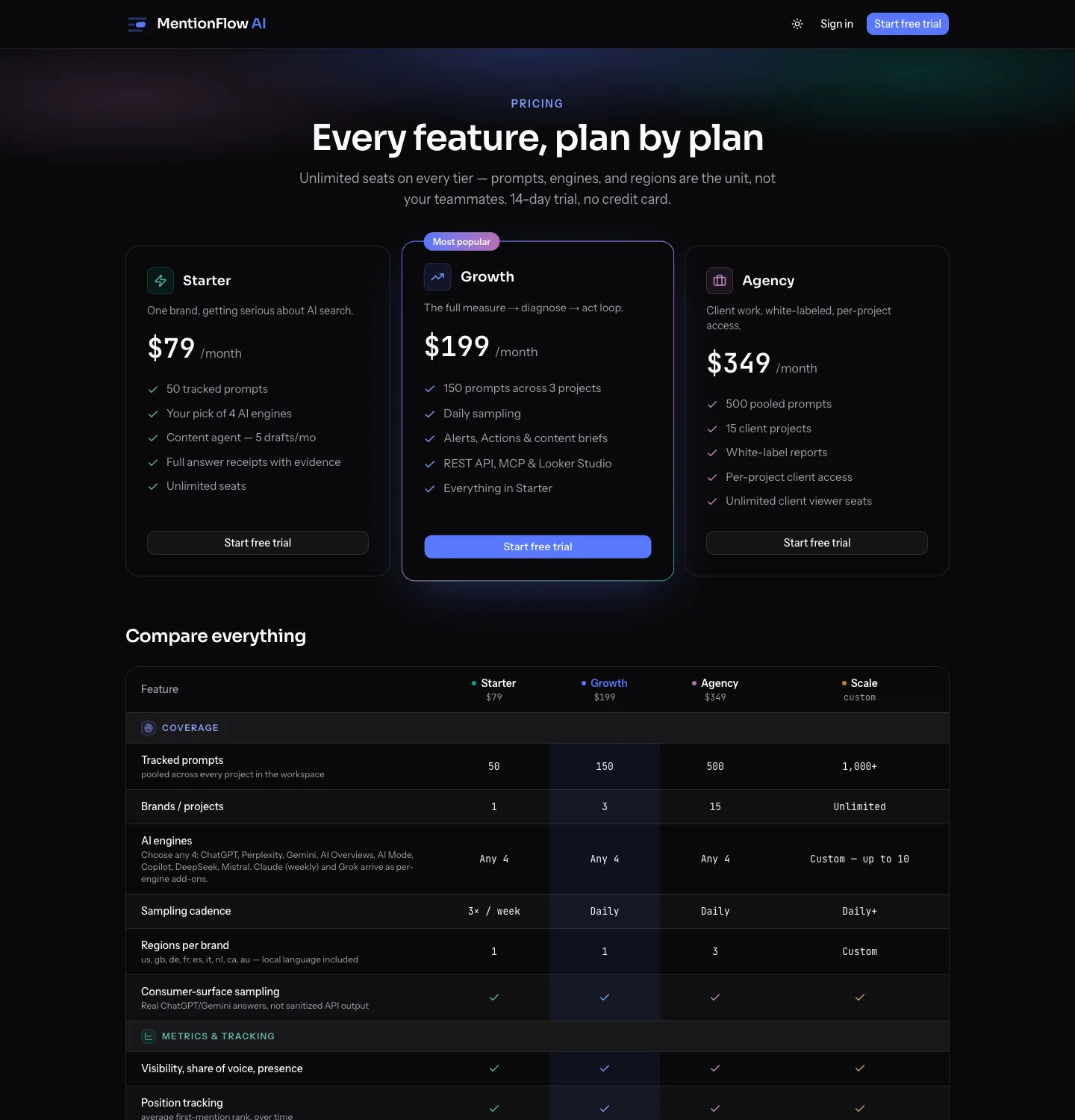
Pricing is public and starts at $89 a month for Starter (50 tracked prompts), $199 for Growth (150 prompts), and $499 for Advanced (350 prompts plus API access), with agency plans that pool your prompts across unlimited client projects and add white-label reports. Every plan includes seats with no per-seat billing and a 14-day trial with no credit card. If you would rather compare it against the alternatives first, we keep an opinionated rundown of AI visibility tools, competitors included. And if you would rather not run any of this yourself, that is what our AI search optimization engagements are for, with MentionFlow underneath.
Start counting before your competitors finish
Here it is in one breath. Your buyers increasingly get one AI answer instead of a page of links, that answer names a few brands, and rank tracking cannot tell you whether one of them is you. Share of voice can. Build a panel of ten questions, run it across ChatGPT, Claude, Perplexity, and AI Overviews, score who gets named, and repeat it monthly. Do that by hand this week if you have to.
The reason to start now is boring and true. The channel is small but growing fast, OpenAI put ChatGPT at 900 million weekly active users in February 2026, and the brands winning the AI answer are already keeping score. The ones still watching only their keyword rank are grading themselves on a scoreboard their buyers quietly stopped reading.