

Most digital marketing course roundups are 31-item lists that nobody, including the author, has thought hard about. Half the links are dead, the prices are from three years ago, and every course is "awesome". This is not that list.
Here is the honest version: in 2026, the fundamentals of every major channel are free, taught by the platforms themselves. A handful of paid programs are genuinely worth money for specific people. And the newest skills, the AI-era ones, mostly do not have good courses yet, no matter what the $2,000 masterclass ads say.
Below is a short framework for choosing, then the courses we would actually point someone to, grouped by what you need. Every entry covers what it teaches, who it fits, the price as verified on the vendor's own site this month, and the honest limitation the sales page will not tell you. And if you suspect you do not need a course at all, you might be right: our guide on how to learn digital marketing lays out the self-taught path we would take ourselves.
How to Choose a Digital Marketing Course in 2026
The short version: start free, treat certificates as a bonus rather than the goal, and pick a project before you pick a course. Paid programs make sense only when you have a specific gap, real experience, and verified current pricing. That is the whole framework; here is why each part matters.
Free covers more than you think. Google, Meta, HubSpot, Ahrefs, and Semrush all give away serious training because it profits them when you know their tools. That incentive means the product mechanics are taught well and kept current. It also means you should notice what free vendor courses will never tell you: when their platform is the wrong choice. For fundamentals, that trade is fine. Take the free material first and let the gaps you hit tell you whether paid is worth it.
A few certificates matter; most are paper. Google Ads certifications and Meta certifications get checked for paid media roles, because they map to the actual job. Google's Career Certificate carries some weight for entry-level applications. Nearly everything else, including most completion certificates you can earn in an afternoon, signals only that you watched videos. Employers and clients hire proof of work: a site you grew, a campaign with numbers you can explain, a portfolio piece. Collect certificates if a job posting asks; never confuse them with the skill.
Learn-by-doing beats watch-and-forget. This is the highest-leverage decision on this page. Course completion feels like progress, but marketing knowledge that is not applied within weeks evaporates. Reverse the usual order: start a real project first, a niche site, a newsletter, a friend's business, your own launch, then use courses to solve the problems the project surfaces. If you are starting from zero and want a ready-made project, our free startup launch checklist is 41 steps of exactly this kind of practice.
When paid is actually worth it. Three situations: you need advanced, specialized depth the free ecosystem does not teach; you are experienced and paying for structure, peers, and current playbooks rather than information; or your employer pays. One more rule that this article follows itself: never trust a price you have not seen on the vendor's own pricing page this month. Course pricing changes constantly, and stale roundup prices are how people budget wrong.
Free Foundations: Where Everyone Should Start
If you are new, the answer is simple: these four cover the fundamentals of search, paid, social, email, and analytics at zero cost (one costs about the price of two textbooks), and no paid beginner course beats them by enough to justify the invoice.
Google Skillshop
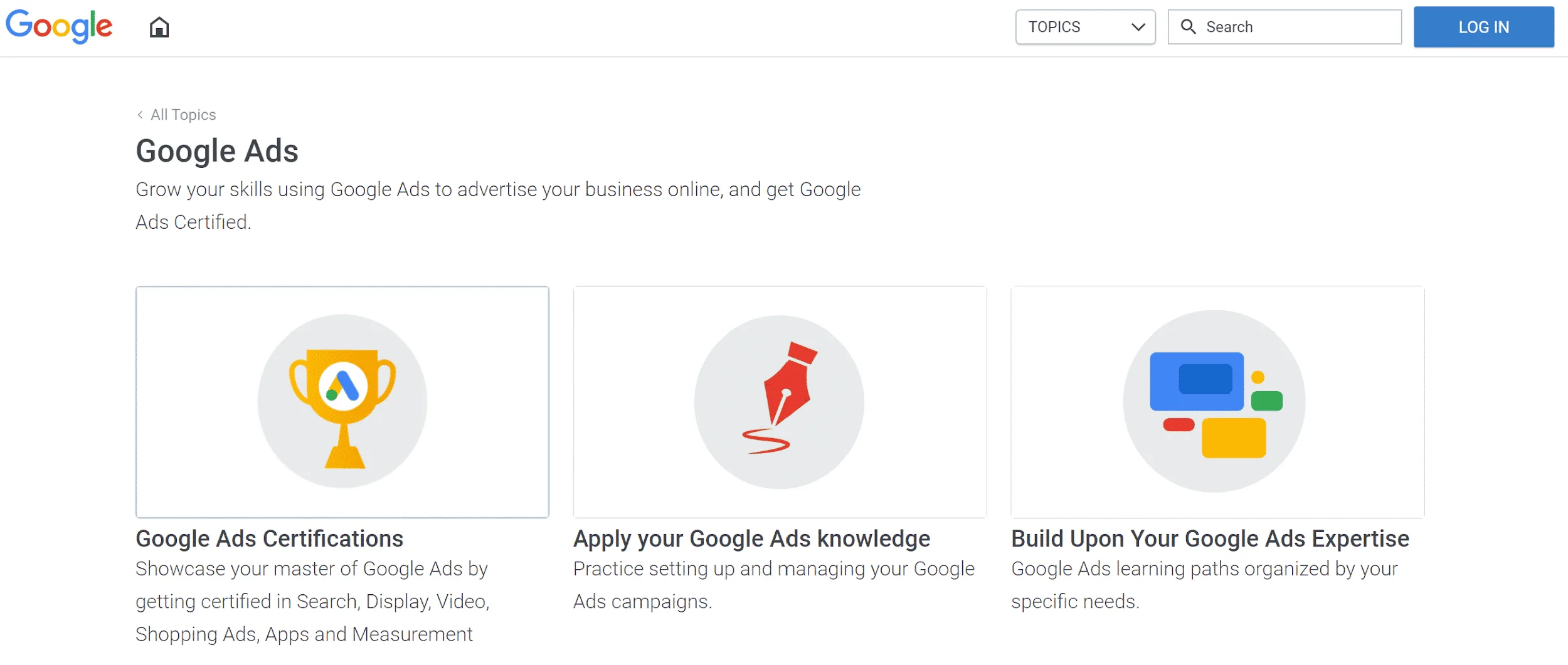
Skillshop is Google's own training platform, and Google's support pages state it plainly: the platform is available at no cost.
What it covers: Product training and certifications across Google Ads (Search, Display, Video, Shopping, Apps, and Measurement), Google Analytics, and the wider Google Marketing Platform. The Google Ads certification assessments run 75 minutes, need 80% to pass, and can be retaken a day later if you miss.
Who it fits: Anyone who will touch Google Ads or Analytics professionally. For paid search roles specifically, these are the certificates recruiters actually look for, and they count toward Google Partner status if you ever run an agency.
Price: Free, per Google's own Skillshop FAQ.
The honest limitation: This is Google teaching you to be a better Google customer. You will learn the machinery thoroughly and strategy barely at all, and Skillshop will never tell you when the honest answer is to spend your budget somewhere other than Google.
Google Digital Marketing & E-commerce Career Certificate
This is Google's structured beginner program on Coursera, and it is the best single starting point for someone who wants a guided path into the field rather than a pile of scattered lessons.
What it covers: 8 courses running from digital marketing foundations through SEO and search ads, social, email marketing, analytics and measurement, and building e-commerce stores. Google sizes it at roughly six months at 10 hours per week, though you can move faster. Over 1.5 million people have enrolled.
Who it fits: Career changers and beginners targeting entry-level marketing roles. No degree or experience required, and it is one of the few certificates in this article with some recognition on a resume.
Price: $49 per month on Coursera after a 7-day free trial (US pricing, verified on the course page). Coursera says most learners finish for under $300.
The honest limitation: The pace is aimed at true beginners, so anyone with a year of experience will find it slow. And treat Google's claim that 75% of graduates see a positive career outcome within six months the way you would treat any vendor's own survey: as marketing, not evidence.
HubSpot Academy
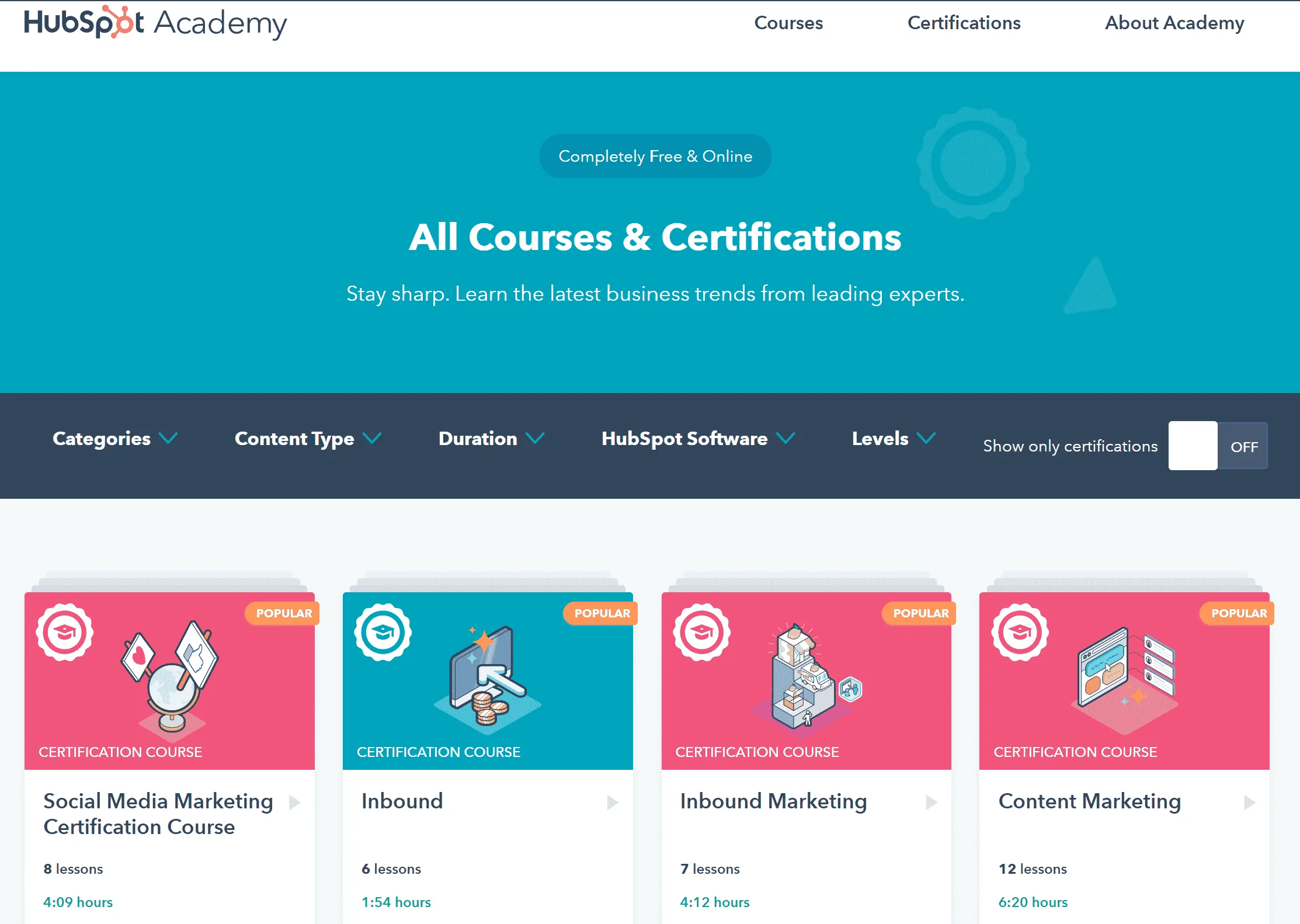
HubSpot Academy is the largest free library of marketing courses that is not tied to an ad platform, and the certifications are free too.
What it covers: A catalog of over 1,100 courses and lessons. The certifications worth your time for marketing: Digital Marketing (3 hours), Content Marketing (8 hours), Inbound (3 hours), Social Media Marketing (5 hours), and Digital Advertising (4 hours). Each ends in a real exam and a certificate you can put on LinkedIn.
Who it fits: Beginners who want channel breadth beyond Google's ecosystem, and content-leaning marketers especially. The Content Marketing certification is one of the better free structured courses on that subject anywhere.
Price: Free, including the certifications. An account is all it takes.
The honest limitation: Everything is filtered through HubSpot's inbound worldview, and the curriculum quietly funnels you toward HubSpot's software. The marketing fundamentals are real; just remember you are inside one vendor's philosophy, not a neutral survey of the field.
Meta Blueprint
Meta Blueprint is the official training for advertising on Facebook, Instagram, Messenger, and WhatsApp, and given how much money flows through those platforms, it belongs in every foundation stack.
What it covers: Free self-paced courses, tutorials, and live webinars with Meta experts across the Meta ad ecosystem. Above the free courses sits a track of Meta Certifications, from the beginner Digital Marketing Associate up through Media Buying Professional, Media Planning Professional, and the advanced Marketing Science Professional.
Who it fits: Anyone planning to run paid social. For media buying roles, Meta certifications are the social-side equivalent of the Google Ads ones: credentials that map to an actual job.
Price: The courses and webinars are free. The certification exams are a separate registration; Meta does not publish the exam fee on the overview page, so check it when you register.
The honest limitation: Platform training, not marketing training. Blueprint teaches you to operate Meta's machine and says nothing about whether paid social is the right channel for a given business, and nothing about organic anything.
SEO Courses Worth Your Time
The direct answer: the two best SEO course libraries in 2026 are free, from Ahrefs and Semrush, and no paid beginner SEO course we know of justifies its price against them. What no course can give you is the thing that actually makes you good: a real site to practice on.
Ahrefs Academy
Ahrefs put its full course catalog online for free, including material it used to charge hundreds of dollars for, and it is the strongest free SEO education available right now.
What it covers: The SEO Course for Beginners (14 lessons, about 2 hours) covers keyword research, on-page, and link building. Blogging for Business (40 lessons, roughly 5 hours) is the standout: how to grow a blog past 100,000 visitors, and the best course on content-driven SEO we can point to at any price. There is also an Advanced Link Building course, a full How to Use Ahrefs track with a 67-question certification exam, and a newer Answer Engine Optimization course on AI search (more on that below).
Who it fits: Beginners through intermediate SEOs, and anyone building an SEO-driven business who wants the content side taught properly.
Price: Free, all of it.
The honest limitation: The tool tutorials assume an Ahrefs subscription, which is not cheap, and every workflow is demonstrated through Ahrefs even when other tools would do. The strategy material stands on its own; the hands-on parts quietly assume you are a customer.
Semrush Academy
Semrush Academy is the other big free SEO school, with a wider topic spread and outside instructors rather than in-house voices.
What it covers: Free courses across SEO, content marketing, analytics, e-commerce, paid advertising, social, local SEO, and AI-and-search topics, with certification exams at the end. The instructor list is a genuine strength: Brian Dean of Backlinko teaches five of the courses, alongside people like Andy Crestodina.
Who it fits: Beginners who want short, structured lessons with quizzes, people who use Semrush at work, and anyone who wants Brian Dean's material in course form for free.
Price: Free, including the certification exams.
The honest limitation: Same vendor bias as Ahrefs pointed the other way, and course depth varies more across the catalog: some courses are excellent, others are thin. Pick by instructor, not by title.
One more thing, and it is the most important sentence in this section: no SEO course substitutes for doing SEO on a site you control. Buy a $10 domain, publish, watch what happens in Search Console for three months, and you will learn more than another 40 hours of video will teach you. If you want to see how the work actually looks end to end, our SEO process is the exact playbook we run for clients, published free, and it pairs well with any course above.
Paid Deep-Dives: The Short List
Up front: most people reading this should not buy a paid course yet, and the list below is short because we only include programs whose existence and current pricing we verified on the vendor's own site this month. Famous programs change prices and formats constantly, so anything we could not verify did not make the list, no matter how well known it is. That is also the rule we suggest you apply before paying anyone.
Reforge
Reforge is the serious option for people already working in growth, product, or marketing at a tech company, built around programs taught by operators rather than instructors.
What it covers: An individual membership includes 40+ live courses, 600+ on-demand courses, and a library of 1,400+ guides and real artifacts from practitioners, across growth, retention, monetization, marketing strategy, and increasingly AI workflows.
Who it fits: Mid-career and senior people in tech who are past fundamentals and want current, peer-level playbooks. It is the rare paid program where the buyer is paying for depth and recency rather than repackaged basics.
Price: $1,995 per year plus tax for an individual seat, verified on Reforge's pricing page. Team plans go up from there.
The honest limitation: Beginners should not buy it. The material assumes you already have a job where you can apply it, and at this price the honest math is that your employer pays, or you have a very specific gap it closes.
The Blueprint Training
Ryan Stewart's Blueprint Training has evolved from an SEO course library into a membership that is closer to an operating system for agencies, and it is the one we would point agency owners to.
What it covers: Training modules on sales, positioning, onboarding, and AI implementation, plus 128 ready-to-use SOPs and templates, pre-built AI agents for audits, proposals, and reporting, twice-weekly live coaching calls, and a community of 3,000+ agency owners.
Who it fits: People running (or seriously starting) a client services business, especially SEO and local. Not aspiring marketers, and not in-house teams.
Price: $199 per month on a limited-time sale at the time of checking, regularly $299 per month, month to month with no contract, verified on the vendor site.
The honest limitation: It is an agency operations product more than a course now. If what you want is to learn SEO, this is the wrong purchase; the free Ahrefs and Semrush material above teaches the craft better per dollar, since their dollar count is zero.
AI-Era Marketing Skills: Mostly Not a Course Yet
Straight answer: for the skills that define marketing in 2026, prompt-driven workflows, generative engine optimization, getting your brand cited by AI assistants, there are very few formal courses, and most of what is sold as one is expensive repackaging of blog posts. The field is moving faster than curricula can, and anyone charging four figures for "AI marketing mastery" is selling certainty that does not exist yet.
Here is what actually exists and is worth your time:
Ahrefs' Answer Engine Optimization course. A free, 12-lesson course (about an hour and a half) on how AI search works and how brands get recommended. Short, current, and honest about how young this discipline is. It is the closest thing to a formal GEO course from a serious vendor right now.
Practitioner guides, free. This is where the real learning lives at the moment. Our generative engine optimization guide covers what GEO actually is and the work behind it, based on doing it for clients rather than theorizing. It is the same material we would charge for if we packaged it as a course, and we would rather you just read it.
Working with AI in your actual workflow. Prompt-driven marketing is learned by shipping with it, not by watching videos about it. Take a real task and run it end to end with AI in the loop; our free content brief generator is a concrete place to start, turning a keyword into a structured brief you then have to make good, which is exactly the judgment the era rewards.
Communities over courses. When a field reinvents itself every quarter, practitioners sharing what worked this month beat any recorded curriculum. That is why we run r/SEOCapitalist: teardowns, experiments, and straight answers about SEO and GEO, free. Lurk, ask, and test what you read on your own site.
The honest summary: spend zero dollars on AI marketing courses in 2026. Spend hours instead: run prompts about your own category in ChatGPT and Perplexity, study who gets cited and why, and fix your site until you are the answer.
The Self-Taught Alternative (No Course Required)
Direct answer: you can reach employable, and beyond, without ever buying a course, and for self-directed people it is often the faster route. Courses organize information; they were never the only source of it.
The self-taught loop is: pick one channel, build a real project around it, publish and measure, and read specifics only when a problem demands it. A niche site for SEO, a small ad account with a strict budget for paid, a newsletter for email. Three months of that produces something no certificate can: results you can show and explain. It also produces better job applications, because "I grew this to 5,000 visits a month, here is what worked" beats a wall of course badges in every interview we have ever been on either side of.
We wrote the full version of this path, which channels to start with, what to build, where the free resources are, in our sister guide: how to learn digital marketing without wasting a year. If this section resonates more than the course lists above, that guide is your next read, and if you want a structured project to learn against, the startup launch checklist gives you 41 steps of real marketing work with stakes.
Digital Marketing Courses FAQ
Are digital marketing certificates worth it?
A few are, most are not. Google Ads and Meta certifications get checked for paid media roles, and Google's Career Certificate helps entry-level applications. Nearly every other completion certificate is decoration. What gets you hired or gets you clients is proof of work: a site you grew, a campaign you ran, numbers you can explain.
Should I pay for a course or learn for free?
Start free. Skillshop, HubSpot Academy, Meta Blueprint, Ahrefs Academy, and Semrush Academy cover every major channel's fundamentals at zero cost, most with certificates included. Pay only when you have a specific gap the free material cannot close, a real project to apply it to, and a current price you verified on the vendor's own site.
How long does it take to learn digital marketing?
Roughly 2 to 3 months of consistent effort to be usefully competent in one channel, and 6 to 12 months of real practice to be genuinely employable. Google sizes its own beginner certificate at about six months at 10 hours per week. The videos are the fast part; running a real site or campaign is the slow part that builds the actual skill.
What is the best course for complete beginners?
The Google Digital Marketing & E-commerce Career Certificate, if you want one structured program: broad, guided, $49 per month after a 7-day trial, usually under $300 total. If you want zero cost, stack HubSpot's free Digital Marketing certification, Google Skillshop, and Ahrefs' free SEO Course for Beginners, then start building something real.